
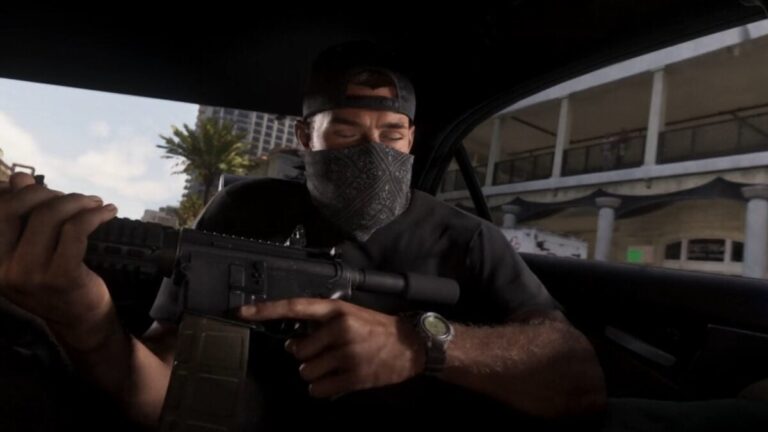
Key takeaways
- Suppressive fire debuts in GTA 6, allowing players to deliberately miss shots to confuse police and create escape opportunities without killing.
- A criminal profile system tracks player behavior and shifts NPC perception from 'psycho killer' to 'refined thief' based on choices made.
- Store robberies trigger early police responses if players carry visible weapons, requiring tactical planning beyond the franchise's traditional shoot-everything approach.
Alongside the Netflix trailer reveal, Rockstar Games has confirmed a brand-new approach to handling high-stakes situations in Grand Theft Auto 6—one that doesn’t require a body count.
Suppressive Fire Arrives in GTA 6
In an interview with Famitsu magazine, Rob Nelson, head of development and co-studio head at Rockstar Games, detailed how suppressive fire makes its series debut in GTA 6. The mechanic represents a significant shift in how players can approach combat scenarios, particularly during robberies and escapes from law enforcement.
How Suppressive Fire Works
The core concept is straightforward: instead of firing directly at police or civilians, players can deliberately aim their shots to miss, firing near opponents to confuse or startle them. This approach creates a window for escape without necessarily leaving a trail of bodies behind. According to Nelson, “We have a new mechanic where you can control the direction of your gunfire. Instead of shooting directly at the police, you can deliberately miss and fire your shots near to them instead, which may confuse or startle the opponent and allow you time to make your escape.”
Freedom of Approach
The developers specifically designed this mechanic to give players agency in how they handle criminal scenarios. Nelson explained the design philosophy: “We wanted to give players the choice not to kill police or civilians while trying to get away. In other words, you can force them to remain in place while you escape, but it also sits in line with the story of how Jason and Lucia are trying to get away from the law.”
The game still allows traditional lethal force—players aren’t locked into non-violent approaches. However, choosing to kill carries consequences within the game’s systems, a design decision that encourages experimentation beyond GTA’s historical reliance on gunning down everyone in sight.
Store Robberies and Risk Management
One scenario where suppressive fire comes into play is store robberies. Nelson confirmed that robbing stores is one of several money-making methods available in GTA 6, alongside traditional options like stealing vehicles.
Pre-Crime Detection
Interestingly, the game creates opportunities for situations to escalate even before a crime occurs. If a player enters a store visibly carrying a weapon, NPCs may call the police immediately, even if the robbery hasn’t started yet. This design choice adds an extra layer of planning to criminal activities—players must consider whether to conceal weapons or accept the risk of early police arrival.
Escape Options Beyond Killing
Once police arrive, suppressive fire becomes just one tool among several non-lethal alternatives. The 26-minute Netflix trailer included examples of other approaches: protagonist Jason shoots the tires on a police truck during a chase, immobilizing it without killing the officers involved. As Nelson noted, “There are quite a few moments where you can make progress without killing anyone. [In that scene from the trailer] they were able to overturn the police car by shooting the tyres, but none of the police involved in that chase died. If Jason aimed directly at the policeman he could have killed him, but instead he chose not to do so.”
The inclusion of wounding and knockout mechanics suggests a spectrum of non-lethal options available throughout the game.
The Criminal Profile System and Reputation
Beneath these mechanical choices lies GTA 6’s criminal profile system, a persistence mechanic designed to track player behavior and dynamically shift how the game world treats them.
Shaping Perception
The system monitors a player’s actions throughout the game and adjusts their in-game reputation accordingly—the world will perceive them differently depending on how they operate. Kill indiscriminately, and you become known as a psycho killer. Use stealth and restraint, and you might build a reputation as a refined thief. This approach transforms the consequences of combat choices from abstract moral questions into concrete changes in how NPCs, law enforcement, and the broader world respond to the player.
Story Alignment
The design also reinforces the narrative arc of the game’s protagonists. Nelson emphasized that Jason and Lucia’s story wouldn’t naturally support prolonged firefights in every situation: “It would be unnatural to have the pair stay there and get involved in a long gunfight when they aren’t cornered or left with no other choice but to shoot. You can shoot, of course, but it will impact your reputation, and the police are tough opponents this time round!”
This statement suggests the game’s police have been significantly strengthened for GTA 6, making prolonged combat increasingly risky for the player—an incentive structure that naturally encourages the use of suppressive fire and other alternatives.
A Shift in Criminal Simulation
The introduction of suppressive fire and related non-lethal mechanics represents a departure from how previous GTA entries have handled law enforcement encounters. While the franchise has always offered player choice in theory, the mechanical incentives have historically favored shooting first and asking questions never.
GTA 6 appears to be inverting that pressure. By giving players viable, rewarding alternatives to lethal force—by making the police genuinely threatening in direct confrontation, and by implementing a reputation system that tracks how they operate—Rockstar is creating space for more varied criminal roleplay. A player who wants to be a careful planner can be rewarded for their restraint. A player who wants to be a reckless killer can pursue that too, but with understood consequences.
Rather than removing player agency or imposing moral judgments, the design gives players genuine choice and lets them live with how their path shapes their identity within the world.
What This Means for GTA 6 Gameplay
These mechanics open doors to new strategies and playstyles. Store robberies aren’t just binary scenarios of “get in, shoot everyone, get out.” Players can scout for cameras, check for weapons on NPCs before entering, time their entry to minimize civilian presence, disable power, use suppressive fire to control the situation, and escape without triggering a full police response—or escalate to lethal force if situations demand it.
The combination of suppressive fire, wounding, knockouts, and a criminal profile system means that GTA 6 robberies, chases, and confrontations could play out in ways that feel genuinely different from one playthrough to the next, depending on how each player approaches the challenge. That’s the kind of systems design—where the game rewards multiple solutions—that keeps open-world games feeling fresh across 50, 100, or 200 hours of play.
Frequently Asked Questions
What is suppressive fire in GTA 6?
Suppressive fire is a new mechanic allowing players to deliberately miss shots near police or civilians to confuse and startle them, creating an opportunity to escape without killing anyone.
How does the criminal profile system work?
It tracks the player's actions throughout the game and adjusts how the world perceives them—ranging from 'psycho killer' to 'refined thief'—based on how they choose to handle criminal situations.
Can you rob stores in GTA 6 without getting caught?
Store robberies are possible with careful planning. Carrying a visible weapon risks NPCs calling police before the robbery starts, and players can use suppressive fire or other non-lethal tactics like shooting vehicle tires to escape without killing.
