
Key takeaways
- Final Fantasy VII Revelation is set to receive a Mature rating, the first in the remake trilogy and only the second mainline FF game to carry an M rating.
- Speculation centers on whether the game will make Cloud and Tifa's originally ambiguous Highwind scene explicit, a possibility the rating's sexual content descriptor allows but does not confirm.
- The rating reflects more graphic violence from hyper-realistic graphics, expanded Cid Highwind's profanity, and potentially more mature relationship depictions than previous entries.
Final Fantasy VII Revelation carries a pending Mature rating from the ESRB, marking the first time the remake trilogy will receive that classification and only the second mainline Final Fantasy game ever to carry an M rating. The pending designation, first reported by IGN based on the game’s Xbox store listing, represents a significant shift in how Square Enix approaches the climax of its ambitious three-game retelling.
The two preceding entries in the remake trilogy—Final Fantasy VII Remake and Final Fantasy VII Rebirth—both received Teen ratings. Revelation’s jump to Mature (17+) reflects substantial and deliberate changes to the game’s content across multiple dimensions, a decision that has already sparked widespread discussion among fans about what narrative moments and character relationships the game plans to depict more explicitly than its predecessors.
What Triggered the Rating Upgrade
Violence and Hyperrealistic Combat
Revelation features some of the series’ most demanding superboss encounters, including the notorious weapons—a fan favorite element from the original that poses serious mechanical and narrative challenges. These battles culminate in the final confrontation with Sephiroth, the franchise’s most iconic antagonist. Unlike the 1997 original’s pre-rendered backgrounds and relatively low-polygon character models, these sequences play out through the remake’s hyper-realistic graphics engine, which renders violence and gore with substantially more visceral and explicit detail than was ever possible in the original era.
This visual escalation appears directly responsible for the “intense violence, blood and gore” criteria accompanying a Mature rating. What the original presented through visual abstraction—flat graphics, limited animation cycles, sprite-based character models—becomes explicit carnage in a contemporary engine built on modern rendering technology. The ESRB’s assessment likely reflects exactly this shift: the same narrative moments that were acceptable in 1997, rendered through 2026 technology and visual fidelity, cross into territory the Teen rating no longer contains.
Language and Character Prominence
Cid Highwind, the Highwind’s captain, plays a much larger narrative role in Revelation compared to previous entries in the remake trilogy. His coarse vocabulary has long been a character trait throughout the Final Fantasy series, but an expanded role means more opportunities for strong language throughout the game. This factors directly into the “strong language” component of the Mature classification. An increased Cid Highwind presence apparently contributes enough to the overall dialogue tone to merit the rating bump independently, without requiring any other content changes.
Sexual Content and the Cloud-Tifa Question
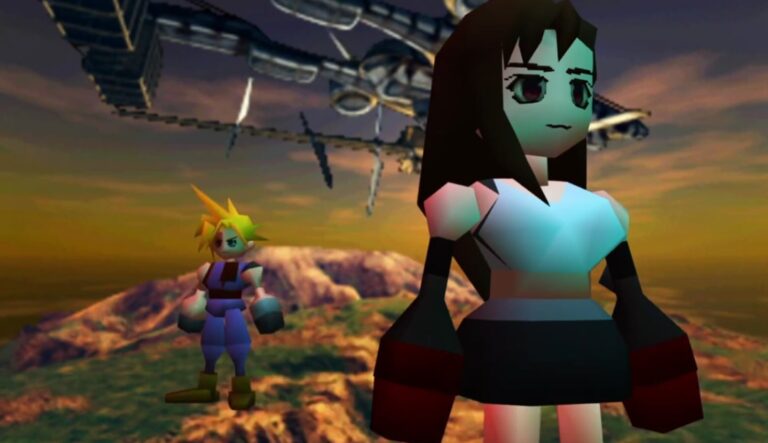
The “sexual content” descriptor embedded in the Mature rating has attracted far more fan attention than violence or language, centered on one ambiguous moment from the 1997 original that players have debated for nearly three decades. In Final Fantasy VII’s third disc, Cloud and Tifa share an intimate conversation beneath the Highwind airship. After Cloud says he doesn’t know what to say to her, Tifa responds that words aren’t the only way to express what one is thinking. The scene then fades to black. When the camera returns, Cloud and Tifa are shown cuddled together, with Cloud mentioning it’s almost dawn.
The 1997 version leaves the nature of this encounter entirely to the player’s interpretation. The dialogue carries romantic weight—these are two characters whose relationship spans the entire game, laden with childhood history and unresolved tension—but the fade-to-black technique was standard industry practice for suggesting intimacy without depicting it explicitly. For nearly thirty years, players have questioned whether this was a tender moment of emotional connection or something more physical.
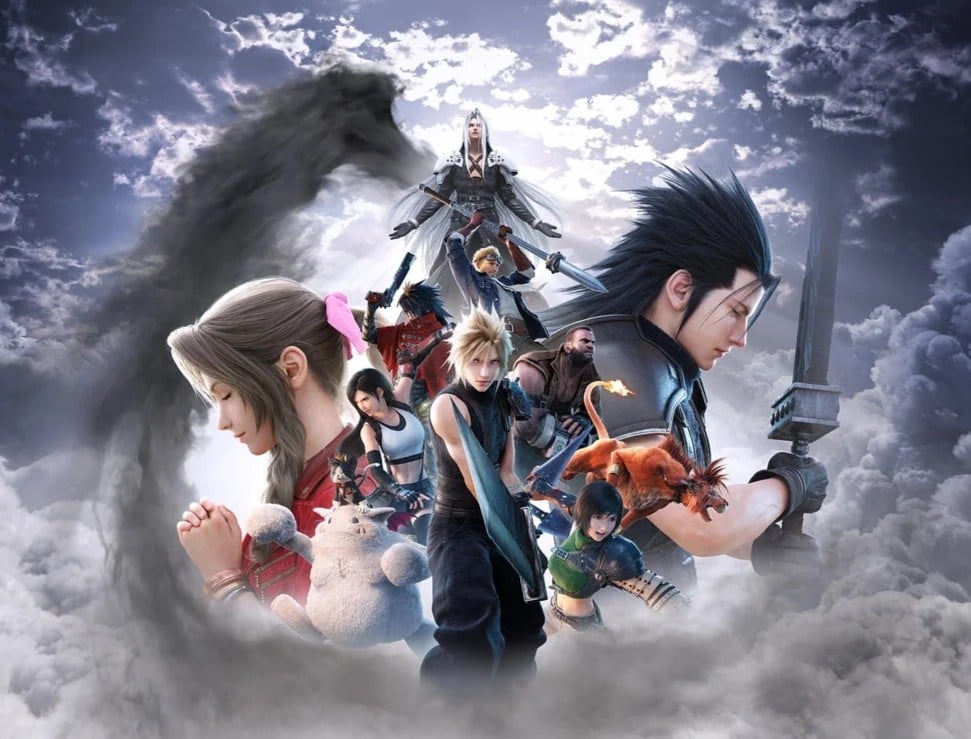
Cloud and Tifa in the Mature Rating Era
What Modern Technology Enables
Square Enix now possesses the technology, budget, and creative freedom to render the Highwind moment explicitly rather than suggestively. The presence of a “sexual content” descriptor in the ESRB’s pending Mature rating has prompted many fans to theorize that Revelation might finally resolve the ambiguity that has surrounded this scene since 1997, making the nature of that night clear through explicit depiction.
Whether this speculation proves accurate remains unconfirmed. A Mature rating doesn’t guarantee explicit sexual content—the descriptor covers a range of approaches from suggestive to explicit—but the combination of contemporary graphics technology, developer statements about mature storytelling, and the rating descriptor itself has crystallized fan expectation around this particular scene. Fans have spent weeks since the rating announcement speculating about what Square Enix might choose to do with this narrative moment.
Series Precedent
Final Fantasy has occasionally moved beyond implication toward explicit depiction when the story calls for it. Final Fantasy X, most notably, includes scenes where sexual intimacy between characters is rendered directly rather than implied through fade-to-black techniques. That precedent exists within the franchise, which strengthens the theory that Revelation might follow suit for Cloud and Tifa.
The two characters carry romantic and sexual tension across the entire original game. Their arc represents one of the trilogy’s central emotional throughlines. If Square Enix intended to bring fuller narrative closure to their relationship in what is explicitly described as the third and final part of the remake trilogy, a Mature rating provides the framework and creative space to do so in a way that was impossible under the Teen classification.
Developer Vision for the Trilogy’s Conclusion
Naoki Hamaguchi, director of the remake trilogy, has indicated that the project embraces mature storytelling across multiple dimensions. He stated that the presence of queer people and relationships in the remake trilogy enhances the world’s realism—signaling that the development team has consciously embraced more sophisticated approaches to character development and relationship complexity than the original game could achieve.
Hamaguchi has also recently indicated that he’s pushing to ensure Revelation receives a physical release, addressing distribution concerns specific to the trilogy’s conclusion. These statements together suggest that the development team views Revelation as a capstone that warrants investment in multiple distribution formats and presentation approaches, underscoring how seriously the team is treating this final entry.
What the Mature Rating Confirms
The Mature rating serves as confirmation that Revelation will treat Final Fantasy VII’s narrative with greater creative sophistication than the previous two entries in the remake trilogy. The leap from Teen to Mature across an entire three-game series represents a deliberate creative choice rather than an accident of rating system mechanics or content creep.
Whether players encounter more graphic violence, more explicit language, more overt depictions of sexual content, or some combination thereof remains officially unconfirmed by Square Enix. But the rating itself telegraphs that the studio is committing to a conclusion that doesn’t soften its mature themes or shy away from the complexity and nuance of its character relationships.
Frequently Asked Questions
Why is Final Fantasy VII Revelation receiving a Mature rating?
The ESRB cited reasons including intense violence and gore from hyper-realistic graphics depicting superboss battles and the Sephiroth fight, strong language from an expanded Cid Highwind role, and sexual content.
Will Cloud and Tifa's Highwind scene be made explicit?
The Mature rating's sexual content descriptor has fueled fan speculation, but Square Enix has not confirmed whether the originally ambiguous fade-to-black scene will be rendered explicitly in Revelation.
Is this the first Final Fantasy game with a Mature rating?
No—Final Fantasy X included explicit sexual content between characters. Revelation will be the second mainline FF game with an M rating and the first in the remake trilogy.
