
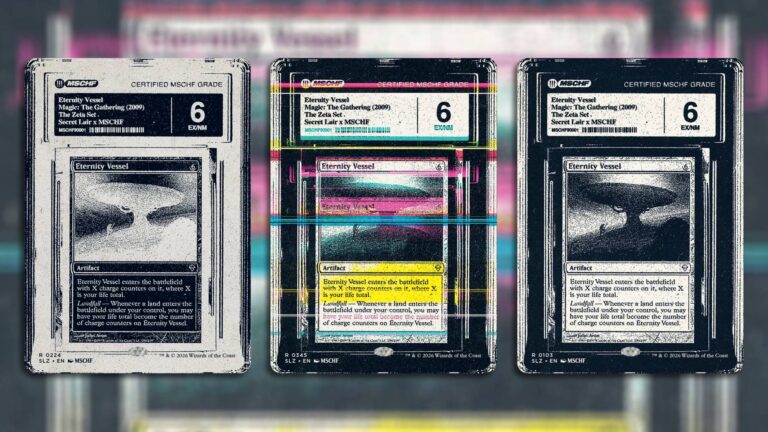
Key takeaways
- The Zeta Set reimagines Magic reprints with hand-made aesthetics inspired by pre-commercial playtesting materials, marking Secret Lair's first booster pack venture.
- Eternity Vessel features a self-referential design depicting itself graded a 6, serving as satire on collector culture and card preservation practices.
- The MSCHF collaboration signals Wizards of the Coast's willingness to partner with conceptual artists rather than relying on established intellectual properties or individual artists.
Magic: The Gathering continues to redefine what specialty releases can accomplish, with its latest Secret Lair offering pushing the medium into unexpected creative territory. Wizards of the Coast has partnered with Brooklyn-based art collective MSCHF to produce The Zeta Set, a collaboration revealed by Polygon that marks a watershed moment for the reprint department. For the first time in Secret Lair’s history, the reprint team has undertaken full booster pack production, signaling a fundamental shift in how Wizards approaches specialty card design and distribution.
The Aesthetic Philosophy Behind The Zeta Set
Drawing from Developmental Origins
The core creative directive for The Zeta Set involves reprinting older Magic cards with entirely new artwork. Rather than commission contemporary digital illustrations, MSCHF selected a visual language inspired by Magic’s earliest playtesting materials predating the game’s original commercial release. These developmental artifacts—hand-annotated prototypes, blueprint sketches, handwritten notes, photocopied iterations, and fanzine-style layouts—became the foundation for the set’s aesthetic identity. Each card reimagines this archival visual language without simply imitating a specific historical period, instead weaving together multiple strands of pre-commercial design culture into a unified visual statement.
The Unconventional Visual Vocabulary
The art direction deliberately celebrates techniques and materials traditionally classified as rough, preliminary, or amateurish. Biro pen sketches, blueprint grids, layered photocopies, and the lo-fi energy of underground publications define the collection’s visual tone. Evidence from Scryfall’s comprehensive card database reveals consistent thematic execution across each piece, where perceived imperfection functions as intentional design philosophy rather than limitation. This approach stands markedly apart from Magic’s recent decades of trend toward increasingly polished, digitally-rendered card artwork. The set succeeds in creating a visual coherence despite—or perhaps because of—its deliberately unrefined presentation.
Positioning Within Specialty Releases
Secret Lair has historically paired with individual artists or established intellectual properties, seeking commercial synergy or fandom connection. MSCHF’s involvement represents a different calculus: collaboration with a collective known for conceptual art commentary and internet culture intervention. The decision to have the reprint department produce booster packs, rather than limiting production to premium print-on-demand or extremely limited runs, indicates Wizards’ confidence in the product’s commercial viability and cultural resonance.
Eternity Vessel: The Card Within the Card
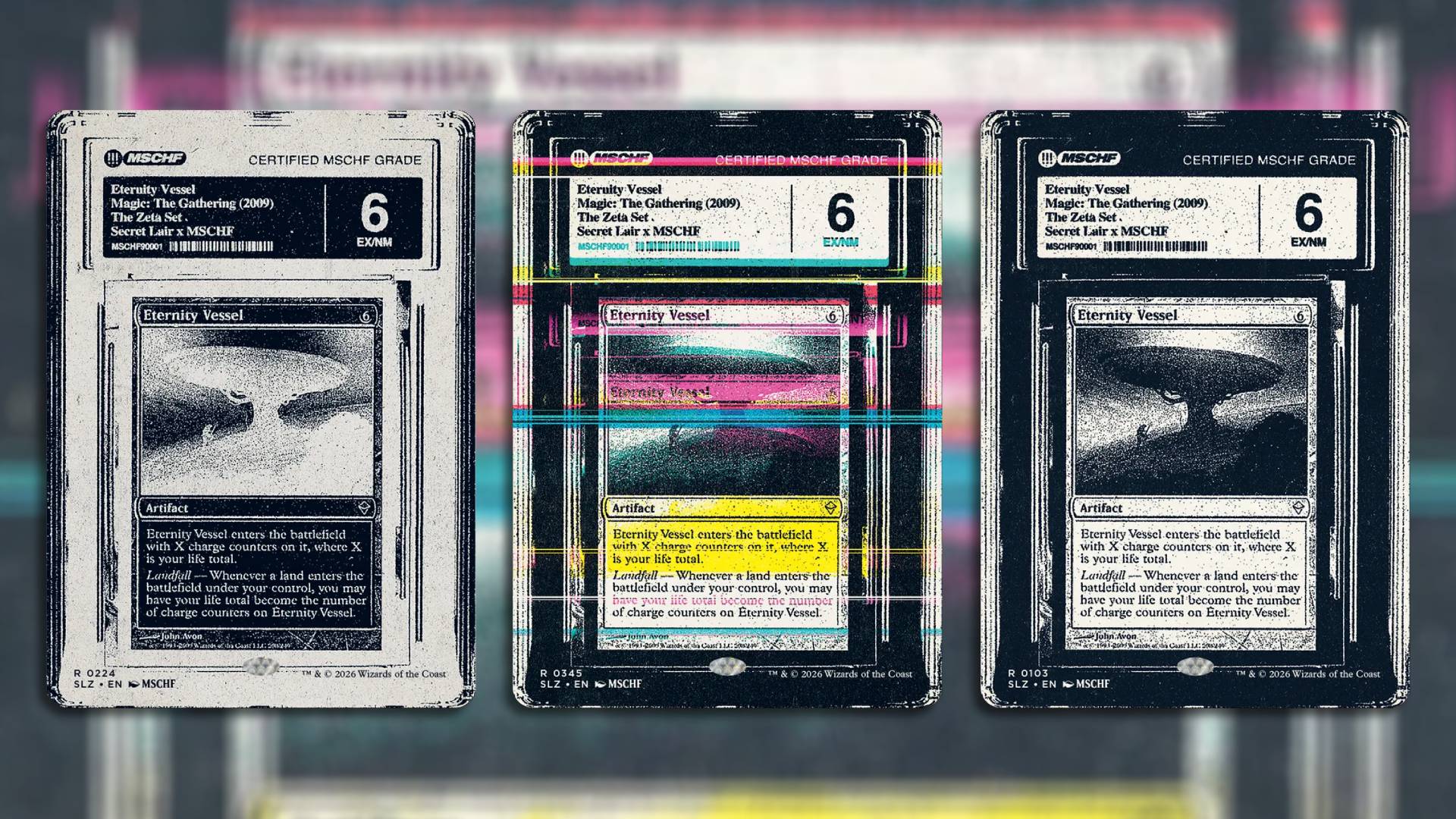
The collection’s defining achievement manifests through one specific reprint: Eternity Vessel, rendered not as a traditional Magic card but as a black-and-white photograph of the card sealed inside a professional grading slab. This recursive concept creates an image of Eternity Vessel depicting itself as a collectible item that has undergone professional evaluation and preservation. The photograph shows the card in grayscale inside the transparent plastic housing standard to card-grading companies, complete with the numerical rating visible at the top of the slab.
The grading assigned to this card-within-a-card adds another conceptual layer: MSCHF chose a grade of 6 out of 10. This seemingly arbitrary choice becomes the mechanism for the card’s deepest commentary. A grade of 6 indicates the card shows noticeable wear, handling marks, and imperfections—the sort of condition that makes the protective slabbing seem almost ironic. The Reddit community quickly identified this recursive humor: a card showing a card showing itself in suboptimal condition, sealed in protection despite not achieving pristine status.
The Economics and Practice of Card Grading
How Grading Works
Professional card evaluation services including PSA examine trading cards under controlled conditions for defects, wear, alignment issues, and overall preservation. The numeric scale ranges from 1 (poor) through 10 (gem mint), with each grade increment representing specific condition thresholds. A perfect grade of 10 commands the highest market valuations, as it signifies an unblemished, unhandled card. A grade of 6 occupies the middle range, indicating visible evidence of use and environmental exposure. Crucially, cards graded at this level often command lower prices than those sold loose without grading, because the cost of slabbing does not offset the value premium gained through grading verification.
The Satire of Suboptimal Preservation
MSCHF’s selection of a 6-grade functions as visual satire aimed at collector culture and investment mentality within trading cards. By depicting the card in a protective slab despite its imperfect condition, the artwork questions the economics of preservation itself. Why seal a card in plastic if it has already sustained damage? The choice celebrates the absurdity inherent in some collecting practices while honoring that cards deserve preservation regardless of their market tier.
Acquisition and Current Availability
The Zeta Set has not yet entered circulation for general purchase. Wizards of the Coast’s recent portfolio of Magic sets has experienced pronounced availability challenges, with numerous releases selling out or remaining perpetually difficult to obtain. Given this landscape, acquiring copies of The Zeta Set will likely prove competitive. The company has implemented a reminder notification system for interested collectors, allowing potential buyers to receive alerts when stock becomes available—a practical acknowledgment that demand will exceed immediate supply.
A Collaboration That Redefined Reprint Culture
The partnership between Wizards of the Coast and MSCHF signals evolution in how the company approaches specialty products. Rather than rely solely on nostalgia, licensed characters, or individual artist prestige, Wizards engaged a collective recognized for conceptual interventions in contemporary art and digital culture. The result—The Zeta Set with its hand-made aesthetics, self-referential card designs, and playful commentary on collectibles—demonstrates that Magic’s reprint strategy need not repeat established formulas to succeed commercially and creatively.
Frequently Asked Questions
What is The Zeta Set?
The Zeta Set is a new Secret Lair product created through collaboration between Wizards of the Coast and Brooklyn-based art collective MSCHF, featuring reprints of older Magic cards with entirely new artwork inspired by hand-made playtest materials from Magic's early development.
Why is the Eternity Vessel card unique in this set?
The Eternity Vessel card depicts itself as a black-and-white photograph sealed inside a professional grading slab with a grade of 6, creating a recursive image of a card within a card. MSCHF chose the 6 rating intentionally to satirize collector culture by showing a protected collectible in imperfect condition.
Has The Zeta Set been released for purchase?
The Zeta Set has not yet gone on sale. Wizards of the Coast has offered a reminder notification system for interested collectors, given that Magic sets have experienced recent availability challenges and competitive demand is anticipated.
