
Key takeaways
- Strange Scaffold's Truck-kun inverts isekai conventions by keeping the player in the real world while a transported character handles fantasy realm progression.
- The game combines arcade driving mechanics inspired by Crazy Taxi with destructive objectives, delivering a focused $20 experience that respects its scope.
- By removing traditional isekai storytelling beats entirely, Truck-kun creates genuine humor through mechanical innovation rather than exhausting narrative tropes.
- Despite limitations like its single map and lack of trick mechanics, the game succeeds because it knows exactly what it wants to be.
The isekai genre has become synonymous with modern anime, manga, and interactive entertainment. The premise—a protagonist transported between worlds with unexpected consequences—appears everywhere. For many critics and fans, the formula has worn thin. Yet Strange Scaffold’s latest project, Truck-kun Is Supporting Me from Another World?!, manages what seemed impossible: it makes the isekai concept genuinely funny and, more importantly, it makes it work.
The game’s hook is simple and delightfully dark. You take the role of a delivery driver who has just committed a vehicular homicide. Your victim is Carissa Ward, a corporate ladder-climber who was moments away from achieving a promotion that would lift her out of financial hardship—until your truck intervened. This incident becomes the catalyst for everything that follows. Carissa doesn’t disappear; she materializes as a ghostly presence whispering in your ear, communicating from the fantasy world now her home courtesy of your delivery vehicle. Her mission is clear: you will not sabotage her advancement again. Working together across dimensional boundaries, she expects you to ensure her success in this magical realm while you continue operating in the real world.
The Subversion of a Tired Formula
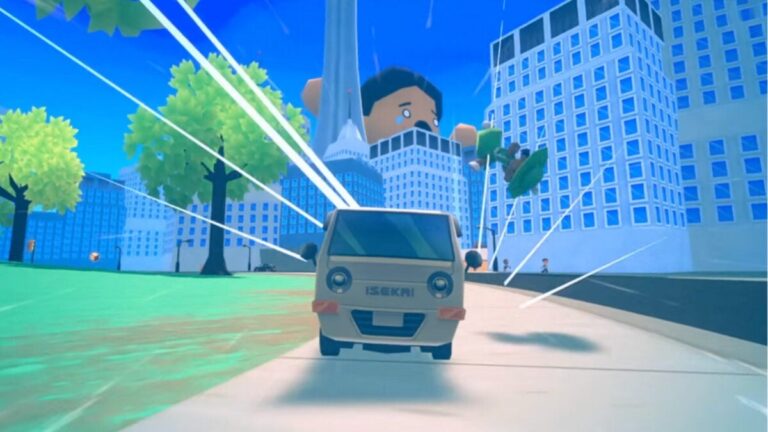
What makes Truck-kun work where other isekai stories stumble is architectural. The game keeps you firmly rooted in reality, operating your delivery truck through an urban landscape. Carissa handles the fantasy world elements independently. This design choice achieves something crucial: it removes the player from direct engagement with traditional isekai storytelling beats. You never watch Carissa bumble through fantasy world politics or experience her slow adaptation to magic systems. Instead, you receive a clean progress bar tracking her advancement while you focus on what the game does brilliantly—driving with anarchic purpose.
The connection between your actions and Carissa’s success creates the mechanical core. Every pedestrian and object you hit in your delivery route translates into power for her fantasy realm combat. Running over a fire hydrant? Her sword grows stronger. Clipping a pedestrian? She receives a power boost. Beyond the base destruction system, you can occasionally trigger her ultimate attack by pressing a dedicated button—a mechanic that feels rewarding when her special ability lands a critical hit against some distant monster.
Arcade Driving Meets Vehicular Mayhem
Truck Handling and Movement
The kei delivery truck itself is a character study in vehicle design. With its exaggerated grin emblazoned across the front, the vehicle radiates personality. This isn’t a vehicle simulator in the Forza Horizon tradition, where physics realism takes priority. Instead, Strange Scaffold designed the driving experience around accessibility and fun. The truck responds immediately to input commands. Acceleration feels responsive. The boost function launches the vehicle forward with satisfying momentum, and drifting—the heart of any arcade driving game—carries genuine weight and feedback.
The developers understood that this game needed to feel like Crazy Taxi reimagined through a lens of comedic destruction. That comparison holds considerable weight. Just as Crazy Taxi married time pressure with arcade precision, Truck-kun marries objective completion with moment-to-moment driving satisfaction. There’s no pretense of realism. The laws of physics operate at the designer’s discretion, serving fun above simulation.
Collision Mechanics and Environmental Interaction
The sideswipe mechanic—activated through a shoulder button—adds tactical depth to driving sequences. Beyond merely plowing forward through obstacles, you can angle yourself to strike specific targets from the side, either powering Carissa’s arsenal or disrupting police pursuit during the inevitable law enforcement response to your vehicular rampage. These encounters channel the spirit of Twisted Metal‘s vehicular combat philosophy, though filtered through comedic restraint rather than dystopian competition.
The city layout encourages experimentation and discovery. Boost pads scattered throughout allow you to build momentum quickly. Ramps launch your truck skyward, triggering cinematic wide-angle camera cuts reminiscent of The Fast and the Furious franchise—maximum spectacle for maximum entertainment value. Then there are the rings, mysterious barriers that serve no apparent gameplay function except the pure joy of flying through them. They exist because the developers understood that exploration and experimentation drive engagement in sandbox driving experiences.
The Single-Map Limitation

Technical Limitations Within a Focused Design
The most significant constraint Truck-kun faces is its single-map design. Once you’ve memorized the layout—and you will—the driving becomes somewhat autopilot. Objectives like drifting for 10 seconds or hitting 30 objects lose their challenge through familiarity. The environmental layout, while initially engaging, doesn’t provide enough variation to sustain dozens of hours of engagement. Where the developers could have elevated the experience would have been through integration of Tony Hawk’s Pro Skater-style trick mechanics. The truck can jump, yet the developers didn’t implement button combinations or stick flicks that unlock aerial maneuvers. Adding tricks would have layered complexity and rewarded mastery of the vehicle’s movement system.
That said, Truck-kun comes packaged at a twenty-dollar asking price with compact length. The developers clearly understood their scope. Rather than bloating the experience with unnecessary content, they delivered a focused, funny game that knows what it wants to be. Padding it out with additional maps or complex trick systems might dilute rather than strengthen the core experience. For the price point and playtime, the game offers genuine value without overstaying its welcome.
Finding Comedy in Genre Subversion
The fundamental appeal isn’t the driving mechanics alone, though those are solid. It’s the conceptual inversion of isekai conventions that creates genuine humor. The genre traditionally positions the protagonist as helpless newcomer thrust into unfamiliar circumstances. Truck-kun inverts this: the real-world character remains grounded in their job while the transported character handles adaptation. The dialogue between you and the increasingly frantic Carissa creates comedy through contrast. She’s negotiating fantasy politics and combat encounters while you’re simply trying to hit your delivery quotas through maximum destruction.
The game also benefits from existing outside the framework that makes isekai storytelling tiresome in other mediums. You’re not watching extended sequences of cultural misunderstanding or repetitive fish-out-of-water dialogue. Every interaction serves the core mechanic: destruction equals progress. The formula strips away everything that typically makes the genre exhausting and keeps only what generates immediate fun.
The Verdict on a Surprise Success
Strange Scaffold created something that shouldn’t work by traditional industry logic. Taking a genre broadly disliked by critics, transplanting its core concept into a comedic arcade driving game, and stripping away the elements that make isekai narratives exhausting—it reads like a risky proposition. Yet through clear design choices and focused execution, the studio delivered a game that works despite its ridiculous premise, perhaps even because of it. The twenty-dollar price point feels generous given the entertainment value delivered. Truck-kun doesn’t outstay its welcome, and it doesn’t pretend to be something it’s not. It’s a murder simulator masquerading as a delivery game, and that self-awareness makes it one of the most enjoyable takes on isekai conventions in recent memory.
Frequently Asked Questions
What is Truck-kun Is Supporting Me from Another World?!
A comedic arcade driving game by Strange Scaffold where you play a delivery driver hitting pedestrians and objects to power up a character named Carissa Ward who exists in a fantasy world. Carissa communicates with you from the fantasy realm as a ghostly presence.
How do the real world and fantasy world mechanics connect?
Your destruction in the real world directly empowers Carissa's character in the fantasy world. Every object and pedestrian you hit makes her sword stronger, and you can press a button to trigger her ultimate attack during her fantasy encounters.
What games influenced Truck-kun's design?
Truck-kun channels Crazy Taxi's arcade driving philosophy combined with Twisted Metal's vehicular combat elements, deliberately avoiding the simulation focus of games like Forza Horizon.
