
Key takeaways
- Splatoon Raiders successfully translates the franchise into a 20-hour single-player campaign that emphasizes constant action and aggressive play rather than defensive positioning.
- Build customization and weapon variety enable diverse playstyles, with satisfying moment-to-moment mechanics that justify the design philosophy throughout the experience.
- Limited environmental aesthetics, sparse fashion options, and a weak soundtrack diminish what is otherwise excellent core gameplay.
Nintendo’s ink-based shooter franchise has matured significantly over the past decade-plus of existence. With three full mainline entries now released, the franchise has proven itself as a surprising pillar of the Switch’s game library—a counterintuitive success given Nintendo’s historical distance from competitive shooters. Splatoon Raiders represents a distinct evolution for the series, abandoning the multiplayer-focused structure of its predecessors in favor of a substantial, mission-driven campaign experience.
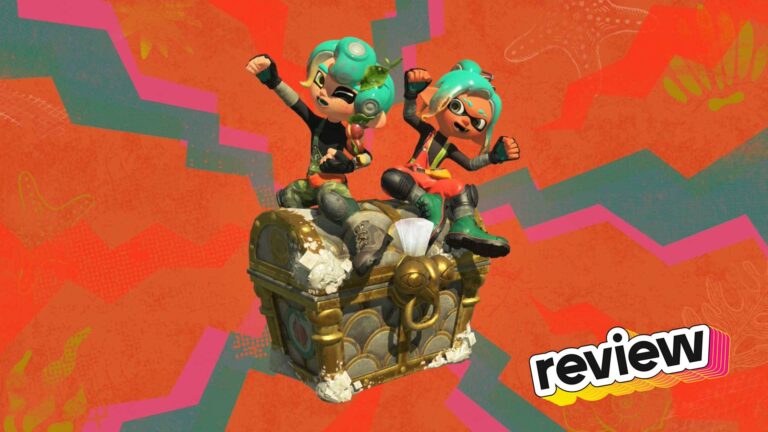
The premise places players in the role of an unnamed character who joins a band of three treasure hunters and their aircraft mechanic pilot on an expedition across a chain of uninhabited islands. The established Splatoon cast members—Shiver, Frye, and Big Man—serve as companions throughout this adventure. The islands themselves harbor abundant riches, but also teem with Salmonids, the hostile creatures that populate the Splatoon universe. While these beings possess clear cultural sophistication, complete with art, music, and established societies, the game treats them as mindless threats to be eliminated. There’s an inherent awkwardness in this narrative framing, particularly given that the developers have publicly acknowledged their internal discomfort with the premise. Yet Splatoon Raiders commits to this approach without offering deeper justification, which somewhat undercuts the lighthearted tone the developers are clearly pursuing.
The narrative itself remains relatively shallow, though not unwelcome. Shiver, Frye, and Big Man bring vibrant, enthusiastic personalities to the campaign that enhance emotional beats throughout the experience. For players invested in Splatoon’s broader lore, the game scatters hidden collectibles that expand the universe’s mythology, offering deeper context for dedicated fans to unpack. This approach succeeds in enriching the Splatoon world without demanding its attention from casual players.
Campaign Length and Environmental Scope
The actual campaign spans approximately 20 hours of core content, with substantial additional material available in post-game activities. Across roughly 50 individual stages, the environmental diversity proves limited. The islands repetitively cycle through recognizable biome types—sand beaches, glaciers, volcanic regions, caves, and temples. While each location type appears multiple times with minor variations, the overall aesthetic palette lacks the richness you might expect from a game with this much content.
This limitation extends to fashion customization options as well, which feel surprisingly sparse given how central style has been to Splatoon’s identity across its decade-long history. The audio design similarly misses opportunities. The soundtrack primarily features percussion-based instrumentation, which the developers have explained as a deliberate choice, yet most tracks fail to engage listeners. The final boss encounter’s theme stands as a notable exception, delivering genuine impact where the rest of the soundtrack retreats into background noise. For a franchise that has historically leveraged music as a major element of its appeal, this represents a puzzling step backward.
Mission Design and Enemy Encounters
Varied Mission Structures
Splatoon’s single-player offerings have traditionally emphasized obstacle-course navigation, and Raiders preserves this foundation. Beyond these traversal-focused stages, the game introduces varied mission structures:
- Objective-driven scenarios where players must complete specific tasks
- Enemy-wave survival challenges with time pressure
- Expansive spaces where eliminating all targets progresses the stage
- Boss encounters ranging from modest single-enemies to elaborate multi-phase confrontations
Later stages compound difficulty by introducing challenging enemy combinations that escalate tension and force tactical adaptation. The enemy variety deserves particular praise. The game’s hostile creatures feel creatively designed, with memorable specifics like the sniper variants that perch atop towers of pot lids, presenting clear threats that demand immediate response. Beyond mechanical function, the character designs themselves possess charm. Armor and weaponry throughout the campaign repurpose recognizable human refuse—soap bottles as ink guns, for instance—creating a charming aesthetic that distinguishes the setting from typical shooter environments.
The Absence of Traditional Cover
Traditional shooters rely on destructible or static cover to segment combat spaces and encourage tactical positioning. Splatoon Raiders actively resists this design language. Most stages are constructed flat or gently sloped, with minimal vertical features that would provide defensive positions. Enemy forces attack relentlessly, overwhelming players through sheer presence rather than allowing methodical, protected advancement. While players can theoretically create temporary cover by spraying ink, this strategy carries significant risk—enemies can track and strike through ink-based barriers. Certain enemy types, particularly the aforementioned snipers, actually penetrate walls entirely, negating any defensive benefit.
This architectural choice fundamentally demands player aggression. The game’s level design philosophy pushes players toward constant forward momentum and direct engagement rather than evasion. For players accustomed to defensive playstyles in traditional shooters, this adjustment requires deliberate approach modification. The tactical tank loadout, distinct from the power and speed alternatives, appears designed to accommodate defensive builds and long-range combat preferences. Yet even players equipping these setups will find themselves drawn toward active participation as progression unlocks increasingly powerful equipment. As gameplay extends, acquired upgrades reinforce offensive engagement—equipment that ignites touched surfaces while swimming or generates defensive damage rings that decimate nearby threats simultaneously represent extreme versions of this philosophy.
Customization and Core Mechanics
Build Diversity
The franchise’s emphasis on personalized equipment loadouts reaches full expression here. Different weapon categories—including chargers, rollers, and ink dispensers—function according to distinct tactical principles. Parts and gadgets layer additional customization possibilities, allowing hundreds of potential configurations. Skilled optimization can theoretically accommodate nearly any preferred playstyle, and certain combinations generate genuinely creative synergies that players will enthusiastically share once the game reaches audiences.
The fundamental feel of moment-to-moment gameplay justifies all this customization investment. Movement across stages is responsive and rapid. Ink dispersal creates satisfying visual and audio feedback—the fluid physics and audio design combine to form an immediately pleasurable experience. The visceral rush of deploying multiple gadgets simultaneously and witnessing the resulting devastation never loses its appeal. The earlier Splatoon titles established the series’ strength in moment-to-moment mechanical satisfaction, and Raiders extends this achievement across an entire single-player campaign without dilution.
Multiplayer and Extended Content
Beyond the solo campaign, a robust co-op mode permits two players to complete almost the entire story together, preserving the core experience while enabling shared progression. This addition expands the game’s appeal across social gaming contexts, allowing couples and friend groups to experience the narrative simultaneously.
Numerous post-game activities remain unaddressed after completing the main campaign, promising extended engagement well beyond initial completion. For players seeking diverse content—whether pursuing maximum cosmetic unlocks, discovering hidden secrets, optimizing builds, or simply experiencing stage variations—significant hours await discovery.
Minor Issues in an Otherwise Excellent Package
Several friction points diminish what is otherwise an exceptionally engaging experience:
- Stages lack built-in retry functionality, forcing menu navigation when players encounter difficult bosses or environmental hazards
- Companion characters never acknowledge the protagonist’s name, creating a constant missed opportunity for dialogue relevance
- Roller weapons feel mechanically underpowered compared to other options, though this may reflect limited weapon proficiency rather than genuine balancing issues
- Relationship conversations between the main character and the three companions lack substance, delivering exchange rather than genuine character development
- Environmental design occasionally frustrates collectible hunting, as certain secrets require knowledge of backtracking potential without clear communication
Despite these points of friction, all of them pale against the overwhelming appeal of sustained, energetic play. Hours disappear as the game’s fundamental momentum carries forward. It functions equally well as solo escapism or as shared entertainment with friends. The Splatoon franchise has historically distinguished itself through mechanical satisfaction and welcoming design philosophy, and Raiders successfully extends both qualities across a campaign that could have stumbled numerous times but instead largely soars.
Frequently Asked Questions
How long is the Splatoon Raiders campaign?
The main campaign takes approximately 20 hours to complete, with substantial additional post-game content available for players seeking extended engagement.
Does Splatoon Raiders support multiplayer or co-op play?
Yes, the game features a robust co-op mode that allows two players to complete almost the entire story together while preserving the core single-player experience.
What are the main criticisms of Splatoon Raiders?
The game features limited environmental variety across its 50 stages, sparse fashion customization options, and a weak soundtrack except for the final boss theme, though these issues do not significantly diminish the core gameplay.
