
Key takeaways
- Bubbly Basin concentrates sunken locations tied to beloved characters in one underwater area, with each site reinforcing themes of permanent abandonment and loss.
- Ditto cannot read the notes explaining humanity's departure, creating a painful gap between the protagonist's hopeful reconstruction efforts and the player's knowledge of tragedy.
- The DLC explores climate catastrophe and civilization-wide abandonment as core thematic elements rather than mere background, treating the subject matter with surprising maturity.
- Future areas like Lavender Town, Cinnebar Island, and Indigo Plateau are teased for future DLC, suggesting even darker explorations of loss yet to come.
Pokopia’s base game concluded a few months ago, leaving players emotionally devastated by its exploration of a post-apocalyptic world and the permanent loss of humanity. Despite that emotional toll, the new Bubbly Basin DLC manages to deepen the experience’s melancholy, introducing underwater areas filled with sunken reminders of beloved characters and a world that continued without its people. The expansion proves that there is still capacity to be emotionally wrecked by this game, even after experiencing the base game’s heartbreaking conclusion.
Understanding Pokopia’s World
Pokopia takes place in Kanto during a future era when humanity has abandoned Earth entirely. Facing climate catastrophe, the species escaped into space, storing virtually all Pokémon in PC systems with the intention of returning once conditions stabilized. That return never happened. As players progress through the game, scattered notes and environmental details gradually reveal that humans will likely never come back, leaving their beloved Pokémon abandoned indefinitely. This fundamental despair—the knowledge that an entire civilization chose to preserve its creatures but then failed to retrieve them—permeates every location. Most of the notes about what happened maintain a lighthearted tone, yet the underlying reality remains devastating. Beloved characters from the franchise’s history will never return to Kanto, and many are likely already dead. The entire game is suffused with this quiet sorrow.
Bubbly Basin’s Concentrated Tragedy
Where other regions of Pokopia distribute melancholic locations throughout their areas, Bubbly Basin concentrates its emotional payload. The underwater zone contains multiple specific locations directly tied to recognizable, beloved characters, each one serving as a stark reminder of permanent absence. The density of these locations, combined with their thematic coherence, makes Bubbly Basin uniquely devastating.
Misty’s Flooded Gym
The most immediately recognizable landmark is Misty’s gym, situated in a cavern just off the town square. The structure remains identifiable through the Pokémon statues flanking its entrance, familiar markers for anyone who remembers the water-type gym leader from the franchise’s earliest seasons. Sand has accumulated throughout the interior, partially covering the distinctive swimming pools that defined the space. Clearing away the sediment reveals the pools beneath, their presence a poignant symbol of Misty’s identity and profession. A chamber behind the main gym contains furniture designed specifically in a Mermaid theme, referencing her title as the “tomboyish mermaid.” Standing in this space drives home the central tragedy: Misty will never return to this place. She will never see the Pokémon, like Starmie, who apparently remained here waiting for her. Whether dead or lost in space with all other humans, she is permanently gone.
Bill’s Abandoned Sanctuary
Northeast of town stands another structure that tells an equally cruel story. A modest house contains computer equipment and one of Bubbly Basin’s new introductions—the portal pod, an item that allows players to access Pokémon storage from any location in the world. The contents and placement make Bill’s authorship clear. Bill is the inventor who created the original Pokémon PC storage system and who, in a memorable early encounter, accidentally transformed himself into a Pokémon before being restored. He apparently designed this new portal pod system before departing into space alongside all other humans. Bill never lived to see how useful this system became for rebuilding civilization. The portal pod represents his final legacy, but he will never know its impact.
Ruins of Unfulfilled Intentions
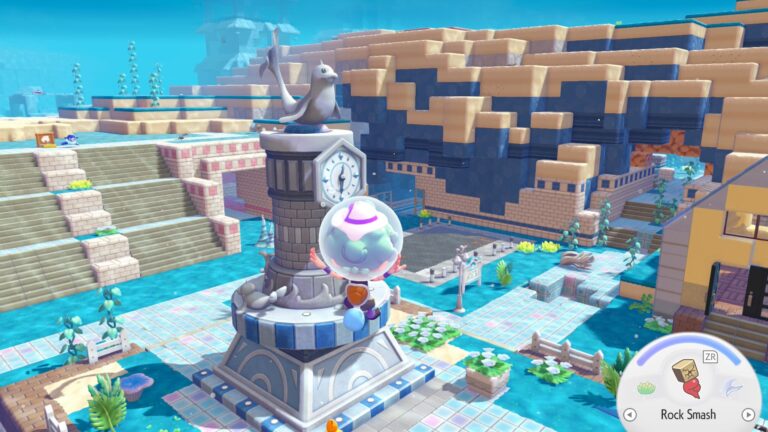
Beyond these two prominent memorials lie other submerged structures throughout Bubbly Basin, each raising questions that will never be answered. A large Japanese-style tower and bridge sink deep into the ocean, its original purpose lost to time and water. Nugget Bridge, once populated with trainer battles in previous games, now rests at the bottom of the flooded zone. Most significantly, the region contains notes describing an unrealized plan to construct a clocktower dedicated to Dewgong in the city center. Humanity never completed this project. Yet as the player controlling Ditto, you succeed in building it. This creates a painful paradox: the Pokémon finishes what the humans who conceived the structure could never accomplish. The vision becomes reality only in their absence, forever denied to its creators.

The Duality of Knowledge
Pokopia presents itself with a cheerful, inviting exterior. The graphics are colorful, the gameplay is cozy, and the core loop revolves around exploration and reconstruction. Yet beneath this surface lies a mature meditation on climate catastrophe and permanent abandonment. The narrative tackles genuinely grim subject matter: an entire civilization chose to leave and never returned, ensuring that the world and the Pokémon they left behind would never experience their care again.
The game deepens this tragedy through a narrative device: Ditto, the player character, cannot read or comprehend the information scattered throughout the world. The notes, the location names, the historical context—all remain meaningless to Ditto. As the player, you understand the tragedy completely. You read the notes describing humanity’s escape and non-return. You know that Misty will never come back, that Bill will never see his invention being used to help the world. Ditto continues pursuing reconstruction and hope without any understanding of the hopelessness underlying the situation. This gap between the protagonist’s determination and the player’s knowledge of tragic reality amplifies the emotional devastation.
What Remains to Come
Bubbly Basin currently represents the DLC’s deepest exploration of these themes. However, the expansion pass has additional areas yet to release. Evidence within the game points toward future explorations of Lavender Town, Cinnebar Island, and Indigo Plateau. Each location carries significant weight within Pokémon franchise history. Lavender Town, in particular, carries haunting associations; as a burial ground in previous games, its appearance in this post-apocalyptic context raises profoundly disturbing possibilities.
Facing the prospect of visiting these locations—discovering what the developers have done with their stories and how they’ve reinforced or evolved these themes of loss—feels simultaneously compelling and overwhelming. Whether the expansion can maintain the delicate balance between hope and despair that currently defines Bubbly Basin’s most devastating moments remains to be seen.
Frequently Asked Questions
What is the setting of Pokopia?
Pokopia takes place in a post-apocalyptic Kanto where humanity escaped Earth to avoid climate catastrophe, storing all Pokémon in PC systems. Humans never returned as promised, leaving their Pokémon abandoned indefinitely.
What is Bubbly Basin and what does it contain?
Bubbly Basin is an underwater DLC area featuring flooded locations of beloved characters like Misty and Bill, emphasizing themes of loss and showing how the world continued without its people.
Why is the knowledge gap between the player and Ditto significant?
Ditto cannot read the notes explaining humanity's abandonment, so they continue rebuilding hopefully without understanding the tragedy. The player knows the hopelessness, which amplifies the emotional devastation of every discovery.
