
Key takeaways
- Cold Symmetry removes the stamina meter, shifting combat emphasis to positioning over resource management—a controversial choice that works for this game's identity.
- The 40-hour campaign doubles down on cosmic horror atmosphere and exploration across mini-dungeons and open vistas that rival Blasphemous in tonal commitment.
- Scarcity of upgrade materials and currency forces midgame grinding, undermining the build experimentation that the shell system otherwise encourages.
- The Slayer Seal provides accessibility through equipment augmentation rather than difficulty toggles, maintaining mechanical integrity for all skill levels.
Cold Symmetry’s follow-up to their 2020 sleeper hit pushes into unexpectedly darker territory, building on the tight, compact design of its predecessor with a sprawling open world. Over 40 hours of exploration across normal difficulty and some sessions in the higher Night (Hard) mode, the studio has crafted something that demands to be experienced in near-silence—a game that seems engineered for dimly lit rooms and a mounting sense of dread that never quite lifts.
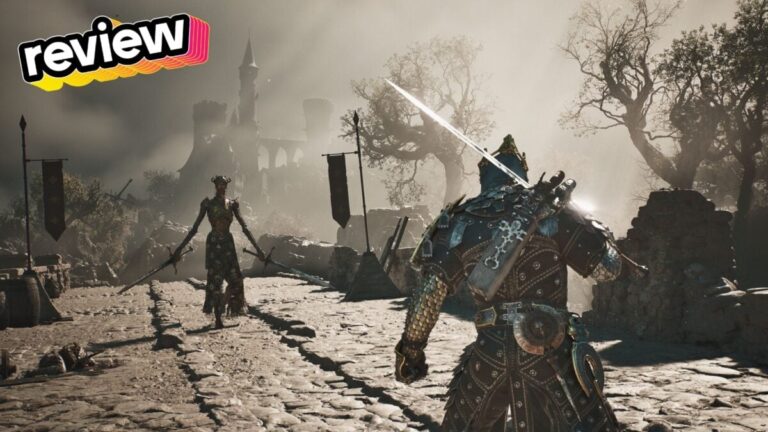
The immediate hook is the presentation. Every frame appears hand-painted with the sensibility of someone obsessed with maintaining perpetual cloudcover above a crumbling 19th-century estate. The visual language borrows heavily from dark fantasy excess; think less “skeletons on album covers” and more genuine commitment to a worldview where cosmic horror isn’t window dressing but fundamental to how environments are constructed and threats are designed. The comparison to Wayne Barlowe’s hellscapes isn’t hyperbole—the painterly approach to backgrounds and creature design creates a cohesive nightmare aesthetic that permeates every biome.
The Cult Awaits: Tone and Atmosphere
The opening signals immediately where allegiances lie. The game introduces cults—and notably, it’s not the only one—as a way to establish that this is a world where extremism, belief systems, and the horrific consequences of devotion form the narrative backbone. There’s an almost comedic severity to how much the game commits to its own darkness. It’s reminiscent of how the Blasphemous series takes itself with such uncompromising seriousness that the experience tips into something absurd, yet the commitment to that vision becomes exactly why the games work. Mortal Shell 2 operates in similar territory: it dares anyone complaining about pacing or tonal consistency to stop complaining entirely. There are no brakes. There are only double bass kick drums.
Visually, gazing across the landscape reveals environments that could have been lifted from a Barlowe painting—genuinely disturbing hellscapes that justify the assessment of a most metal video game. It’s not mere darkness or skeletons; it’s an entire philosophy of design committed to creating a place that radiates wrongness.
Shells, Builds, and Mechanical Depth
Character Customization Through Shells
The core mechanic inherited from the original persists: shells function as character archetypes, each with distinct abilities that can be swapped out at rest checkpoints. Rather than incremental stat increases, the sequel distributes depth through character variety. Each shell unlocks its own skill tree, with progression that ties into narrative beats—some satisfying, some less so. The variety here sidesteps the predictability of traditional RPG leveling systems.
Augmentation and Item Density
Tarstones scatter throughout the world, functioning as augmentation items that enable wildly different approach paths. Weapons themselves are practically everywhere, encouraging experimentation rather than commitment to a single tool. By the midgame, it’s possible to discover combinations of abilities, weapons, and augmentations that enable moving through sections with cinematic flow—a testament to how thoroughly the game satisfies both mechanically and through pure spectacle.
Accessibility Without Compromise
The inclusion of the Slayer Seal—an item discovered early—provides a pathway for players uncomfortable with demanding combat systems. Rather than a separate difficulty toggle, it augments your capabilities through a specific piece of equipment, allowing harder skill checks while maintaining engagement on the game’s mechanical terms.
Combat Without the Stamina Meter
Perhaps the most contentious design decision: the complete removal of the stamina meter, a Souls-genre staple. Players can attack, run, and dodge without resource management, fundamentally shifting how combat unfolds. Initial resistance—this felt like backwards thinking—eventually gave way after hundreds of encounters. The absence of a stamina meter recontextualizes the importance of spacing and positioning. Where traditional Soulslike games ration your actions, Mortal Shell 2 trusts player timing and spatial awareness to create tension. For this game’s heavy, lurching protagonist, it’s the correct call. That said, this design choice works specifically for this game and shouldn’t necessarily become gospel for the genre writ large.
The consequence is that Mortal Shell 2 occupies unusual territory: it retains Soulslike DNA while introducing combat vocabulary closer to traditional action games. It never transforms into a high-flying, combo-fest, but by endgame, with the right loadout, the game flows almost cinematically.
Exploration and Environmental Design
The world doesn’t hold your hand. There’s a black-robed figure with knives; should you approach? A snail wearing a bell sits atop a distant hillside—worth investigating? Nearly every checkpoint hosts a small dungeon, with many more sprinkled throughout the landscape. What distinguishes these mini-dungeons is their construction: they operate as genuine environmental puzzles rather than pure gauntlets, often rewarding thorough searching with forging materials and experience point caches. There’s genuine satisfaction in sussing out solutions and claiming rewards for curiosity.
The draw isn’t the collection of MacGuffins that technically gate endgame content. It’s the constant wonder about what lies behind the next corner, what the mysterious figures might be guarding, and what weapons or upgrades wait to be uncovered. The density of content means 40 hours still left weapons undiscovered, which speaks to the sheer amount packed into this world.
Difficulty Balancing and Grinding Friction
The game calibrates easier than other contemporary Soulslike offerings, though Cold Symmetry has indicated balance adjustments may arrive via patches. Players seeking greater challenge can engage Night (Hard) mode, which includes additional content. However, a genuine friction point emerges midgame: upgrade materials and currency become increasingly scant. This scarcity creates grinding obligations—not from challenge but from resource limitation. Character builds feel restrictive because you simply lack the means to experiment. It’s a design flaw that undermines the build variety the game otherwise promotes. By forcing players to farm enemies for cash and materials, what should be natural progression becomes a chore.
Why This Game Matters
Mortal Shell 2 succeeds because it commits entirely to its vision. It’s not attempting to iterate incrementally on existing formulas or chase the trends of comparable genre entries. It’s asking what happens when you apply uncompromising artistic direction to Soulslike mechanics, then answering that question with bloody-minded commitment. The reward isn’t mechanical novelty or perfectly balanced difficulty tuning; it’s the experience of existing within a world that radiates genuine wrongness, moment to moment. That sensibility—the tone, the placement, the atmosphere—is what pulls players back through multiple playthroughs.
The cult is satisfied.
Frequently Asked Questions
How does removing the stamina meter affect combat?
Players can attack, run, and dodge without resource management, making positioning and spacing critical. This initially felt like backwards design but recontextualizes the importance of timing over action rationing.
How long does it take to complete Mortal Shell 2?
The reviewer spent 40 hours completing the main campaign, exploring dozens of dungeons, and finding every shell, though some weapons remained undiscovered.
What accessibility options does Mortal Shell 2 offer?
The Slayer Seal, an item found early, provides combat augmentations without a separate easy mode—allowing players uncomfortable with demanding Soulslike mechanics to engage on the game's own terms.
