
Key takeaways
- Valve initially claimed the Steam Machine could deliver 4K60 gaming with FSR upscaling, but independent reviewers have found these assertions require significant caveats.
- Valve has moved quickly to secure developer backing, announcing that titles verified for the Steam Deck will automatically qualify for Steam Machine verification, with fewer constraints than the handheld device.
- The original Steam Machine launched on November 10, 2015, as a collaborative effort with multiple hardware partners, each building machines with different components and performance profiles.
- While the PS5 offers superior power-per-dollar value and smoother, optimized performance for gaming, the Steam Machine provides versatility that traditional consoles cannot match.
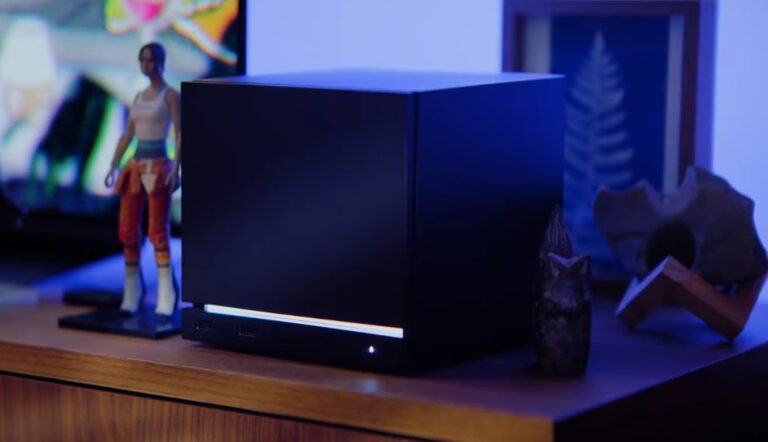
Valve launched the Steam Machine on June 29, 2026, at a base price of $1,049 for the 512 GB model, positioning its second-generation living-room PC as a direct competitor to PlayStation 5 and Xbox Series X despite costing $550 more than either console. The device features a semi-custom AMD Zen 4 CPU equivalent to a Ryzen 5 7540U, an RDNA 3 GPU matching the Radeon RX 7600M, and 16 GB DDR5 RAM running SteamOS, Valve’s Linux-based operating system. Industry veterans and console gamers have begun questioning whether the premium pricing justifies the performance gains, with early reviews revealing significant gaps between Valve’s marketing claims and real-world gameplay.
Valve’s Second Swing at the Living-Room PC
Valve announced the Steam Machine on November 12, 2025, marking a dramatic departure from its first attempt in 2015, when the company outsourced hardware manufacturing to third-party partners like Cyber who built machines with wildly inconsistent specifications. This time, Valve manufactures the hardware directly, controlling every component to ensure a standardized “console-like” experience that mirrors the company’s success with the Steam Deck. The shift reflects lessons learned from the original Steam Machine’s discontinuation on April 2, 2018, when fragmented hardware specs and partner misalignment doomed the initiative.
The 2026 relaunch targets Steam’s massive ecosystem: the platform reached a record 42,042,778 concurrent users online in June 2026, surpassing the previous 40 million mark set in March 2025. This represents the largest PC gaming audience globally, a user base Valve hopes will upgrade to a unified living-room device. However, the $1,049 entry price—$400 to $450 higher than the PS5 or Xbox Series X—signals that Valve is positioning the Steam Machine as a “PC-plus” premium product rather than a traditional console aimed at mass-market adoption.
Performance Claims Meet Skepticism in Reviews
Valve initially claimed the Steam Machine could deliver 4K60 gaming with FSR upscaling, but independent reviewers have found these assertions require significant caveats. In Cyberpunk 2077 with ray tracing enabled at 4K, the device managed only 14 frames per second, jumping to 42 fps only after disabling ray tracing—a far cry from the promised 4K60 experience. IGN’s review of the $1,049 device found that while the Steam Machine averages 50–60 fps across various games on medium presets, it falls short of base console power in raw graphical fidelity, particularly when ray tracing is involved.
Specific benchmarks underscore the performance inconsistency across different titles. In Forza Horizon 6, the Steam Machine hit 57 fps at 4K on medium presets; in Cyberpunk 2077, it reached 64 fps at 4K with ray tracing reduced to medium settings. However, at 4K Ultra in Total War: Warhammer 3, performance plummeted to 23 fps. These results highlight the device’s reliance on FSR downscaling and medium-preset compromises to achieve playable frame rates at 4K—a far cry from the “set it and forget it” experience that console players expect from a $1,049 machine.
Industry Response and Developer Support
Valve has moved quickly to secure developer backing, announcing that titles verified for the Steam Deck will automatically qualify for Steam Machine verification, with fewer constraints than the handheld device. Lawrence Yang, a Valve designer, stated this rule of thumb to reassure developers that optimizing for the Steam Deck’s lower-power specifications is sufficient for Steam Machine compatibility, simplifying the development pipeline for the existing Steam library. This approach sidesteps the fragmentation issues that plagued the original Steam Machine, where developers faced inconsistent hardware configurations across partner-built machines.
The Steam Machine’s raw power advantage over the Steam Deck is substantial: the new device is roughly six times more powerful, delivering 60 fps or more for every game tested in out-of-box configurations. According to Digital Foundry analysis, this performance positions the Steam Machine between the Xbox Series S and PlayStation 5 in raw computational power. Yet reviewers note that 8GB of VRAM remains a limitation compared to modern consoles, which ship with 10GB to 16GB depending on the platform.
Lessons from 2015: Why Valve’s First Steam Machine Failed
The original Steam Machine launched on November 10, 2015, as a collaborative effort with multiple hardware partners, each building machines with different components and performance profiles. This fragmentation created confusion in the marketplace: consumers could not easily understand what they were buying, and developers faced the nightmare of optimizing for dozens of hardware configurations. By April 2018, Valve had discontinued the initiative, with most partner models phased out as the experiment quietly failed to gain traction.
The Steam Deck’s estimated 4 million units sold since launch demonstrates Valve’s ability to execute on portable hardware, providing a blueprint for the Steam Machine’s direct manufacturing approach. If the Steam Machine achieved GameCube-level sales (approximately 21.7 million units), it would represent a 543% increase over Steam Deck volumes—a theoretical ceiling that the $1,049 price point makes unlikely to reach in reality.
Supply Constraints and the Reservation Gamble
Valve implemented a randomized reservation queue for the Steam Machine, with pre-orders opening June 23 and closing June 25, citing AI-driven memory shortages and rising chip prices as justification for the limited availability model. Pierre-Loup Griffais, Valve’s hardware designer, framed the $1,049 price as “honest pricing” rather than subsidized hardware, acknowledging that Valve is not absorbing manufacturing costs to compete on price. The raffle-based system contrasts sharply with traditional console launches, which rely on wide retail availability to drive mass adoption.
This supply strategy creates significant risks: the device is not available in retail stores, creating what industry observers have termed a “scalpers dream” and limiting initial sales volume. Console players accustomed to walking into a GameStop or Best Buy to purchase a PS5 will find the Steam Machine’s exclusivity frustrating, potentially alienating the mainstream audience Valve needs to justify the hardware investment.
What Sets Steam Machine Apart from PlayStation 5
While the PS5 offers superior power-per-dollar value and smoother, optimized performance for gaming, the Steam Machine provides versatility that traditional consoles cannot match. The device can run emulators for retro gaming, accept custom boot animations, and function as a mini workstation for coding and writing—capabilities locked down entirely on the PS5. Users who want to consolidate their entire PC game library (including non-Steam games) into a single living-room device gain significant flexibility with the Steam Machine.
However, critics argue these features do not justify the $1,049 price premium given the PS5’s superior performance-per-dollar ratio and the certainty of optimized game experiences. PlayStation veterans accustomed to plug-and-play simplicity may find the Steam Machine’s requirement to tweak settings, manage FSR upscaling, and troubleshoot driver issues frustrating—negating the primary advantage of a console-like form factor.
The Months Ahead: Adoption and Market Viability
The Steam Machine’s long-term success hinges on whether Valve can overcome the $1,049 psychological barrier and expand beyond the hardcore PC gaming audience. Supply availability and actual sales figures through the randomized reservation system will provide the first indicators of consumer demand in the coming months. Additionally, how aggressively third-party publishers optimize games for Steam Machine verification will determine whether the device becomes a gaming destination or remains a niche product for existing Steam enthusiasts.
The Steam Machine represents Valve’s most ambitious hardware push since the Steam Deck, betting that PC gamers will accept premium pricing for a unified, manufacturer-controlled living-room experience. Whether console players will abandon the PS5 and Xbox Series X for $1,049 of flexibility and versatility remains the central question facing Valve’s second attempt at conquering the living room.
