
Key takeaways
- Sony will stop manufacturing PlayStation physical discs in 2028, forcing all new games onto digital-only platforms.
- The shift eliminates the used games market and replaces real ownership with permanent licensing agreements.
- Beyond serious access concerns, the era will end Disc Butts, accidental visual gags created when game disc artwork aligns in particular ways.
Sony announced it will cease producing physical discs for PlayStation games beginning in 2028, signaling the final chapter for physical media in the PlayStation era. The decision has prompted legitimate concern from players worldwide. Questions about digital ownership, the erosion of the used games market, and potential pricing barriers for casual players all deserve serious consideration. These represent genuine shifts in how people will access games going forward.
There’s also something smaller worth mourning: the end of new Disc Butts.
Understanding the Disc Butt Phenomenon
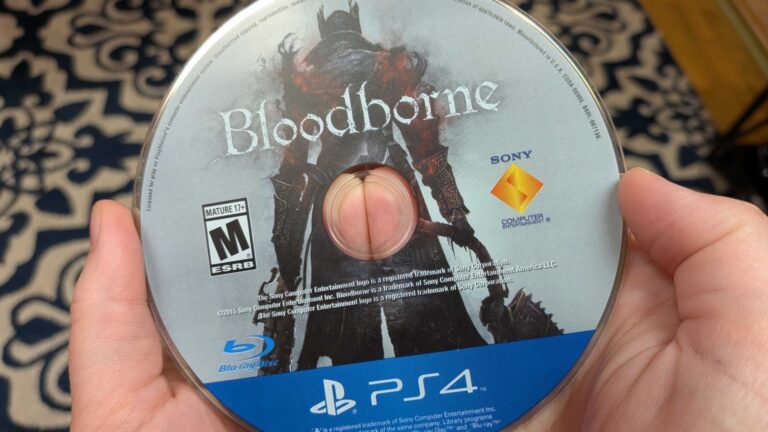
A Disc Butt emerges when the artwork printed on a game disc aligns with the disc’s reflective inner ring in a specific way. When a player positions two fingers against the back of the disc, the character on the front appears to gain an unintended posterior. It’s deliberately childish humor, which gives it genuine staying power.
The Gold Standard: Bloodborne
Bloodborne holds the crown for the most famous Disc Butt. The alignment is nearly perfect—so precise that the image became instantly recognizable across gaming communities and social media. It transcended its original joke status to become something approaching digital folklore, representing the kind of accidental humor that can only emerge from the physical nature of manufactured goods.
Expanding the Canon
Bloodborne didn’t monopolize this accidental art form. Far Cry: Primal offered similar opportunities, as did Uncharted 4. Each game in this small canon provided slightly different visual material for players to discover and share. The fact that multiple major releases created these moments suggested that despite decades of industry experience, game publishers remained capable of shipping products with these particular oversights intact.
The Ownership Question
The shift away from physical media masks a more significant transition that rarely gets framed clearly enough. When someone purchases a physical game disc, they own that disc. They can sell it, trade it, lend it to a friend, store it indefinitely, or hold it as a collectible. That ownership comes with genuine rights and permanence.
Digital games exist under different terms. They are subject to licensing agreements, corporate policy changes, server shutdowns, and platform closures. Access depends on the continued health of entire systems beyond the player’s control. Companies have already demonstrated this risk multiple times—digital storefronts have closed, games have been delisted, access has been revoked. After 2027, every new PlayStation game purchase will exist in this precarious ecosystem with no physical counterpart and no real ownership guarantee.
The Used Market Collapse
The used games market has always functioned as an economic pressure valve. Budget-conscious players, families saving money, and younger gamers without disposable income could access new releases through secondary purchases. Eliminating physical media doesn’t just remove shopping options—it eliminates one of the primary mechanisms through which less affluent players could participate in current gaming.
Publishers have long recognized that digital-only markets allow them to maintain higher prices longer. Without physical used copies undercutting new sales, pricing floors remain high. Combined with multiplayer cosmetics, battle passes, and seasonal content monetization, the barrier to entry for casual players becomes increasingly prohibitive.
The Trivial Loss That Isn’t Quite Trivial
On one level, lamenting the end of Disc Butts is absurd. It’s a joke—juvenile, silly, and built entirely on an accidental design oversight. No reasonable argument could identify the loss of Disc Butts as a major social problem.
Yet it represents something worth considering. When players owned physical games, they could interact with them in ways digital files forbid. You could draw on a disc (though you shouldn’t), pass it to someone else, discover accidental visual gags, or simply hold something tangible. These interactions were made possible only because games were real objects.
The Physicality of Ownership
What gets lost isn’t just the ability to own something in a legal sense. It’s the ability to interact with something concrete. Digital games exist as abstractions—invisible, unchangeable, intangible. Disc Butts are trivial, but they’re trivial proof that physical objects enable interactions impossible in purely digital systems. In that sense, every Disc Butt that ever existed represents a form of play and interaction that will never exist again after 2028.
If Physical Media Continued
One might reasonably assume that over decades, game publishers would have learned to prevent accidental anatomical humor on disc artwork. Surely approval processes are rigorous enough to catch such things now.
The historical record suggests otherwise. Companies cycle through different leadership, different quality assurance structures, different approval chains. Learning requires institutional memory and organizational priority. Previous mistakes don’t guarantee future prevention. If physical discs continued production, probability strongly suggests that another game would eventually reach manufacturing with the same accidental setup. The joke would continue. Players would discover it, photograph it, and share it across the internet.
That won’t happen anymore. The Disc Butt era closes. Whatever exists on shelves now—Bloodborne, Far Cry: Primal, Uncharted 4, and others—becomes the complete final collection of this specific corner of gaming history.
The Bigger Picture
This entire digression about Disc Butts circles back to something more substantial. The shift from physical to digital games represents a meaningful change in how people relate to what they purchase. Some argue that physical media represents unnecessary complexity. Others see it as essential to genuine ownership.
The decision eliminates tangible ownership and replaces it with indefinite licensing. Whether that represents progress or loss depends largely on values. But the loss is real, and dismissing it as mere nostalgia sidesteps what’s actually changing. Digital ownership isn’t equivalent to physical ownership—it’s categorically different in kind and certainty.
Perhaps this makes me sound like I’m nostalgic in a way that’s supposed to be embarrassing. Maybe the digital-only future is genuinely better. But the Disc Butts will be missed. The physicality will be missed. The fact of ownership, as opposed to the concept, will be missed.
Frequently Asked Questions
What is a Disc Butt?
A Disc Butt is an accidental visual phenomenon created when game disc artwork aligns with the disc's reflective inner ring, making it appear a character has a naked posterior when fingers are positioned against the back. Bloodborne is the most famous example.
When will PlayStation stop making physical discs?
Sony will begin phasing out physical disc production for PlayStation games starting in 2028.
What are the main concerns about ending physical games?
Key concerns include loss of actual ownership since digital games are licensed rather than owned, the collapse of the used games market that allowed budget-conscious players to access new releases affordably, and potential higher pricing without physical competition to drive prices down.
