
Key takeaways
- Quest designer Philipp Weber revealed that Witcher 3's NPC fear reaction system inadvertently caused mothers to drop babies for several weeks during development.
- CD Projekt Red prioritized environmental authenticity in small countryside villages, requiring every NPC to feel genuinely integrated into the world.
- The baby-dropping bug exemplifies how systems-driven game design can produce unintended consequences when crucial constraints are overlooked.
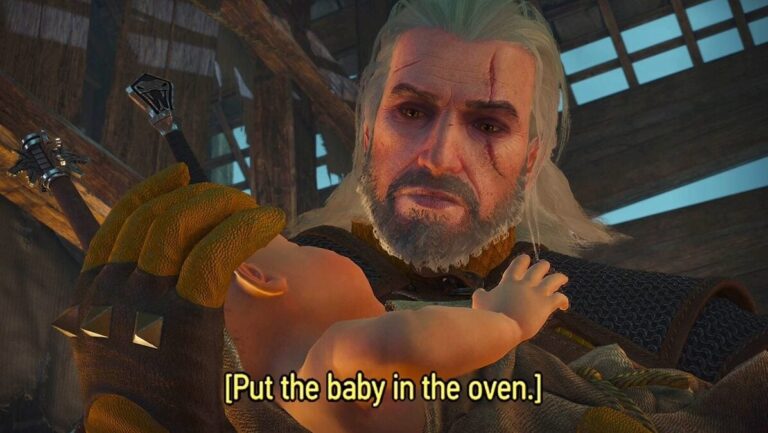
CD Projekt Red’s commitment to environmental authenticity in The Witcher 3 created one of gaming’s most immersive open-world RPGs—and also produced a development crisis that became legendary within the studio: a multi-week period during which NPCs, particularly mothers, repeatedly dropped their babies whenever the protagonist Geralt entered their homes.
The anecdote, revealed by quest designer Philipp Weber in a recent conversation with Edge magazine (via GamesRadar), illuminates both the sophistication of CD Projekt Red’s approach to NPC behavior and the unforeseen complications that arose from prioritizing realism without sufficient guardrails.
Small Villages Demand Authenticity
The scale of The Witcher 3’s countryside environments placed unusual pressure on NPC believability. Unlike sprawling cities where density could mask behavioral shortcuts, small villages demanded that every inhabitant appear genuinely integrated into the world. Weber explained the reasoning to Edge: “Because we were focused on the countryside, it was easier for players to become curious. If a village only has eight houses, people will want to see if the people truly exist in the world, or if it’s just fakery. Lots of people nowadays are interested in those kinds of details, and it really came to haunt us.”
With only a handful of houses in some locations, players would inevitably test the boundaries of NPC behavior. They would peer through windows, observe daily routines, and check whether characters inhabited the world with genuine agency or merely appeared when the player looked in their direction. The village itself became a puzzle that demanded authentic solutions.
The System Behind Living Worlds
Activity Cycles Over Fixed Schedules
Rather than programming rigid schedules that moved characters through predetermined waypoints at set times, CD Projekt Red implemented activity cycles. NPCs would engage in specific tasks—chopping wood, preparing meals, cradling children—and cycle between these activities organically. This approach created the impression of a world with genuine rhythms rather than a stage set that only became active when observed.
The advantage of activity-based systems lies in their emergent quality. Characters could interact with the same tasks in slightly different ways, at different paces, creating variation that static schedules could never achieve. A mother cradling her infant might do so for varying durations. A villager chopping wood might move between the task and other activities unpredictably. This variability contributed substantially to the sense that the world existed independently of the player’s attention.
NPCs Reacting to Threats
The developers added another layer to this system: the capacity for NPCs to notice when Geralt disrupted their routines. A monster hunter brandishing weapons and bursting into homes represented a clear threat. The studio wanted characters to respond with authentic fear when encountering this danger.
“Our NPCs were supposed to have fear reactions,” Weber detailed. “They would drop what they’re currently working on, that thing would fall to the ground, and they’d run away, afraid.”
The system was conceptually sound: startled characters abandon their current activity and flee. The implementation became problematic only when developers considered what activities mothers might be performing. The cradling of infants was assigned as one valid NPC task.
The Unintended Logic Chain
The problem emerged not from a coding error but from incomplete constraint definition. The fear reaction system was working exactly as designed—when threatened, drop what you’re holding and flee. But the system had no special handling for objects that should never be dropped, regardless of circumstance. It treated all held items equally: tools, food, children.
When Systems Produce Horror
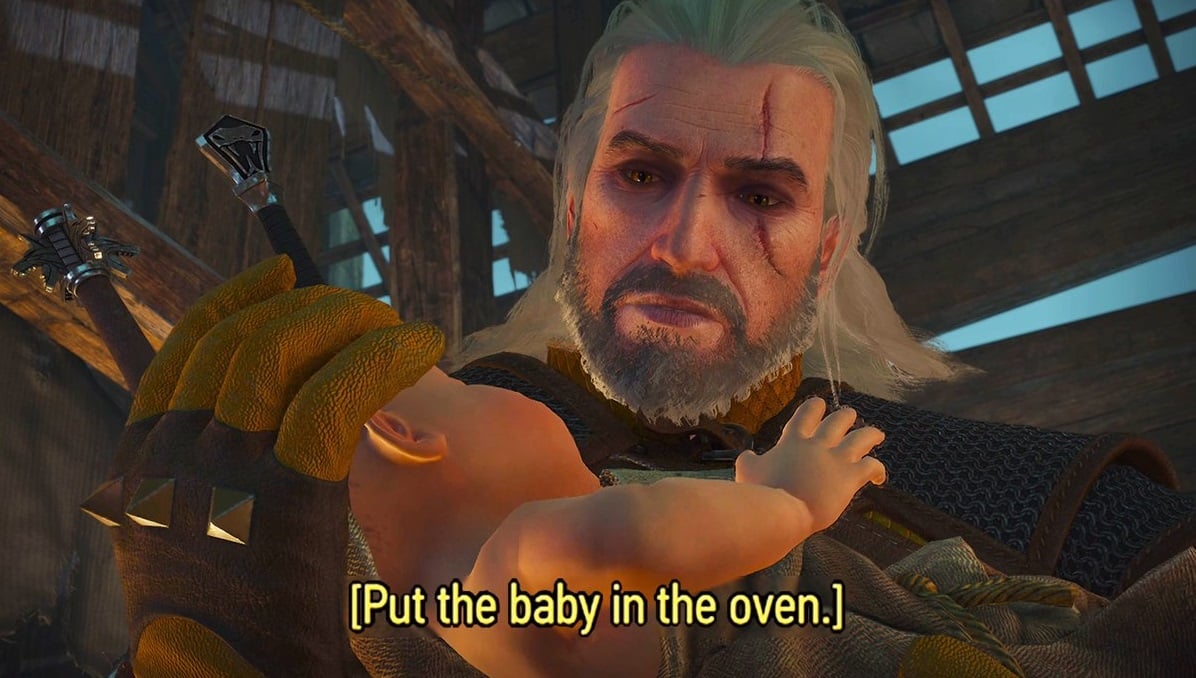
The result was immediately apparent once testing revealed the behavior. Whenever Geralt entered a home where a mother was holding an infant, the fear reaction triggered as designed: the character would drop what they were holding and run away in panic. In this case, “what they were holding” was a baby.
“For a few weeks, women were just dropping their babies, left and right,” Weber confirmed.
The unintended outcome produced a scenario so absurd and horrifying that it became memorable throughout the studio. Mothers across the countryside were fleeing from Geralt, leaving infants scattered in their wake. The system was functioning exactly as programmed—it simply had not accounted for the moral and physical implications of dropping an infant during a fear reaction.
Lessons From the Early 2010s
The incident reflects a broader historical reality of open-world game development during the early 2010s, when The Witcher 3 was in active development. Fear-based reactions and responsive NPC systems have since become standard in modern open-world titles, established as a means to preserve immersion by preventing the jarring moment when players interact with characters who default to indifference.
Implementing such systems was less standardized in The Witcher 3’s development era. Developers had fewer established patterns for handling edge cases—determining what should be droppable, what should trigger flight responses, and how characters should distinguish between genuine threats and routine interruptions. These problems were solved reactively as they arose, rather than proactively designed against.
Realism Without Compromise
The Witcher 3 ultimately achieved what CD Projekt Red intended: a countryside that felt authentically inhabited by people with genuine daily routines and realistic responses to danger. But that achievement required wrestling with complications that simpler, less committed games never encountered.
The baby-dropping weeks became an unexpected cost of pursuing environmental authenticity without compromise. The solution was eventually implemented before release, though the specific fix remains unclear from Weber’s account. What remains certain is that the problem became part of the studio’s institutional memory—a cautionary tale that reminds developers of how systems-driven design can produce unexpected outcomes when crucial constraints are overlooked.
Frequently Asked Questions
What caused the baby-dropping bug in The Witcher 3?
A fear reaction system was implemented so NPCs would drop what they're holding and flee when Geralt threatened them. The system didn't account for mothers holding babies as a valid activity, causing them to drop infants whenever the player entered their homes.
Who explained the bug in The Witcher 3's development?
Philipp Weber, quest designer at CD Projekt Red, revealed the anecdote to Edge magazine (via GamesRadar), explaining how the fear reaction system created the unintended behavior.
Why did small villages make NPC behavior especially important in The Witcher 3?
With only eight houses in some villages, players would inevitably test whether NPCs were genuine characters or fake set dressing. This made authenticity non-negotiable in countryside environments.
