
Key takeaways
- GameXplain's comparison video reveals that locations in the Ocarina of Time remake and Breath of the Wild are the same places aged by thousands of in-world years.
- Death Mountain, the Temple of Time, and Lon Lon Ranch show architectural decay consistent with the timeline separating the two games.
- The remake uses visual continuity to demonstrate Hyrule's connection across vastly different eras without requiring players to consult external timeline references.
The Switch 2 remake of Ocarina of Time documents something the Zelda series has long claimed but rarely shown directly: the locations players revisit across different games are the same physical spaces, altered by centuries of history. A new comparison video from GameXplain arranges side-by-side footage from Breath of the Wild and the Ocarina remake, placing the same landmarks adjacent to demonstrate how design choices reinforce that continuity.
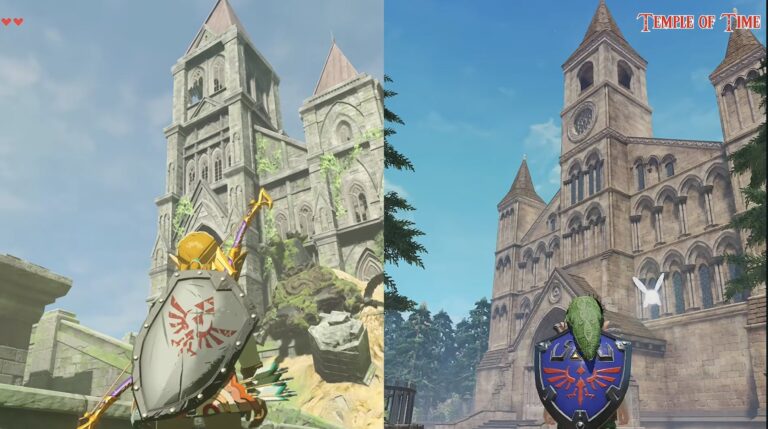
The video examines several shared locations, including the Temple of Time, Lake Hylia, Lon Lon Ranch, and additional sites. Beyond the graphical refinements that separate the Switch 2 version from its predecessor, the footage reveals a more subtle commitment: each location’s condition in Breath of the Wild appears to be a consequence of time’s passage since the events of Ocarina. Structures stand intact in the N64 era, then deteriorate across the thousands of in-world years separating the two games.
Architectural Evidence of a Shared World
The Temple of Time’s Decay
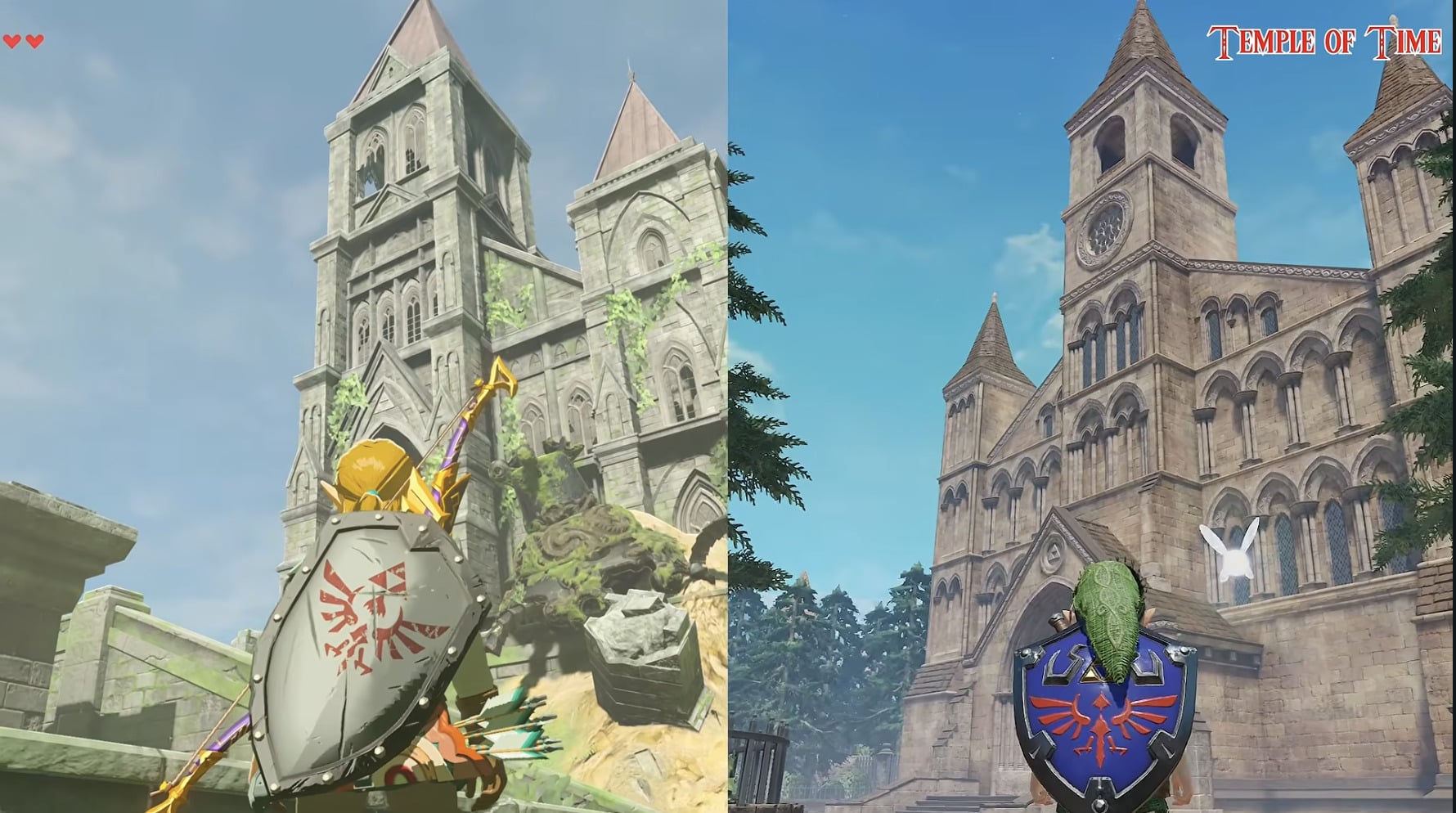
In Ocarina of Time, the Temple of Time is a complete structure. By Breath of the Wild, a significant portion of the facade has been stripped away as a consequence of calamity and centuries of weather. Yet the remaining geometry is recognizable. The interior layouts differ slightly, a divergence that could reflect restoration work or asset redesign, but the core footprint remains consistent. The temple demonstrates how architectural identity persists even as materials and decoration succumb to time. The Zelda franchise has for years relied on the Hyrule Historia and fan timelines to assert that games take place in one continuous world, but this visual parallel between two very different eras establishes the claim without requiring players to consult reference materials.
Death Mountain’s Transformation
Death Mountain presents an even starker change. In Ocarina, it rises as a prominent peak dominating the landscape. In Breath of the Wild, the same mountain has weathered into a much lower formation, worn down by geological processes over millennia. The comparison illustrates how the remake’s designers have considered the physical implications of time. Mountains don’t erode quickly, but in a fantasy world where thousands of years separate these two games, such transformation becomes plausible. The shift from an imposing peak to a worn nub reads as a natural progression rather than arbitrary redesign.
Lon Lon Ranch’s Abandonment
Lon Lon Ranch in Ocarina is an active location where Malon and Talon maintain their business. By Breath of the Wild, only scattered ruins remain, crumbling walls and overgrown structures suggesting decades or longer of abandonment. This progression tells a story without dialogue. Players who know the original understand what has been lost. Players encountering the locations for the first time in the remake can infer from the ruins’ appearance that this place once functioned as a home and workplace before something interrupted that life. The visual narrative emerges from architectural decline.
Why Visual Continuity Matters More Than Timeline Charts
The Zelda series has experimented with various methods to establish continuity. Character recurrence across games, through recurring characters, monsters, and NPCs, creates immediate recognition. The Hyrule Historia, an official chronology, settled many fan debates about when each game occurs relative to others. But visual continuity of locations strikes at something deeper. A player doesn’t need to study timeline charts or remembering character cameos to understand that the Temple of Time in Ocarina and the Temple of Time in Breath of the Wild are the same place. The architecture itself communicates the relationship.
This approach also accommodates the franchise’s willingness to alter, reinterpret, and reimagine its world across different games and eras. Locations can change appearance significantly, flooded in one timeline, volcanic in another, abandoned in a third, yet remain recognizable to players who return. The Ocarina remake, by placing these transformations in direct visual comparison, validates decades of lore while illustrating how the same world can sustain radically different gameplay experiences and narratives separated by in-world centuries.
The Remake’s Design Philosophy
The Switch 2 version appears to have adopted a specific constraint: upgrades in technology and art direction should enhance these existing parallels rather than obscure them. The graphical polish that separates this remake from Breath of the Wild is evident in lighting, geometry detail, and environmental clarity. Yet rather than using that power to create wholesale new designs, the developers have chosen to render recognizable spaces more precisely, allowing the original architectural logic to become clearer under scrutiny. Players comparing the two versions can see not just that locations are related, but specifically how structural elements have persisted or eroded.
This decision affects how the remake functions as both a standalone experience and a meditation on Zelda’s recurring world. Newcomers encounter a fully realized version of Ocarina’s Hyrule without needing external context. Veterans of the franchise, particularly those familiar with Breath of the Wild, gain an additional layer of meaning from recognizing how the locations connect. The side-by-side comparisons GameXplain compiled make explicit what the games themselves only imply: that the player is exploring the same geography across vastly different timescales and circumstances.
Expectations for Deeper Continuity
As players continue examining the Ocarina remake’s data files and environment design, speculation about additional connections to Breath of the Wild will likely intensify. Gaming communities have already identified content that may point to harder dungeon variants in future updates, along with emerging speedrunning techniques that exploit physics interactions. These technical discoveries exist separately from the thematic continuity the visual comparisons suggest, but both types of engagement feed interest in understanding how thoroughly the remake has reconsidered its relationship to recent Zelda history.
The video from GameXplain serves as documentation of an intentional design choice, not an accident of shared inspiration. The developers rebuilt Ocarina of Time with access to Breath of the Wild’s foundation, and the overlapping geography appears to be a deliberate expression of Zelda’s core assumption: that Hyrule, across its many incarnations, remains fundamentally one world, simply older or younger, richer or impoverished, peaceful or embattled, depending on which era players explore.
Source: Kotaku
Frequently Asked Questions
What locations does GameXplain compare in the video?
The video shows side-by-side comparisons of the Temple of Time, Lake Hylia, Lon Lon Ranch, and other shared locations between Breath of the Wild and the Ocarina of Time remake.
How has Death Mountain changed between the two games?
In Ocarina of Time, Death Mountain rises as a prominent peak dominating the landscape. By Breath of the Wild, it has weathered into a much lower formation after thousands of in-world years.
Why is visual continuity of locations significant for the Zelda franchise?
Visual continuity shows that Hyrule is the same world across games without requiring players to study timeline charts or character cameos, making the connection evident through architecture alone.
