
Key takeaways
- House House developed Big Walk from a one-week pandemic prototype focused on proximity voice chat and human connection.
- The team deliberately prioritized communication and expression over traditional gameplay mechanics in their design philosophy.
- An early cooperative tunnel-and-door challenge proved unsuccessful but convinced developers that puzzle design was essential to Big Walk.
- Big Walk evolved from a tool for pandemic-era friend gatherings into a Game of the Year contender after the team realized its commercial and artistic potential.
House House’s latest project, Big Walk, stands as a contender for Game of the Year recognition, and the developers wanted to discuss its creation in the most fitting way possible: by actually walking through the game itself. During a nearly 90-minute stroll through Big Walk’s island setting, Stuart Gillespie-Cook, Jake Strasser, and Nico Disseldorp—three of House House’s five full-time members—reflected on how a pandemic-era experiment in human connection evolved into a fully-fledged multiplayer experience.
The unconventional interview setting, conducted entirely within Big Walk’s world, revealed something fundamental about how the studio thinks about design. Rather than sitting across from one another in the sterile confines of a video call, the three developers wandered through their creation, occasionally waving their character’s arms around or picking up objects, creating an atmosphere far more intimate and natural than the standard developer interview.
From Pandemic Experiment to Playable Game
The One-Week Prototype
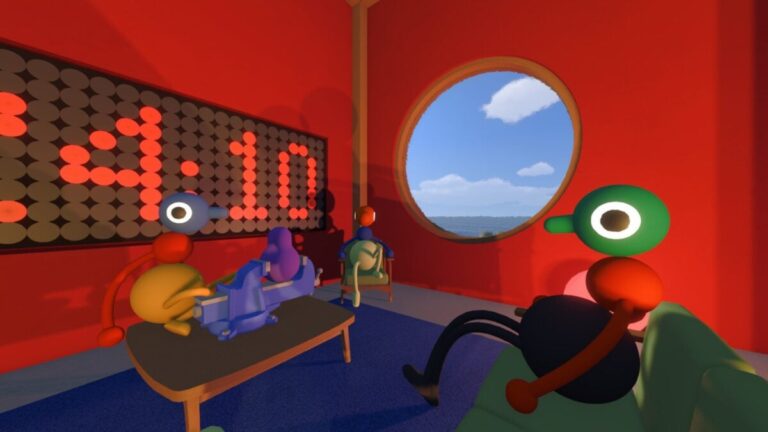
The genesis of Big Walk traces back to the early pandemic period, when House House seized on the opportunity to create something during lockdown. Within a single week, the team had built a functional prototype that established the game’s core direction. That first version featured a simple character model: three spheres arranged vertically with small arms and legs, topped with a duck-like face. “I think you looked pretty much like this,” Disseldorp recalled when asked about those early iterations. “You’re just like a model that jumped up and down.”
The prototype’s environment was deliberately sparse. Strasser and Disseldorp described it as essentially a blank terrain with physics objects scattered throughout. The real magic lay not in visual sophistication but in the mechanics that made togetherness essential. Proximity-based voice chat meant players could only hear teammates if they were physically close to one another in the game space. “You’d walk around and make sure you were staying together and making sure no one got too far ahead,” Disseldorp explained. “If you started running off, you’d have to really turn around and say, like, ‘Is everyone here? One, two, three. Okay.’”
The Shift From Concept to Commercial Product
What began as a potential tool for staying connected with friends evolved gradually into something far larger. Neither the developers nor House House initially conceived of Big Walk as a commercial project. Gillespie-Cook stated plainly: “I think the idea that we were going to sell this to people was way later.” The team’s immediate goal was simpler—if they could polish the prototype enough, perhaps they could host a small gathering with friends within a month.
That modest ambition shifted when the potential of the concept became clear. For Gillespie-Cook, one particular use case crystallized the vision: Zoom birthday calls where everyone talks over one another in absolute chaos. If Big Walk could recreate the social dynamics of physical gatherings by allowing people to naturally break into smaller conversations or step away from the main group, it would address a genuine problem of pandemic-era remote connection.
Visual Design and Setting Evolution
Inspiration From Isolated Landscapes
The original terrain drew inspiration from the Faroe Islands, located north of the UK. The team discussed how these small, isolated islands seemed ideal for a game world—limited in size yet visually striking. There were even discussions of a particular location that resembled (or possibly was) Icelandic musician Bjork’s residence, though that detail remained somewhat uncertain even to the developers themselves. “Imagine the kind of place where Bjork would live,” Gillespie-Cook suggested, “and that’s where the first game took place.”
However, the team quickly realized that expanding beyond a single Faroe Islands setting made sense. “We very quickly realized that we wanted to make something that was more local and responded to things we knew about more,” Strasser said. This shift toward familiar environments proved crucial. Coming off the success of Untitled Goose Game, which had its own specific geographical inspiration, House House felt drawn to exploring their own surroundings rather than distant, exotic landscapes.
From Reference to Final Aesthetic
The actual photogrammetry of Big Walk’s final environments came together through the team’s decision to ground the game in places meaningful to them. Michael McMaster, House House’s member responsible for aesthetics (and not present during the interview), helped shape the game’s distinctive visual character alongside the three developers in the conversation.
The Philosophy of Proximity and Communication
Designing for Connection Over Complexity
When the team began adding depth to Big Walk beyond the initial prototype, they made a deliberate choice about what mechanics would matter. Rather than focusing on traditional game systems, Disseldorp articulated the revelation that changed their approach: “If you don’t have something else to do and you’re really just focusing on the people you’re playing with, then you can put in things like hand movements and waves and picking people up. And rather than it feeling like added noise, it’s something that you really pay attention to and can feel really intimate.”
This insight drove every subsequent design decision. The scale of interaction became paramount. With players constantly making eye contact and noticing minute details of one another’s character animations, the verbs available to players shifted toward expression and communication rather than traditional gameplay mechanics. Hand gestures, picking up other players, waving—these seemingly simple animations carried tremendous weight because the game created space for players to actually observe and react to them.
Layering Communication Methods
As the team developed Big Walk, they introduced multiple communication layers. Proximity voice chat remained foundational, but they added radios and other tools to expand how players could interact at varying distances. Disseldorp explained the intentionality behind these additions: “We’re putting in radios and things like that, as you want to do if you’re making a proximity voice chat game. But also these bodily communication styles and stuff as well.”
By the time the developers had established this communication-focused philosophy, they felt they had created something “rich enough” to build challenges around.
Challenge Design and Puzzle Philosophy
The Evolution of Cooperative Obstacles
The first formal challenge House House created didn’t survive to the final game. That early design featured a tunnel-and-door mechanic where one player had to navigate through a tunnel while their teammate opened doors to let them through. “It was just like real basic co-op stuff,” Disseldorp remembered. Gillespie-Cook recalled the moment they decided to formalize challenges: “I remember making a first challenge. I remember making that gauntlet.”
Strasser wasn’t convinced the early version worked. “It was un-fun,” he stated bluntly. Despite the scrapped challenge, the team had proven that players wanted obstacles to overcome together. This realization kept them committed to expanding the game beyond mere walking and talking, developing a puzzle and challenge framework that would ultimately define Big Walk’s structure.
Looking at Big Walk’s Place in Gaming
House House’s three developers—Gillespie-Cook, Strasser, and Disseldorp—have built something genuinely unusual in the multiplayer space. By prioritizing authentic human connection and communication over traditional gameplay mechanics, Big Walk offers an alternative vision for how cooperative games can function. The decision to conduct this interview within the game itself, walking through its forests and riding its trains, felt entirely appropriate for a project so fundamentally about presence, observation, and togetherness.
With Kalonica Quigley joining as the studio’s first new employee after Untitled Goose Game, bringing the team to five full-time members, House House expanded its capacity to realize larger visions. Big Walk represents the fruit of that growth—a game born from pandemic isolation that transforms the experience of connection into its central mechanic.
Frequently Asked Questions
What was the original prototype of Big Walk like?
Within one week, House House created a simple prototype featuring a character model made of three spheres with arms, legs, and a duck-like face, placed in blank terrain with physics objects and proximity-based voice chat.
How did House House decide on the game's visual setting?
The team initially drew inspiration from the Faroe Islands, but eventually chose to base Big Walk on more familiar, local environments that the developers knew personally, rather than distant, exotic landscapes.
What was House House's original goal for Big Walk?
The developers initially saw Big Walk as a tool for staying connected with friends during the pandemic, with the modest goal of hosting a small gathering within a month, rather than as a commercial game product.
