
Key takeaways
- Elite Force 2 originally featured a shuttle crashing into Starfleet Academy before 9/11 forced developers to abandon the scene entirely.
- Both Elite Force 2 and Grand Theft Auto 3 were forced to redesign content mid-production due to their release timing relative to September 11.
- Rockstar's GTA 3 cover art redesign—made in response to 9/11—became the visual template for all subsequent Grand Theft Auto covers, including GTA 6.
- Despite commercial disappointment at release, Elite Force 2 became a fan-favorite by maintaining solid game design and respectful Star Trek storytelling despite narrative cuts.
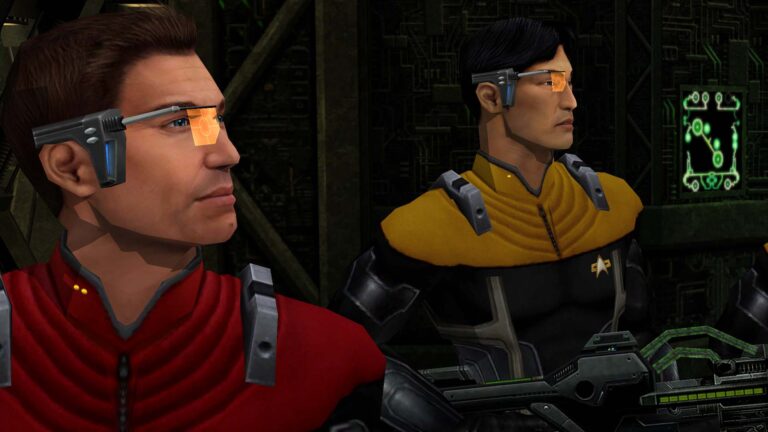
Star Trek: Elite Force 2 stands as a peculiar footnote in the first-person shooter landscape, arriving on PC in June 2002 with a fundamentally altered vision from what its developers originally conceived. The game proved a commercial disappointment upon release, yet it has ascended to the status of fan-favorite within the Star Trek gaming community, prized for its intelligent level design, environmental puzzle-solving, and respect for the franchise’s universe. This unlikely rehabilitation owes much to the quality of its underlying design—but that design itself was substantially compromised by real-world events that forced developers to reshape the narrative mid-production.
The revelation emerged recently through an interview between Benson Russell, who held the position of lead scripter and level designer on Elite Force 2, and the gaming outlet FRVR. Russell detailed how the September 11, 2001 terrorist attacks forced a comprehensive rethinking of the game’s opening sequence and major plot elements, resulting in cuts and rewrites that fundamentally altered the player’s introduction to the campaign.
The Original Vision: Starfleet Academy Under Siege
What Developers Planned
The initial concept for Elite Force 2 positioned the campaign’s opening at Starfleet Academy, the Federation’s flagship institution for training Starfleet officers. Rather than a peaceful training scenario, the Academy was designated for an attack sequence that would serve as the dramatic catalyst for the entire storyline. This choice followed a common game design principle: establish stakes immediately, place the player in a position of disadvantage, and escalate the tension from there.
The Shuttle Collision Concept
The specific mechanism for this attack represented the element that became untenable. According to Russell, one of the original scenes involved the Academy coming under assault, with a shuttle flying into a building as part of the sequence. The image was direct and visceral—a spacecraft crashing into Academy architecture, creating an emergency that would force players into combat and defensive positions throughout the grounds.
In the context of science fiction, this concept presented no inherent problems. Star Trek’s universe regularly features starship destruction and dramatic aerospace accidents. The scenario would have been narratively coherent and thematically consistent with the franchise’s willingness to depict large-scale conflict.
The Timing Problem
Everything changed when the September 11 attacks occurred in 2001. Elite Force 2 was approximately nine months away from release when news of the attacks spread. The timing created an impossible situation for the developers: they possessed a near-complete game featuring exactly the imagery—large aircraft impacting structures—that had just caused real-world devastation and thousands of deaths.
The Decision to Revise
Why the Scene Had to Go
The response was inevitable. According to Russell, the decision to remove the material was straightforward: it was simply a no-no for understandable reasons. The decision reflected not censorship or excessive caution, but genuine cultural awareness. Players would encounter the opening sequence fresh from a world still processing a national tragedy. A game that depicted shuttle-into-building collisions, no matter the fictional context, would have felt tone-deaf at best and exploitative at worst.
Reworking Rather Than Deleting
Rather than simply removing the sequence and shipping a fragmentary opening, the developers chose the more labor-intensive path: reworking the Starfleet Academy sequence entirely. This meant new dialogue, reimagined cutscenes, alternative triggers for the emergency situation, and narrative adjustments to ensure the campaign remained coherent and impactful. The alternative—shipping Elite Force 2 with a visibly truncated opening—would have created narrative gaps and frustrated players aware of what was removed.
Broader Industry Upheaval: When Real-World Events Forced Creative Changes
Grand Theft Auto 3’s Precarious Release
Rockstar Games faced an even more immediate crisis. Grand Theft Auto 3, the groundbreaking open-world game that redefined the franchise and the entire genre, was scheduled for October 2001 release—arriving just weeks after September 11. The game’s setting was Liberty City, a meticulously detailed fictional version of contemporary New York City, rendered with unprecedented fidelity for the time. Rockstar had invested enormous creative and technical effort into making Liberty City feel authentic and lived-in.
The attacks forced rapid recalculations. Police vehicles in the game had originally been designed to resemble actual NYPD cruisers, following Rockstar’s commitment to New York authenticity. These were redesigned to appear more generic, distancing the game from real-world police forces. Other elements were similarly adjusted to prevent the game from feeling like a direct simulation of post-9/11 New York City.
How a Cover Art Decision Shaped Twenty-Five Years of Design
Perhaps the most lasting consequence involved GTA 3’s box art. Rockstar had developed a cover design for the North American release before the attacks occurred. Following September 11, the company made the decision to use different cover art for American distribution, while the European release proceeded with the originally planned design. The alternative cover that shipped in North America featured a grid-based, minimalist aesthetic that ultimately proved so visually striking and distinctive that it established the template for every Grand Theft Auto cover that followed.
That decision, made in late 2001 as a cautious response to cultural context, calcified into franchise identity. Every subsequent GTA game adopted variations of the grid-based design. The pattern continues unbroken: Grand Theft Auto 6, the upcoming entry expected to release later in the decade, maintains that same grid-based cover design philosophy established more than two decades earlier in response to 9/11.
Elite Force 2’s Path to Retrospective Appreciation
Commercial Failure, Cult Success
Upon its June 2002 release, Elite Force 2 disappointed in commercial terms. Sales figures trailed expectations, and the game received less industry attention than its predecessor. Yet within the dedicated Star Trek gaming community, the game gradually developed genuine appreciation. Players recognized that despite narrative compromises and a mid-production redesign, the core game design remained solid and engaging.
Technical Foundation and Authentic Voice Work
The game ran on id Tech 3, the robust engine that powered Quake III Arena and Return to Castle Wolfenstein. This technical foundation provided the responsiveness and performance that FPS enthusiasts expected. More remarkably, Elite Force 2 secured Patrick Stewart to reprise his role as Captain Jean-Picard, delivering voice work for the campaign. While the character models featured the low-polygon aesthetic typical of 2002, Stewart’s authoritative voice work lent weight and authenticity that elevated the narrative experience substantially.
Puzzle-Solving and Franchise Respect
What ultimately sustained Elite Force 2 among players was its commitment to intelligent design. The game balanced action sequences with environmental puzzle-solving and character-driven moments. Rather than pure combat, players spent significant time exploring environments, finding solutions to obstacles, and engaging in dialogue that respected Star Trek’s intellectual tradition. These design elements proved resilient enough to survive the narrative compromises imposed by historical circumstances.
The Lessons Games Teach About Adapting to Reality
When external real-world events force mid-production changes, developers face a stark choice: delay and redesign comprehensively, or ship a revised version on schedule. Raven Software and Activision, like Rockstar Games, chose the latter path. Both studios maintained their fundamental vision while removing or reframing specific elements that had become culturally inappropriate. The results diverged markedly: Grand Theft Auto 3 became a landmark commercial and critical success that transcended its compromises, while Elite Force 2 struggled initially before finding appreciation.
Yet Elite Force 2’s trajectory suggests something important about game legacies. A game’s opening-week commercial performance does not determine its ultimate place in player memory or gaming history. Elite Force 2 persists as a fan-favorite precisely because the underlying experience—the puzzle design, the action mechanics, the dialogue, the respect for Star Trek canon—remained intact even as the introductory narrative required restructuring. In retrospect, the game demonstrates that creative resilience and technical competence matter more than whether developers can preserve every element of their original vision.
Frequently Asked Questions
What was the original opening sequence of Star Trek Elite Force 2?
The original opening at Starfleet Academy featured a shuttle flying into a building as part of an attack sequence, but this entire scene was reworked due to 9/11 occurring during development.
Why did 9/11 force changes to both Elite Force 2 and Grand Theft Auto 3?
Both games released within months of September 11 and featured imagery of aircraft or vehicles impacting buildings, which became culturally inappropriate given the real-world tragedy.
How did Grand Theft Auto 3's cover art change affect the franchise?
Rockstar's alternative North American cover featuring a grid-based design became so iconic it established the template for every subsequent Grand Theft Auto release, including the upcoming GTA 6.
