
Key takeaways
- A Walmart banana shortage erupted when players used the fruit as a discount workaround for Fire Emblem: Fortune's Weave after a promotional code malfunctioned.
- Physical copies sold out across retailers despite being $10 more expensive than the discounted digital version.
- The launch raises questions about whether Nintendo underestimated Switch 2 demand or intentionally limited physical game inventory.
Fire Emblem: Fortune’s Weave launched this week as Nintendo Switch 2’s first major exclusive title for the fall season. The strategy RPG marks the franchise’s debut on the new hardware and continues the long-running series for a fanbase often described as having ride-or-die devotion. Yet the story that defined its release had nothing to do with tactics, storylines, or gameplay innovations. Instead, a viral retail promotion turned the game’s launch into an inventory crisis involving bananas.
The Walmart Promotion That Started Everything
Wario64, a Twitter/X account functioning as an informal wire service for gaming deals and promotional opportunities, shared news of an active Walmart promotion: $10 off digital and physical game orders when customers selected online pickup or delivery. For the $70 digital edition of Fire Emblem: Fortune’s Weave, this represented roughly 15 percent savings. Wario64 generates revenue through affiliate links and promotional sharing, making the aggregation of discount codes central to how the account operates and maintains influence within the gaming community.
How the $10 Discount Works
The promotion appeared straightforward: apply the discount code at checkout for Walmart’s Fire Emblem: Fortune’s Weave orders placed for online pickup or delivery. The savings applied cleanly for some customers but encountered technical blocks for others. No clear pattern determined who would successfully redeem the promotion and who would face rejection from the system, making the discount unreliable for consumers attempting to plan their purchases.
When the Code Fails
Wario64 acknowledged that the discount code didn’t work consistently. He suggested a primary workaround: switching the delivery method from digital to in-store pickup sometimes bypassed the system blocks preventing the code from activating. But he offered a second option that quickly became the focus of the launch week narrative.
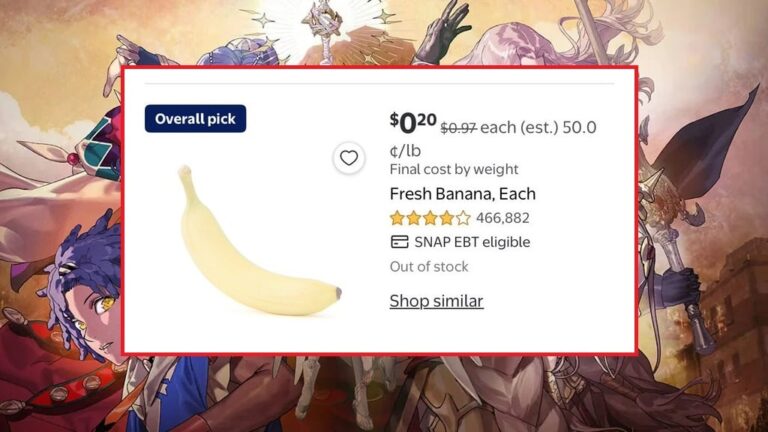
If pickup didn’t work, he recommended adding a banana to the order. Not metaphorically—a literal piece of fruit from Walmart’s produce section, purchased through the same online order and shipped alongside the game. According to Wario64’s own experience with a similar code (FAST30), this method actually worked. He provided a direct link to Walmart’s single-banana listing to eliminate any friction from the process, making it easy for followers to attempt the workaround.
The Banana Hack
The suggestion seemed almost absurdist: players needed to add unrelated produce to their game purchases to unlock a discount intended to work without such complications. Fire Emblem’s dedicated fanbase tested it anyway, and the results transformed the suggestion into launch-week legend.
An Absurd Solution Takes Off
The banana workaround actually worked for enough people that it became a launch-week phenomenon. Screenshots and social media posts proliferated showing Fire Emblem: Fortune’s Weave copies positioned next to bananas—photographic documentation that players had purchased fruit purely to unlock a discount on something entirely different. The absurdity resonated with the gaming community, and the images spread widely across social platforms, transforming the banana shortage from a hypothetical edge case into a real retail event unfolding in real time.
Unexpected Retail Consequences
The practical result was swift: Walmart’s online inventory for single bananas became depleted. The item now displays as out of stock for online shipping, a fact multiple players and industry observers documented. Physical retail locations maintained normal fruit inventory, so in-store banana availability remained unaffected. The shortage existed only in the online fulfillment system, yet it happened nonetheless—evidence of how densely concentrated online gaming communities can focus consumer behavior toward unexpected targets when given a clear incentive and a novel solution.
Physical Copies Vanish Across Retailers
While the banana shortage captured attention and became the launch’s defining cultural moment, a more significant inventory event unfolded in parallel. Fire Emblem: Fortune’s Weave physical cartridges became scarce across major retailers with unexpected speed. The game carries an $80 price tag for the boxed version. Despite Walmart’s promotion pushing the digital edition lower and making it the more economical choice, players apparently chose to pay the premium for the physical cartridge. At Walmart, the game displays as “Low Stock” on its website. Amazon experienced multiple out-of-stock episodes spanning from launch day through the present, with availability fluctuating as inventory shifts between restockings.
Supply Constraints or Underestimation?
The critical question underlying these shortages is whether Fire Emblem: Fortune’s Weave experienced unprecedented consumer demand or whether Nintendo simply manufactured physical copies at conservative volumes. The distinction carries substantial implications for understanding market trends and planning future hardware launches.
The Pokémon Pokopia Precedent
A similar situation occurred with Pokémon Pokopia, which faced pronounced difficulty for consumers attempting to obtain physical copies during its launch month. Those initial shortages eventually subsided as retailers received fresh inventory, suggesting the limitation was production volume rather than permanent market saturation. Fire Emblem: Fortune’s Weave might follow an identical trajectory if Nintendo had underestimated demand and manufactured accordingly.
The alternative explanation suggests Nintendo manufactured physical copies at levels matching historical demand patterns, and that Fire Emblem: Fortune’s Weave simply exceeded those projections. The coming weeks will likely clarify which scenario applies: rapid restocking would indicate underestimation of sales potential, while gradual inventory replenishment would suggest sustained demand pressing against existing supply constraints.
What This Launch Reveals About Physical Gaming
The broader significance extends beyond a single game or retailer’s logistics. The gaming industry has anticipated declining physical sales for over a decade. Digital distribution offers convenience, eliminates manufacturing costs, and removes purchasing friction. Yet Fire Emblem players demonstrated a willingness to pay $80 for a physical cartridge instead of $70 for a discounted digital copy. Some of those same players added a banana to their order solely to access the discount, a choice reflecting the persistence of physical media appeal for certain market segments despite industry predictions of digital dominance.
Wario64’s influence in orchestrating this moment deserves recognition. The account’s reach translated a single suggested workaround into a retail event that reshaped inventory across one of North America’s largest retailers. The banana shortage became the defining cultural moment of Fire Emblem: Fortune’s Weave’s opening week, overshadowing conventional launch coverage and demonstrating how concentrated online communities can focus purchasing behavior when given a clear incentive and an unexpected solution.
Frequently Asked Questions
Why did a banana shortage happen at Walmart?
Wario64 suggested adding a banana to orders as a workaround when the $10 Walmart discount code wasn't working properly on Fire Emblem: Fortune's Weave purchases, and enough players followed the advice that online banana inventory depleted.
How much more expensive are physical copies compared to digital?
Physical copies cost $80, while the digital version costs $70. A Walmart promotion offered $10 off qualifying digital orders, reducing the price to $60 for customers who could successfully apply the code.
What does this shortage tell us about physical game sales?
Despite industry predictions of digital dominance for over a decade, Fire Emblem players chose to pay a premium for physical cartridges, suggesting physical media still holds significant value for a meaningful portion of the gaming market.
