
Key takeaways
- At least 10 clones of Needle in a Haystack Simulator appeared on Steam within days of the original's viral reveal, which garnered over 50 million views on Twitter.
- The original developer was forced to add a red box to their Steam key art and explicitly label the game as "the one and only" to distinguish it from clones.
- AI-generated games and rapid cloning are becoming a systemic problem across Steam, affecting player discovery and creating advantages for speed over originality.
- Other viral games like Meccha Chameleon and Librarian: Tidy Up the Arcane Library have faced similar clone invasions, suggesting a broader pattern requiring platform intervention.
In August 2026, a video clip of an unnamed incremental game called Needle in a Haystack Simulator accumulated over 50 million views on Twitter. The premise was straightforward: players search through a haystack to find a single needle, a deliberately tedious task wrapped in the mechanics of an idle sim. What began as a viral moment has since exposed a growing problem on Steam’s storefront—within days of the original’s reveal, at least ten clones bearing nearly identical names began appearing on the platform.
The Clone Invasion
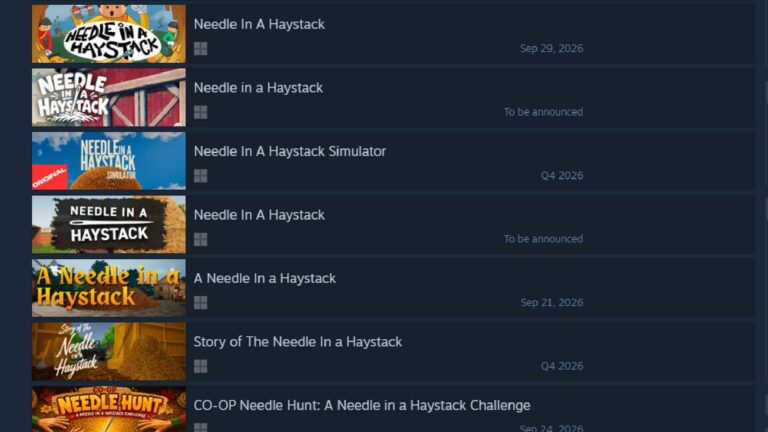
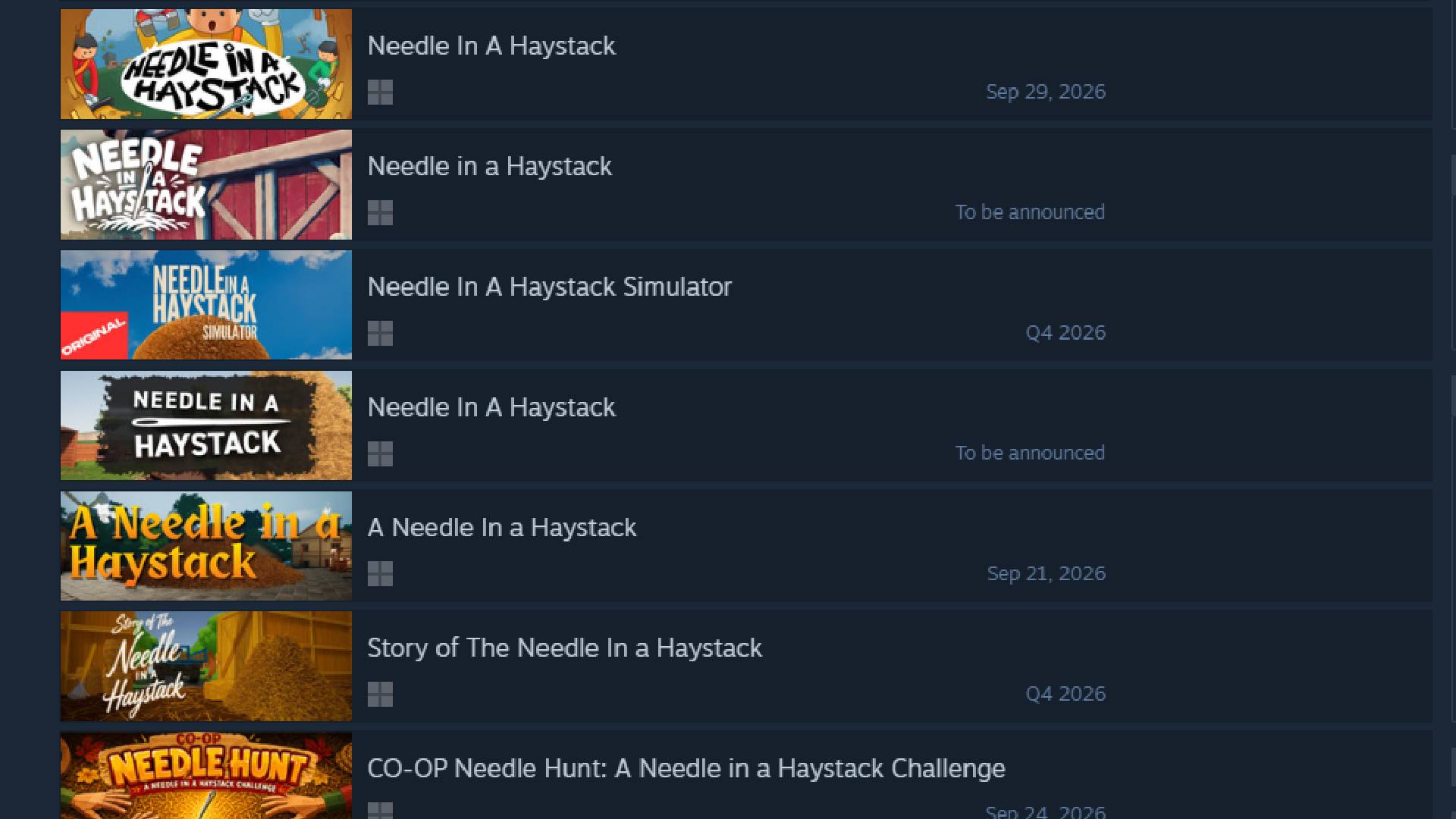
Reddit user Final_Narwhal_2557 documented the rapid proliferation of copycat titles flooding Steam in the wake of Needle in a Haystack Simulator’s viral success. The clones arrived with minor variations on the original’s name: A Needle in a Haystack, CO-OP Needle Hunt: A Needle in a Haystack Challenge, Story of The Needle in a Haystack, and Needle in a Million Haystacks were among the earliest. Others took slightly different approaches, such as Hay! One Billion! and Find the Needle, bringing the total count past ten copies for a game that won’t release until Q4 2026.
Speed of Replication
The clones arrived with remarkable speed. Some are scheduled for release before the original game itself, suggesting developers prioritized rapid deployment over any meaningful differentiation. A review of each clone’s Steam page reveals virtually no variation from the original formula—the core gameplay loop remains unchanged, with only cosmetic adjustments separating them from one another.
AI’s Fingerprints
While most clone listings lack AI disclosures, several display visual markers consistent with AI generation—logos that carry what has become recognizable as “ChatGPT sheen.” The speed at which these games reached Steam, combined with their visual presentation, strongly suggests AI played a central role in their creation, though definitive proof remains absent from the public record.
A Broader Pattern Across the Platform
Needle in a Haystack Simulator is far from the first game to face this treatment. Meccha Chameleon, which became a surprise hit, continues to spawn copies that replicate its core mechanics with only minor aesthetic changes—some swap player models for animals, while others add features that appear designed purely to create separation from the original rather than serve any gameplay purpose. Similarly, Librarian: Tidy Up the Arcane Library!, the cozy organization game that already drew controversy over AI involvement in its creation, triggered a flood of organization-themed AI-assisted games across Steam’s library.
Scale of the Problem
The proliferation extends beyond individual titles. Steam Next Fest, the platform’s showcase event for upcoming games, has become inundated with what observers describe as “AI slop”—a growing volume of algorithmically generated or minimally modified games designed to capitalize on viral trends rather than offer genuine creative work. The volume of releases has reached a point where discovering original games has become increasingly difficult for players navigating the storefront.
Impact on Developers and Discovery
The original developer of Needle in a Haystack Simulator was forced into an unusual defensive position. To distinguish their game from the wave of clones, they added a prominent red box to the game’s Steam key art. The game’s description now includes a statement declaring it “the one and only,” a visual and textual shield against consumer confusion. Such measures represent a burden on legitimate developers that should not exist.
Friction for Legitimate Players
For players seeking the genuine article, the clone problem transforms a straightforward search into a task that mirrors the game’s premise—sorting through a haystack to locate the original needle. The red box and explicit labeling provide some guidance, but only after a player has already navigated past multiple fake entries, each designed to occupy search real estate and create confusion.
The Absence of Platform Guardrails
Steam’s curation model, which permits vast quantities of content onto the platform with minimal upfront filtering, enables this dynamic. The clones occupy digital shelf space, pollute search results, and fragment the audience for original work, yet face no systematic barrier to publication. The platform’s reliance on user reviews and community flagging creates a reactive rather than proactive system for managing duplicate or derivative content.
Steam’s Next Steps
The scale of the cloning problem has prompted calls for Steam to implement policies that would prevent or significantly restrict the republication of games using nearly identical mechanics and naming conventions. Without intervention, the phenomenon appears set to worsen rather than resolve, as the low barrier to entry and high visibility of viral games create ongoing incentive structures that reward rapid, low-effort replication.
The Role of Incentives and Technology
The ease with which clones can be generated, combined with the financial motivation to capitalize on viral moments, creates a system fundamentally tilted toward reproduction. AI tools that can rapidly produce game assets, boilerplate code, and marketing materials have lowered the technical and creative barriers to game publishing to historic lows. A developer with minimal skills or resources can now generate functional game builds in hours rather than months, then upload them to Steam and begin marketing before most players have even heard of the original.
The resulting ecosystem punishes originality and rewards speed, a dynamic that disadvantages smaller independent developers and legitimate creators who invested time in the original concept. Needle in a Haystack Simulator’s creator did not invent a complex game—the appeal is its simplicity and the audacity of its premise. Yet that very simplicity makes it trivial to copy, and the viral attention that should have been their asset becomes instead a liability as search algorithms and storefront recommendations become cluttered with alternatives.
What Comes Next
The situation remains unresolved. Needle in a Haystack Simulator’s arrival in Q4 2026 will provide a test case for whether the original can maintain player interest and sales despite the clone competition it now faces. The broader implications for Steam’s marketplace and the discovery experience of its users remain an open question. As more games go viral and the speed of cloning accelerates, the platform will face increasing pressure to establish clearer policies around derivative content, AI-assisted releases, and the protection of original creative work from rapid reproduction.
Frequently Asked Questions
What is Needle in a Haystack Simulator?
It's an incremental sim game where players search through a haystack to find a single needle. A video clip of the game went viral in August 2026 with over 50 million views on Twitter. The original is scheduled to release in Q4 2026.
How many clones appeared on Steam and how quickly?
At least 10 clones appeared on Steam within days of the original's viral reveal in late August. Some clones are scheduled for release before the original game itself.
What role did AI play in creating the clones?
While most clones lack explicit AI disclosures, several display visual characteristics consistent with AI generation, and the rapid speed of their creation suggests AI tools were involved in their development.
