
Key takeaways
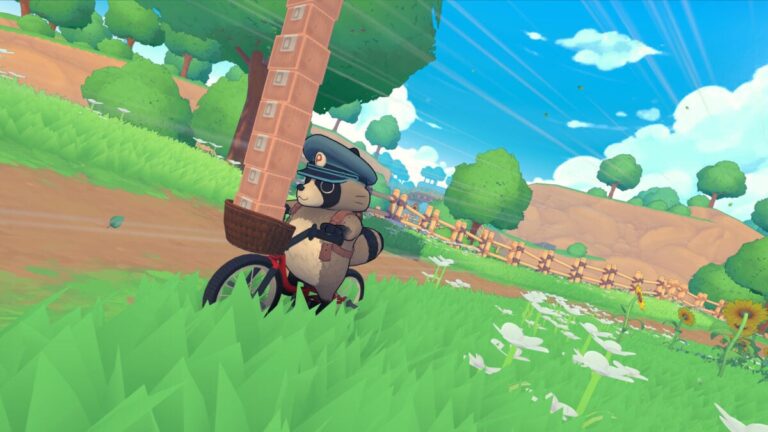
- Tanuki: Pon's Summer casts players as a tanuki mail carrier on a BMX bike who must restore a shrine by summer's end through a combination of delivery puzzles and exploration.
- The game blends Tetris-style package packing, Tony Hawk's Pro Skater-influenced trick challenges, and side activities like photography and bartending that deemphasize obligation.
- While set in rural Japan with a tanuki protagonist, Pon's Summer captures the universal feeling of unstructured childhood summers and reclaims that freedom for adult players.
- A free demo on Steam lets players experience Pon's adventures before the full game releases.
Tanuki: Pon’s Summer follows a straightforward premise: a tanuki named Pon works as a mail carrier in a rural Japanese town, and his mission for the season is straightforward—earn enough money to restore a local shrine before summer ends. The vehicle for this character study, quite literally, is a BMX bike. The gameplay loop, when described in its component parts, sounds almost mundane. Yet the demo available on Steam and previously shown at PAX West reveals something more textured than the surface suggests: a game fundamentally about recapturing the particular freedom of unstructured childhood summers.
Pon doesn’t move through his town with urgency. There are no timers. Deliveries must eventually reach their recipients, but the route between pickup and dropoff exists as open territory for exploration. The bicycle serves as both practical transportation and invitation for meandering, allowing players to treat the environment not as a level to complete but as a space to inhabit.
The Package-Sorting Puzzle
Tetris Logic in Mailbag Form
Each day begins with a Tetris-style puzzle. Pon must collect an assortment of parcels and fit them into his backpack using spatial reasoning. The constraint is genuine—each package has a distinct shape, and the goal is to arrange them so all fit without overflow. This isn’t busywork; it’s an actual puzzle layer that requires planning and sometimes trial-and-error before Pon can depart on his route. The satisfaction of sliding the final package into place, discovering that every item somehow compresses into the available space, provides a small but genuine victory before the day’s deliveries even begin.
Delivery as Permission to Explore
Once Pon leaves the post office, the actual delivery work becomes the framework rather than the cage. He must visit addresses, hand off packages, and generally move through the town in ways that satisfy the day’s requirements. But nothing prevents him from taking scenic detours, investigating areas not strictly necessary for the route, or spending extended time in specific locations. This design philosophy—using objectives as permission to explore rather than constraints that limit exploration—forms the emotional bedrock of what makes Pon’s Summer resonate.
BMX Bikes and Trick Culture
Tony Hawk’s Influence on Obstacle Design
The BMX bike isn’t merely transit; it’s an athletic tool for a series of trick-based challenges scattered throughout the town. Ramps, rails, and open spaces invite players to attempt specific objectives: ride through checkpoints within a time limit, accumulate a particular trick score in a set window, or simply experiment with manual wheelies. The design language here borrows openly from Tony Hawk’s Pro Skater, complete with point-based scoring and difficulty tiers that reward technical execution. A player can ignore these challenges and simply cruise, or dedicate time to mastering the hardest ones.
Endearing Incompetence as Design
The visual incongruity of a round tanuki attempting BMX tricks produces comedy without requiring obvious punchlines. Pon’s struggles with the bike—his frequent failures at performing techniques that players themselves struggle to master—create unexpected resonance. The townspeople find his efforts amusing, which frames his imperfection not as failure deserving punishment but as charm deserving attention. When Pon wipes out attempting a wheelie, the game validates that moment as entertaining rather than punishing it as a mistake.
A Town Full of Interruptions
Post office work provides structure, but the game’s heart lies in its digressions. Pon can assist a photographer whose creativity has stalled, documenting specific subjects around town for his portfolio. At a local pub, Pon learns bartending through a minigame requiring precision—pouring beer to exact specifications, ensuring each customer receives the perfect foam-to-liquid ratio. These activities feel organically embedded in the community rather than bolted-on content. Crucially, none are mandatory. Pon can complete his mail route and move on, or he can linger, helping townspeople with assorted problems and absorbing the rhythms of daily life in a small Japanese village.
Childhood Nostalgia Across Borders
Common Ground With Boku no Natsuyasumi
Pon’s Summer occupies the same emotional terrain as Boku no Natsuyasumi and Yo-Kai Watch—games capturing the texture of childhood summers in rural settings. These games understand that the specificity of cultural context doesn’t prevent universal emotional resonance. A child raised in rural America exploring backyard “woods” and creeks experiences something deeply similar to a Japanese child doing the same, even if the details differ. Pon’s Summer bridges this gap not through exact cultural replication but through thematic fidelity to the feeling of extended, unstructured time in a small community.
Adult Foreclosure of Summer Freedom
The particular freedom characterizing childhood summers largely disappears in adulthood. Structured employment replaces open time. Bicycles become exercise rather than transport. Exploring yards and fields that don’t belong to you becomes legally precarious or simply impossible. The freedom to fail, to move without purpose, to stop and absorb a moment—these particular textures of childhood vanish for most people by adulthood.
Pon’s Summer functions partly as a vessel for recovering this emotional experience. The game permits aimlessness. A player can spend time riding in circles, falling repeatedly, wandering without destination, and facing no penalty. The cycling itself becomes the point, not the arrival.
The Tanuki as Proxy
The choice to star a tanuki rather than a human might seem to distance players from the experience, yet it ultimately enhances the game’s emotional accessibility. By removing literal species kinship, the game invites players to project their own childhood memories onto Pon’s actions. The tanuki’s awkwardness at BMX tricks, his willingness to help townspeople, his desire to accomplish something meaningful within a summer-bound timeframe—these are universal rather than species-specific. The Japanese setting, similarly, provides cultural texture without demanding Japanese childhood as prerequisite for emotional understanding.
Experiencing Pon’s Summer Now
The free demo on Steam provides genuine hands-on access to these mechanics and themes. The PAX West showing introduced early players to the experience, but the persistent demo democratizes that opportunity for broader audiences. Players can verify whether the game’s promise of recaptured summer freedom actually resonates on a personal level before committing to the full release.
Frequently Asked Questions
What is the main objective in Tanuki: Pon's Summer?
Pon works as a mail carrier and must earn enough money to restore a local shrine before the end of summer, though how he spends his days between deliveries remains up to the player.
What are the main gameplay mechanics?
The game combines Tetris-like package management for daily mail routes, BMX biking with Tony Hawk's Pro Skater-style trick challenges, and side activities like photography and bartending for townspeople.
Where can players access the game?
A free demo is available on Steam, and the game was previously playable at PAX West.
