
Key takeaways
- Niu Lai, a $200 animated film by Xin Yumeng and Sun Lifang, earned 4 million at the Chinese box office with a 20,000x return on investment, ranking among the most profitable films ever made.
- The film went from selling 300 initial tickets and circulating as pirated bootlegs to mainstream box office success after theaters hand-drew promotional materials and grassroots marketing took hold.
- Audiences embraced Niu Lai's intentionally crude, handmade aesthetic as an alternative to AI-generated content, valuing authentic creative effort by real people over algorithmic output.
- Niu Lai's success contradicts Hollywood's trend-chasing strategy of greenlighting franchises and sequels, demonstrating audiences will support independent, low-budget creative efforts with no pre-existing intellectual property.
Niu Lai, roughly translated as “Here Comes The Cow,” has become a case study in unexpected commercial success. The animated feature, created by mother and son duo Xin Yumeng and Sun Lifang, cost exactly $200 to produce—a figure that would barely cover a birthday dinner. Yet the film has generated four million at the Chinese box office, achieving a return on investment of 20,000 times its original budget, making it one of the most profitable films ever produced.
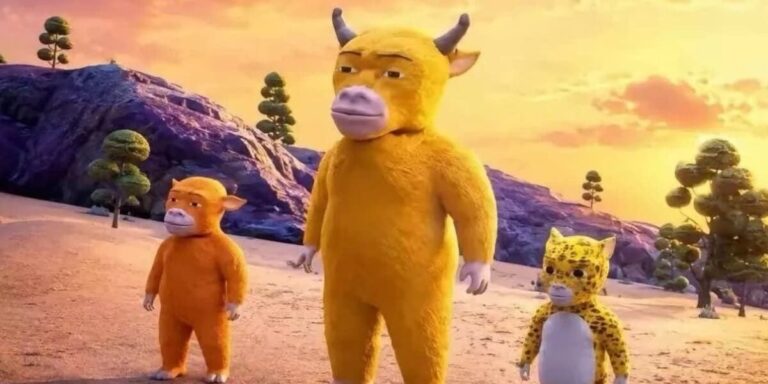
The narrative follows a timid calf separated from his family, navigating dangers and trials on his journey home while discovering courage along the way. The story itself contains the basic elements of a redemptive hero’s arc. But the execution immediately sets Niu Lai apart. The animation carries the rough, unpolished aesthetic comparable to Rapsittie Kids, the 1997 Microsoft Bob tie-in special infamous for its primitive computer graphics and widely considered one of the worst animated projects ever produced.
From Viral Laughingstock to Box Office Phenomenon
The Initial Reception
When Niu Lai first appeared in theaters, audiences treated it as a curiosity—then as a punchline. The film had reportedly sold only 300 tickets during its earliest theatrical run, a number that seemed to confirm every skeptic’s worst expectations. Yet even that modest figure represented an immediate return on its microscopic budget.
International viewers encountered Niu Lai primarily through pirated handycam bootlegs circulating across social media platforms, transforming what could have remained a forgotten theatrical failure into a genuine viral moment. The kind where people share something not because it is good, but because it is so obviously, earnestly, and unintentionally awkward.
Grassroots Marketing Shifts Momentum
The domestic Chinese response followed a markedly different trajectory. Cinemas that chose to exhibit the film faced an unusual problem: there were no marketing materials available. The production lacked any marketing budget whatsoever. Rather than abandoning the film, theaters hand-drew their own promotional posters—a workaround born from necessity that somehow became part of the film’s informal identity.
That grassroots promotion, combined with viral curiosity spreading through digital channels, shifted momentum dramatically. Within approximately one week, box offices reported the staggering four million figure. This haul positioned Niu Lai among the most profitable films of all time in terms of return on investment, reportedly toppling Obsession, a recent dark horse commercial hit.
The Economics of Zero-Budget Cinema
To contextualize that $200 budget: it would not cover two standard edition copies of Grand Theft Auto VI at full retail price. It is less than many people spend monthly on streaming subscriptions. Yet this film managed to outperform countless theatrical productions backed by tens of millions in studio funding, professional marketing campaigns spanning multiple continents, and established distribution networks built over decades.
The profit-to-budget ratio reveals something traditional film industry metrics rarely capture. A Marvel blockbuster earning $1 billion against a $250 million budget represents a 4x return on investment. Niu Lai achieved a 20,000x return, making it arguably the most efficient conversion of capital into revenue in cinema history.

Handcrafted Content in the Age of Artificial Intelligence
Authenticity Over Algorithmic Output
As artificial intelligence increasingly monopolizes crude, low-quality content produced by individuals using carbon-copied templates and generated assets, Niu Lai represents something fundamentally different. This is rough animation born from genuine human creative effort, not algorithmic output churned out by machine learning models trained on existing media.
The film is undeniably crude—computer-generated imagery is rudimentary, colors are flat, movement is stiff and repetitive. Yet audiences appear to be rallying around the film precisely because of what these flaws represent. In an era when AI-generated content floods social platforms with technically competent but creatively hollow material, the earnestness of a mother and son spending $200 and countless unpaid hours on their vision has become almost countercultural.
The Scarcity of Handmade Content
The film’s aesthetic will likely become increasingly rare as AI tools continue advancing. That scarcity—the knowledge that this was built by hand, frame by deliberate frame, by people who cared enough to spend their own time and minimal resources—may be part of why audiences care about it.
A Moment That Confounds Studio Logic
Contradicting Hollywood’s Trend-Chasing
Niu Lai’s acceleration from obscurity to four million in box office revenue happened with remarkable speed. The timeline suggests the film tapped into something that transcends typical film appreciation—a hunger for authenticity, for genuine creative risk-taking, for material that exists because someone wanted to make it rather than because market research suggested it would sell.
Hollywood’s approach to filmmaking increasingly centers on trend-chasing guided by algorithms analyzing box office data and audience demographics. Studios greenlight sequels, franchises, reboots, and properties with pre-existing brand recognition. They minimize risk by betting on known quantities. Niu Lai’s success throws that entire calculation into disarray.
What the Market Actually Wants
The film offered no intellectual property to mine for sequels, no franchise potential to develop, no pre-existing fanbase waiting for the next installment. It showed up looking terrible, virtually unknown, with no marketing support, and people decided to care anyway. That rejection of Hollywood’s playbook may be the most profitable lesson the industry could learn from a film that cost less than a coffee maker to produce.
Frequently Asked Questions
What is Niu Lai about?
Niu Lai, roughly translated as 'Here Comes The Cow,' is an animated film created by mother and son duo Xin Yumeng and Sun Lifang. It follows a timid calf separated from his family, navigating dangers and trials on his journey home while discovering courage and strength.
How much did the film cost and what did it earn?
The film cost $200 to produce and generated four million at the Chinese box office, achieving a 20,000x return on investment and ranking among the most profitable films ever made.
Why did a low-budget animated film with poor production quality become successful?
Audiences were drawn to Niu Lai's handcrafted, intentionally crude aesthetic as an alternative to AI-generated content. The film's authenticity—created by real people using minimal resources—resonated with viewers seeking genuine creativity in an era dominated by algorithmic entertainment.
