
Key takeaways
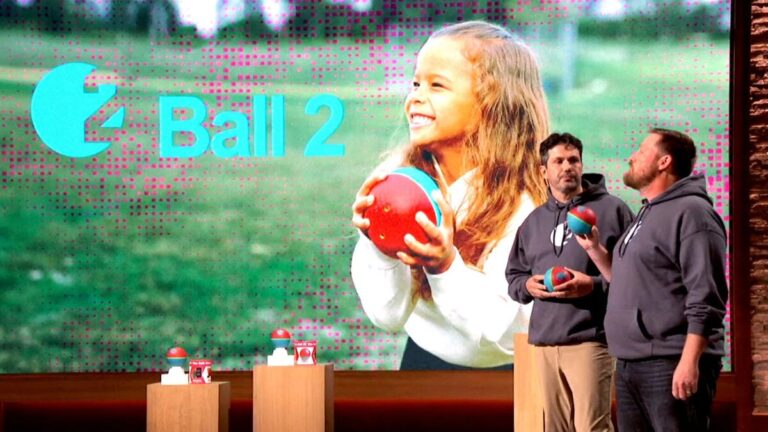
- MrBeast invested $250,000 for a 55% stake in Ball 2, an AI-powered sensor-filled ball that generates custom games through a mobile app, during his Shark Tank debut.
- Other Shark Tank investors expressed skepticism about consumer demand, noting that Ball 2 appears identical to regular balls on store shelves without prior exposure to marketing.
- Donaldson's investment reflects confidence that his understanding of viral trends and youth audience influence can overcome the product's challenge of differentiating itself in a crowded sports equipment market.
YouTube entrepreneur James Stephen Donaldson, known professionally as MrBeast, made his debut on Shark Tank as an investor rather than a pitch recipient. During his first episode on the show, Donaldson committed $250,000 toward Ball 2, an artificial intelligence-powered device designed to create interactive games through embedded sensor technology and a mobile companion application.
What Ball 2 Actually Does
Ball 2, presented by creators Andrew Brown and Kevin Langdon, reimagines a basic sports ball by filling it with sensors capable of tracking movement data. As the ball is thrown, bounced, rolled or handled in other ways, embedded hardware collects information about its motion and trajectory. That data streams to a smartphone app running artificial intelligence algorithms, which can generate new gameplay variations on demand. The AI can modify how far the ball travels when thrown or adjust how it responds to rolling movements, theoretically creating unlimited game modes from a single physical object.
The Pitch Problem
Brown and Langdon faced an immediate obstacle when presenting to the Sharks: explaining why anyone would purchase Ball 2 instead of a conventional ball. The investors pointed out that consumers cannot discern the technology by looking at it. Sitting on a retail shelf next to standard balls, Ball 2 looks identical. Without prior exposure to marketing materials or the video pitch explaining its features, a potential buyer has little reason to select the more expensive AI alternative. Langdon himself acknowledged this challenge directly: “If you put this next to another ball on a shelf it’s a tough sell.”
Live Demonstration
To prove Ball 2’s responsiveness, MrBeast and fellow investor Lori Greiner participated in a competitive test during the episode, shaking the ball to demonstrate how effectively the sensors registered movement through the companion app. Donaldson expressed satisfaction with the device’s performance, stating afterward that it “worked way better than I was expecting it to work.”
MrBeast’s Investment Terms
Donaldson’s financial backing came with substantial equity ownership. The $250,000 investment secured a 55% stake in the company, making him the majority shareholder. After exchanging a brief concerned glance, Brown and Langdon accepted the offer by shouting “beast ball!”—a catchphrase aligned with Donaldson’s personal brand.
The deal reflected Donaldson’s confidence in the product’s commercial viability despite skepticism from other Sharks. At 28 years old, Donaldson has built a substantial business empire partly through sophisticated understanding of YouTube algorithm dynamics and youth culture trends. He has positioned himself as an authority on identifying viral moments and audience behavior patterns that drive engagement among younger demographics.
Why Other Investors Passed
The remaining Shark Tank investors approached Ball 2 with considerable caution. Mark O’Leary, known on the show as Mr. Wonderful, withheld his investment entirely. Both Greiner and O’Leary identified the core vulnerability in Ball 2’s go-to-market strategy: the difficulty of communicating its technological advantage to consumers through traditional retail channels.
The Marketing Gamble
O’Leary specifically stated that Ball 2’s commercial fate would hinge on achieving a “viral” moment powerful enough to generate organic consumer demand. Without such cultural penetration, the product faces an uphill battle in a marketplace already saturated with ball-based sporting equipment. The skepticism centered not on whether the technology functions correctly—the live demonstration addressed that concern—but on whether consumers would pay a premium for features they cannot immediately recognize or understand while standing in front of a store shelf.
MrBeast’s Investment Logic
Donaldson’s backing suggests he believes his personal brand influence and understanding of viral dynamics can overcome Ball 2’s inherent marketing disadvantage. His success on YouTube stems from algorithmic precision and audience psychology—domains where his strategic approach has generated predictable, measurable results. The Ball 2 investment represents an extension of those capabilities into physical consumer goods, betting that his influence with younger audiences and trend-conscious internet users can drive adoption regardless of the product’s appearance in retail environments.
Donaldson has demonstrated this ability to shape youth culture preferences and consumption habits across his digital platforms. His confidence in Ball 2 appears rooted in the assumption that the same audience manipulation strategies that succeed on YouTube can translate to convincing consumers to purchase a non-traditional sports device that must be purchased sight-unseen or based on prior online exposure to marketing content.
The Track Record Question
Donaldson’s broader business ventures present a more mixed picture. His digital operations—YouTube content production and related online ventures—have proven highly efficient at generating returns and audience loyalty. His offline business endeavors, including food product lines, real estate expansion plans, and various commercial partnerships, have attracted greater scrutiny and produced more inconsistent results. Controversies surrounding staff treatment allegations and product quality concerns have occasionally shadowed his brand reputation outside the digital sphere where his algorithm expertise provides clearer advantage.
The Ball 2 investment places Donaldson’s audience influence against a product category that requires successful translation from digital marketing exposure to actual consumer purchase behavior in competitive retail markets. The outcome will test whether his proven mastery of YouTube trends and youth engagement can succeed in a physical goods category where the technology’s benefits remain invisible without prior knowledge or engagement with marketing materials.
Source: Kotaku
Frequently Asked Questions
How much did MrBeast invest in Ball 2 and what stake does he own?
MrBeast invested $250,000 for a 55% stake in Ball 2, making him the company's majority shareholder.
What exactly is Ball 2 and how does it work?
Ball 2 is an AI-powered sports ball filled with sensors that track movement data as it is rolled, thrown and bounced. The data streams to a companion mobile app powered by artificial intelligence, which can generate new gameplay variations and game modes.
Why did other Shark Tank investors express skepticism about Ball 2?
Other investors like Lori Greiner and Mark O'Leary questioned how to market the product since Ball 2 looks identical to regular balls on store shelves and the technology remains invisible to potential buyers without prior marketing exposure. O'Leary said success would depend on achieving a viral moment.
