
Key takeaways
- Kojima expressed mixed feelings about NVIDIA's DLSS 5, citing AI's inability to understand creators' original artistic intentions and choices.
- His concerns extend beyond games to film remasters and audio restoration, where AI could inadvertently overwrite creative decisions made by original artists.
- Kojima's stance has shifted dramatically across 2025 and 2026, from comparing AI to the 2D-to-3D leap to stating he is uninterested in the technology.
- Despite his reservations, Kojima acknowledged that AI upscaling will likely become standard practice, though he expressed discomfort with that outcome.
Hideo Kojima has offered his most detailed assessment yet of NVIDIA’s DLSS 5 technology, revealing a stance far more skeptical than his previous optimistic comments about artificial intelligence in game development. During the latest episode of his KOJI10 podcast—the first in the 36-episode series to feature official English subtitles—Kojima discussed the upscaling technology at length, ultimately concluding that his feelings about it remain deeply conflicted.
What DLSS 5 Does and How It Landed
NVIDIA’s DLSS 5 is designed to take lower-resolution computer-generated imagery and enhance it to appear photorealistic at higher resolutions. According to Kojima, the technology “can make CG characters that were close to the uncanny valley look like real people.” The tool generated significant attention after its leaked version emerged at the end of August, though the reaction, Kotaku noted, proved divisive among players and industry observers.
Death Stranding 2 became an early flashpoint for DLSS 5 discussion. Kojima explained that many players had expressed concerns about the technology’s application to his game: “People kept saying, ‘You don’t need this for Death Stranding 2, it looks a little odd with it on.’ They said it didn’t need it.” To date, no official DLSS 5 support for Death Stranding 2 has been announced, suggesting Kojima may have been referencing the leaked version in his comments.
The Core Problem: Understanding Artistic Intention
Beyond technical assessments, Kojima identified a fundamental philosophical issue with AI upscaling. His concern centers on the technology’s inability to comprehend the creative reasoning behind original artistic decisions. This problem extends far beyond video games into cinema and music, two fields where Kojima has deep experience.
Remasters and Lost Context
Kojima highlighted 4K film remasters as a prime example of the danger. “People still restore old films in 4K by hand, for instance. AI could do that easily. But as the person who made the original, I wouldn’t want someone changing it too much. There was a reason I chose a particular lighting setup.” The same principle applies to audio: AI could theoretically restore or enhance classic albums, but without understanding why an artist made specific production choices decades earlier, the results risk overwriting the original creative vision.
Control and Authorship
Kojima acknowledged one potential exception to his concerns: direct creative control. “Unless I was controlling the AI in my own work, that may be different,” he said, though he remained uncertain even about that scenario. His reservation suggests that even a creator’s ability to guide an AI system might not fully address the underlying problem of artistic intent being lost or misinterpreted in the automation process.
A Year of Shifting Positions on AI
Kojima’s current mixed stance marks a notable departure from statements he made earlier in 2025 and 2026. In early 2025, he described AI’s significance as equivalent to the industry’s transition from 2D to 3D graphics—a seismic shift in creative possibility. Months later that same year, he referred to AI as a “friend” capable of helping “boost efficiency” in game development, suggesting genuine optimism about the technology’s potential.
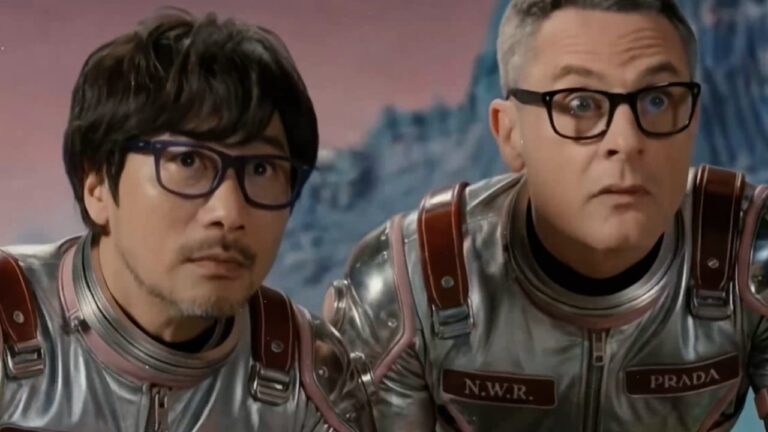
By May 2026, Kojima had moved beyond commentary into direct participation, starring in an AI-generated advertisement for Prada alongside director Nicolas Winding Refn, whose likeness appears as the character Heartman in the Death Stranding series. Yet just one month later, in June 2026, Kojima abruptly reversed course. “Maybe AI could create art, but while I live, I don’t think I’ll see it. I’m not interested in it,” he declared, dismissing the technology’s creative potential entirely.
A Contradiction with Earlier Predictions
Complicating the narrative further, Kojima had told interviewers in 2025 that “remakes and sequels” to films “will be made by AI,” a prediction that now sits in tension with his current resistance to AI-driven creative decision-making. His evolution from that confident forecast to today’s qualified skepticism illustrates how experience and reflection have deepened his concerns about unintended consequences.
Inevitability and Discomfort
Despite his reservations, Kojima acknowledged the likely trajectory of the technology. “This will probably become standard,” he said, a statement that carries both resignation and concern. His phrasing—”I don’t much like that idea”—suggests acceptance of an approaching reality rather than hope that concerns like his will prevent widespread adoption.
The underlying tension in Kojima’s position reflects a broader creative dilemma facing the industry. As AI systems become more capable and integrated into development pipelines, the question of artistic intent becomes not merely philosophical but practical. For a director accustomed to meticulous control over lighting, framing, sound design, and narrative pacing, the prospect of AI making creative adjustments—even improvements by conventional measures—represents a fundamental loss of authorial voice.
Source: Kotaku
Frequently Asked Questions
What is DLSS 5 and why did Kojima discuss it on his podcast?
DLSS 5 is NVIDIA's upscaling technology that enhances lower-resolution CG imagery to appear photorealistic. Kojima discussed it after a leaked version generated divisive reactions in late August. He noted that Death Stranding 2 players had expressed concerns about how the technology looked when applied to his game.
What is Kojima's main concern about DLSS 5 and similar AI upscaling tools?
Kojima's primary concern is that AI lacks understanding of creators' original artistic intentions. He gave the example of lighting setups he specifically chose for his films—AI could alter these without comprehending why those choices mattered to the final product, whether in games, films, or audio remasters.
How has Kojima's position on AI changed from 2025 to 2026?
In early 2025, Kojima compared AI's importance to the 2D-to-3D graphics transition and called it a helpful "friend." By June 2026, he stated he was uninterested in AI. His current stance is mixed—he acknowledges AI upscaling will become standard but expresses discomfort with that outcome, citing concerns about lost creative control.
