
Key takeaways
- Fishing minigames appear across genres from Stardew Valley to Hades because they balance meditative calm with bursts of rewarding tension.
- Game designers must consider when fishing serves relief versus challenge based on the core game's tone and pace.
- Players increasingly want evolution in fishing mechanics beyond simple button-press or bobber-tracking systems that have dominated the past decade.
- Successful fishing systems like ESO's and Stardew Valley's work because they layer multiple objectives—relaxation, collection, and achievement—into a single activity.
Fishing minigames have become nearly ubiquitous in modern video gaming. Whether they appear in action-driven experiences like Hades and The Legend of Zelda, strategy titles such as Fire Emblem, RPGs from the Persona or Tales franchises, or lifestyle simulators like Stardew Valley and The Sims, fishing has become a standard feature. Games without fishing are increasingly the exception rather than the rule. Yet beneath this apparent saturation lies a genuine fascination with what fishing represents in digital entertainment—a moment of reprieve, a chance at reward, and a deeply personal experience that resonates differently across players.
The Universal Appeal of the Virtual Line
The prevalence of fishing in games reflects something fundamental about the activity itself. Whether someone has never approached a real body of water or spends weeks each year casting lines, video game fishing holds broad appeal. Players consistently cite the meditative quality of the experience as central to its charm.
Stephanie Tinsley Fitzwilliam, a PR professional who regularly fly fishes in high-elevation alpine rivers, streams, and lakes, describes real fishing as fundamentally about being outside and soaking in the quiet atmosphere so that I can recharge from a hectic work week. That sense of escape translates readily into digital form. Beyond the peaceful surface, however, Fitzwilliam notes that real fishing demands patience—tangled lines, unexpected weather, and countless small frustrations punctuate the activity. Yet people return to it because, as she explains, just like hitting blackjack in Vegas, getting a fish on your line hits that serotonin in your brain. You always need one more hit, one more bite. This psychological draw mirrors what makes many video game mechanics compelling, but fishing minigames capture something particularly difficult to replicate in other activities: the combination of sustained calm interrupted by moments of genuine tension.
Walking the Line Between Calm and Adrenaline
Fruity Snacks, a Final Fantasy XIV content creator who specializes in in-game fishing and fishes in real life, articulates this balance with precision. The meditative state of waiting and watching gets disrupted when a fish bites, and depending on the species being pursued, reeling becomes anything but relaxing. Learning to return to that calm meditative state after a rush of adrenaline carries benefits that extend well beyond the fishing hole.
This dynamic explains why games like Stardew Valley have earned near-universal praise for their fishing implementation. May Gardens, a game designer who curates fishing mechanics on Steam and holds the title of Saint of the Firmament for fishing in Final Fantasy XIV, caught a 30-pound salmon as a young person and understands fishing from multiple angles. She explains Stardew Valley’s success through its expressiveness: It really gives you a feeling for the give and take, the franticness, and especially, that you can start to learn what fish is on the line well before you’ve gotten it into the boat just from how it acts on the line.
Other games repeatedly mentioned by fishing enthusiasts include Hades, Final Fantasy XIV, and Sea of Thieves. Even virtual reality spaces have recognized this appeal—VRChat recently launched a fishing world titled FISH!, featuring over 20,000 unique fish and a full progression system. A streamer who uses the VRChat fishing world describes it as basically the perfect middle-investment task to be doing while you hang out with people, comparable to real-world fishing except stuff actually bites.

Designing for Different Game Tensions
When Fishing Provides Relief
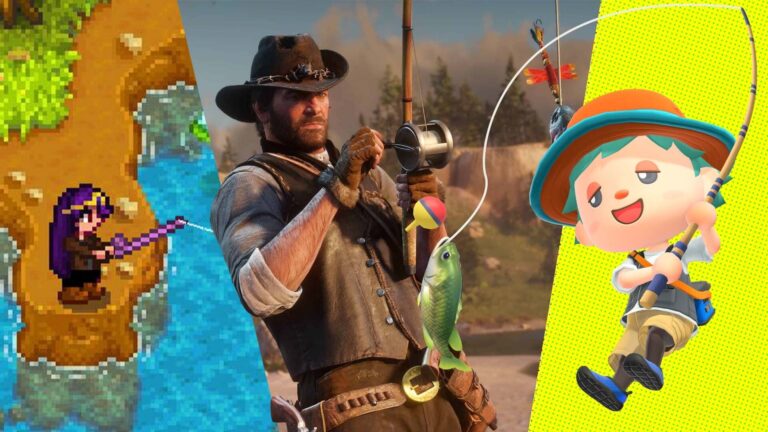
The question of whether every game needs fishing is more nuanced than simple inclusion. Thorne, who runs a social account called Is There A Fishing Minigame? and identifies as the Fishing Minigame Guy, articulates a clear design philosophy: games that are tense or stressful benefit from fishing as a moment of relief, as seen in Hades and Red Dead Redemption 2. Conversely, calm and cozy games should use fishing to add challenge, as demonstrated by Stardew Valley and Animal Crossing.
Games like Outer Wilds have no place for fishing—adding it would either eliminate time for the actual gameplay loop or consume too much play time, fundamentally undermining the game’s core experience. Similarly, Thorne notes that Sega Bass Fishing remains one of the greatest fishing games ever made due to its tension, reward feedback, and emphasis on selecting the right lure and location rather than focusing on the player character.
The Realism Trap
Not every player gravitates toward simulation-heavy fishing. Dr. Anne Ladyem McDivett, a video game historian and scholar, explicitly refuses to play realistic fishing games because they feel too serious. She contrasts her experience with Like a Dragon: Infinite Wealth, where the standard ocean and spear fishing feel relaxing and approachable, while the arcade version of Sega Bass Fishing feels punitive and demanding: I caught the fish, but at what cost? It’s me getting frustrated and unhappy, rather than just relaxing and fishing for fun.
May Gardens, whose personal fishing expertise lies in ocean trolling for salmon and jigging for halibut, notes a persistent gap between what games depict and what she practices. Most fishing minigames draw from freshwater, casting-based traditions—a type of fishing she has barely engaged in. The games that do exist rarely capture her specific fishing experience.
Comedy as an Overlooked Element
Daphne Sophinos, project lead on the rhythm game Beatblock, highlights comedy as a severely underappreciated component of effective fishing minigames. Animal Crossing’s fishing would not resonate as strongly without the dad jokes accompanying each catch. She cites juxtaposition as an equally valid tool—the Nintendo 3DS AR Games fishing application, which allowed catching photorealistic fish alongside cartoon Cheep Cheeps from Mario, leveraged absurdity to strengthen the experience.
Stagnation and the Push for Evolution
Despite the ubiquity of fishing minigames, Fruity Snacks sounds a note of caution about their current state: I’m kind of getting a little tired of fishing systems that are just trying to keep a bobber inside of a bar or are just ‘press a button at the right time.’ She argues that fishing minigames have stalled creatively over the past decade, with dedicated fishing games beginning to experiment with new mechanics while minigames remain largely static. The minigames really could use some evolution, she contends.
The Developer Perspective
Building a fishing system that works requires balancing multiple objectives. Chris Balser, a systems designer who inherited and expanded The Elder Scrolls Online’s fishing starting in 2014 as part of her broader responsibility for crafting and gathering systems, explains the design philosophy: Our goals for the system were for it to be an interesting, relaxing, chill-out activity for you to do while between other things.
Beyond relaxation, ESO’s fishing serves as a collection system for players motivated by completion and acts as a gateway to achievements, titles, and dyes for collectors. The system incorporates mechanical complexity beneath its surface that Balser declines to fully reveal, underscoring that effective fishing design often involves hidden depth that players gradually discover.
Fishing minigames persist across gaming’s landscape because they satisfy something fundamental: they offer agency within constraints, reward without pressure, and a rhythm that mirrors activities people seek in their actual lives. Whether as a source of genuine peace or a moment of respite from demanding gameplay, fishing continues to reel players in.
Frequently Asked Questions
Why do video game fishers often describe fishing as meditative?
Fishing combines sustained calm with periodic moments of tension and reward. Real fisher Stephanie Tinsley Fitzwilliam explains that this cycle triggers the same serotonin response as hitting blackjack in Vegas—the anticipation and payoff feel relaxing and compelling simultaneously.
What's the difference between how games like Stardew Valley and Sega Bass Fishing approach fishing?
Stardew Valley emphasizes expressiveness and learning to read fish behavior through how they react on the line. Sega Bass Fishing adds realism with lure selection and location scouting. Some players, like Dr. Anne Ladyem McDivett, find realistic fishing too serious and prefer relaxing approaches over simulation.
Should every game have a fishing minigame?
According to Thorne, a designer who tracks fishing minigames, it depends on the game's core tone. Tense games like Hades benefit from fishing as relief, while cozy games like Animal Crossing use fishing to add challenge. Games like Outer Wilds have no room for fishing without disrupting their core gameplay loop.
