
Key takeaways
- Endacopia blends nostalgic edutainment design with genuine horror, creating a unique adventure game that corrupts childhood computer game memories.
- The game draws design inspiration from Putt-Putt Goes To The Moon but subverts that formula by mixing whimsical puzzles with unsettling encounters and Punch-Out!!-style combat.
- Endacopia joins a growing subgenre of games made by developers traumatized by school computer lab software, alongside Baldi's Basics and Amanda the Adventurer.
Endacopia, the latest creation from Picayune Dreams developer Andyland, occupies a peculiar creative space that hasn’t quite existed before. The game blends elements of educational edutainment titles with genuine survival horror, creating what might be best described as a fever dream of computer lab nostalgia turned sinister. This surreal adventure game emerges at a time when an increasing number of developers are mining their own traumatic memories of childhood computer games and transforming them into deliberately unsettling experiences.
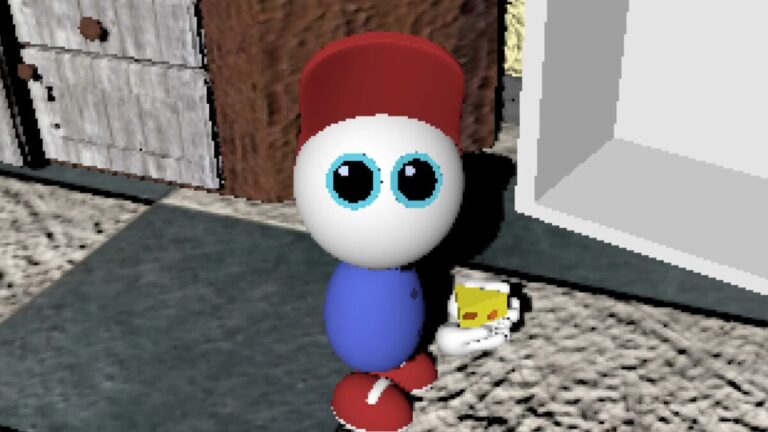
The game casts you as Mellow, a character rendered with distinctly lo-fi aesthetics—a pale, googly-eyed figure wearing a baseball cap, designed with the kind of primitive 3D modeling that evokes early computer-generated imagery. You find yourself trapped in the house of Henry, a hulking, sallow creature whose habit of clubbing you unconscious leaves you grappling with both physical danger and cognitive fog. Between your current predicament and any hope of escape lies a gauntlet of whimsical logic puzzles, creatures from dark realms, and the constant tension between lighthearted discovery and genuinely unsettling encounters.
Puzzle Design Rooted in Childhood Games
The mechanical foundation of Endacopia draws inspiration from a specific tradition in adventure game design. Andyland built much of the game’s puzzle philosophy around the design principles established by Putt-Putt Goes To The Moon, the classic point-and-click adventure that defined how educational games could present challenges to younger players. In Endacopia, this aesthetic sensibility is preserved and then deliberately corrupted.
Hidden Solutions Within Animated Worlds
Puzzles in Endacopia operate within a visual language of constant animation and interaction. Solutions aren’t explicitly telegraphed but rather hidden within the fabric of the game’s loopy, whimsical environments. A single click can trigger sequences of animated objects, transformative visuals, and interactive elements that shift the landscape. The design respects the player’s ability to discover without handholding, though the cheerful presentation masks the fact that some discoveries are far darker than others.
A Mix of Comfort and Dread
Behind many doors and in many corners, players encounter exactly what they might expect from a nostalgic edutainment title: smiley faces, mini-games that recall the kinds of diversions found in educational software, and amusing sound effects. But this veneer of comfort exists alongside something fundamentally different. Around a few corners lurks something genuinely unsettling, something with an alien or eldritch quality that violates the game’s otherwise whimsical tone. This careful balance between the expected and the transgressive defines Endacopia’s peculiar identity.
Combat Drawn From Retro Arcade Tradition
Breaking from pure puzzle-solving, Endacopia incorporates surprisingly complex combat sequences that draw their design language from Punch-Out!!, the classic Nintendo arcade game that pioneered pattern-recognition-based fighting. These sequences force players to read opponent behavior, time their actions carefully, and execute precise responses. The viscous, weighty nature of these encounters contrasts sharply with the puzzle gameplay, creating moments where survival feels genuinely at stake.
The Broader Trend of Corrupted Nostalgia
Endacopia doesn’t exist in isolation but rather represents the most recent arrival in an increasingly visible subgenre of games. This emerging category consists of titles crafted by developers whose childhoods were shaped by a specific technological moment: the computer lab, the school’s aging equipment, the educational software that was simultaneously designed to teach and, in retrospect, deeply uncanny.
Several games have already established this territory:
- Baldi’s Basics weaponized the grammar school classroom itself, transforming educational software aesthetics into a pursuit game where knowing math becomes a curse.
- Amanda the Adventurer took the point-and-click adventure game formula and bent it toward psychological unease.
- Forbidden Solitaire approached the genre from the angle of a classic card game rendered disturbing.
- Pajama Sam, while not intentionally horror, occupies the space where childhood courage meets genuine fear in a claustrophobic cardboard world.
- 3-D Body Adventure represents another reference point for games whose educational content became far more disturbing in retrospect.
- Fatty Bear lurks in the collective memory of players who found the concept of a bear mascot existing within the domestic space to be fundamentally wrong.
What unites these games is a shared source of trauma: the specific aesthetics and interaction patterns of educational software from the 1990s and early 2000s. The developers behind them weren’t trying to create horror but instead were trying to create systems that would teach young children. The fact that these games have proven remarkably effective at generating unease when recontextualized speaks to something about how that era of software struck at a primal level.
Endacopia’s Distinct Identity
While Endacopia participates in this broader movement, it maintains a unique position within it. Where other games in this subgenre tend to directly reference or parody specific educational software—mining specific franchises or gameplay conventions for their unease—Endacopia operates in what might be called its own void. The game establishes its own rules, borrows its aesthetic vocabulary from the broader tradition of childhood computer games without directly copying any one source, and creates a space defined entirely by the tension between childhood game logic and nightmare imagery.
This approach allows Endacopia to feel neither derivative nor particularly nostalgic in a comforting way. Instead, it creates an elevated space—a game world that obeys the rules of the games we played as children but that has been colonized by something uninvited, something that doesn’t belong in spaces designed for learning and play. The result is a game that doesn’t rely on player recognition of specific references to achieve its effect but rather on the player’s muscle memory and emotional associations with an entire era of interactive media.
Design Philosophy and Execution
Andyland’s approach to Endacopia demonstrates a sophisticated understanding of how nostalgia and dread can coexist within the same game space. Rather than attempting to create a game that is simply “creepy educational software,” the developer has created something more nuanced: a game that respects the traditions and mechanics of educational adventure games while simultaneously subverting the safety and comfort those games promised.
The use of primitive 3D rendering for Mellow and Henry serves a dual purpose. On one level, it grounds the game in a specific technological moment, evoking the kind of computer graphics that defined early CD-ROM based educational titles. On another level, the deliberate lo-fi aesthetic creates visual distance that makes unsettling imagery feel slightly more abstract, slightly less immediately threatening—which paradoxically makes it more disturbing rather than less.
Endacopia ultimately represents a maturation of a design trend that has been developing quietly within indie games for several years now. As developers who grew up with educational software reach creative maturity, they’re finding new ways to interrogate their relationship with that era of gaming and media consumption. Endacopia stands out because it doesn’t simply reference that era but instead uses its design principles and aesthetic vocabulary to create something genuinely new—a game that trusts players to find horror not in explicit gore or jump scares, but in the violation of expectation and the corruption of spaces that were supposed to be safe and instructional.
Frequently Asked Questions
What is Endacopia?
Endacopia is a surreal horror adventure game created by developer Andyland at Picayune Dreams that blends edutainment design with survival horror, following a character named Mellow trapped in the house of a creature named Henry.
What games influenced Endacopia's design?
Endacopia draws much of its design philosophy from Putt-Putt Goes To The Moon, an educational adventure game, while also incorporating Punch-Out!!-style combat sequences that create tension within the whimsical puzzle gameplay.
What other games are similar to Endacopia?
Games like Baldi's Basics, Amanda the Adventurer, Forbidden Solitaire, and Pajama Sam similarly transform childhood computer game and educational software aesthetics into unsettling experiences that subvert their originally benign purposes.
