
Key takeaways
- Solomon's reload animations display board positions from historic chess matches, including Anderssen vs. Kieseritzky's 1851 Immortal Game and Deep Blue's 1996 victory over Kasparov.
- The character commands giant chess pieces that move according to chess rules, making strategic positioning and piece coordination central to gameplay rather than traditional aiming.
- Valve distinguishes Deadlock through original character design and mechanical depth, contrasting with competitors that rely on licensed superheroes or cosmetic variation.
Valve’s Deadlock continues to build momentum within its closed-beta player base, and much of that enthusiasm centers on Solomon, a chess-themed hero introduced in the recent “City Never Sleeps” update. The character represents the kind of meticulous world-building and mechanical depth that has begun to distinguish Deadlock from a crowded field of hero shooters struggling to find their identity.
Solomon’s World and Role
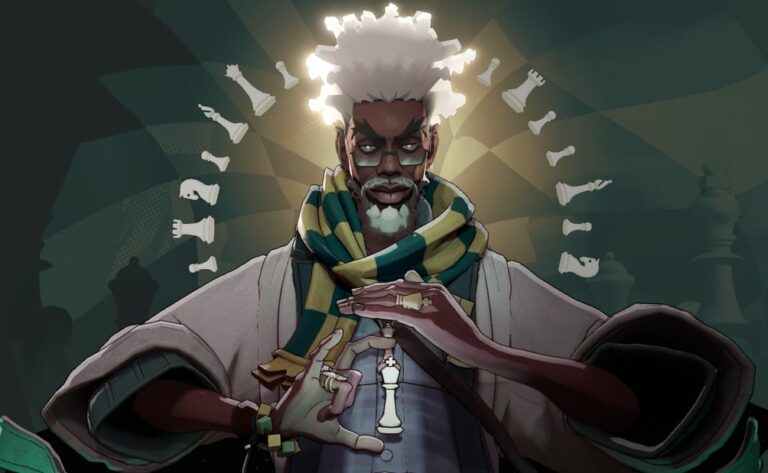
Solomon operates within Deadlock’s alternative mid-century New York, a city contested by two rival deities each seeking dominance. The world underwent fundamental transformation when a catastrophic event known as the Maelstrom unleashed fantasy creatures into the urban landscape, prompting skilled heroes to pledge themselves to competing gods. Solomon emerges from this mythology as a chess grandmaster, visually presented floating in a lotus position—an aesthetic callback to Zenyatta from Overwatch applied to an entirely different strategic fantasy.
The “City Never Sleeps” update introduced Solomon alongside five other new heroes, including a character drawn from folklore depicted as a witch and an antagonist inspired by The Nutcracker. Among this collection of additions, Solomon has garnered the most attention from the beta community, suggesting that his mechanical depth and thematic presentation resonate more strongly than his peers.
Mechanics Beyond Traditional Combat
Chess Pieces as Battlefield Presence
Solomon’s gameplay identity departs from the shooter archetype. Rather than controlling conventional firearms, he conjures giant replicas of chess pieces onto the battlefield and commands them to move according to standard chess rules. This transforms his combat role from gunslinger into something closer to a summoner, where positioning and piece coordination replace aim and reflexes. Each piece operates within the constraints of legitimate chess movement, meaning players must think like strategists rather than aim like marksmen.
The Reload Mechanic
The character’s primary distinguishing feature emerges during reload—the moment when players typically experience downtime between actions. When Solomon reloads, the pieces on his board rearrange into a new configuration determined by his remaining ammunition count. This is not a random reconfiguration; every single board state corresponds to a position from an actual historical chess game. Valve embedded chess history into a mechanical action that most players would normally skip past entirely.
Historical Chess Embedded in Animation
A Curated Selection of Legendary Matches
The board configurations referenced during reloads span from 19th century competitive chess through modern professional play. The 1851 match between Adolf Anderssen and Lionel Kieseritzky—commonly referred to as the “Immortal Game”—appears on Solomon’s board, representing one of the most historically significant matches ever recorded. The animation also displays the 1996 encounter between Deep Blue and Garry Kasparov, the watershed moment when artificial intelligence defeated a reigning world champion. Additional configurations include Maurice Ashley versus Josh Waitzkin from 1999, contributing to a broader historical scope.
Detail as Design Philosophy
The specificity of these selections demonstrates deliberate curation. Each historical game carries narrative and cultural significance within chess—they represent turning points, dramatic upsets, and pivotal moments in the game’s evolution. By threading these exact positions into Solomon’s reload animation, Valve transformed a momentary mechanical action into a celebration of chess history that only the most attentive players would consciously register.
Community Response and Investigation
Beta players responded to Solomon’s design with immediate enthusiasm, with particularly attentive community members identifying the historical chess connections and systematically documenting each board configuration to its source game. This investigation suggests that Valve anticipated dedicated players would invest time uncovering these references, turning the reload animation into an Easter egg hunt rather than a forgotten mechanical necessity. The level of community engagement around Solomon’s design indicates that the character resonated at both mechanical and thematic levels.
Deadlock’s Approach to the Hero Shooter Genre
Contrast With Commercial Competitors
Deadlock distinguishes itself through commitment to original character design and world-building in a genre increasingly populated by licensed intellectual property. Concord, a competing hero shooter, assembled characters that resembled secondary figures from Guardians of the Galaxy. Marvel Rivals took a different approach, licensing established superheroes and supplementing them with alternative cosmetics including swimwear-themed outfits. Valve’s strategy with Solomon and the broader Deadlock cast prioritizes original creation, mechanical depth, and thematic coherence over brand recognition or visual titillation.
Live-Service Skepticism and Creative Response
As mainstream gaming audiences increasingly express skepticism toward live-service games, Deadlock’s building momentum represents an outlier in industry trends. The care evident in Solomon’s design—chess-themed mechanics paired with historical references embedded in reload animations—suggests that Valve is investing in quality and originality as primary differentiators. Whether this gamble succeeds depends on how successfully Deadlock transitions from closed beta to public release and whether the broader player base shares the enthusiasm currently evident within the beta community.
Solomon exemplifies a design philosophy that treats details as substance rather than decoration, embedding intellectual depth into moment-to-moment gameplay rather than relegating complexity to cosmetics or narrative framing alone.
Source: Kotaku
Frequently Asked Questions
What hero did Valve introduce in Deadlock's City Never Sleeps update?
Valve introduced Solomon, a chess grandmaster hero, alongside five other characters. Solomon summons giant chess pieces that move according to standard chess rules and commands them on the battlefield.
Which historic chess games does Solomon reference in his reload animation?
Solomon's reload animations feature board positions from famous matches including Adolf Anderssen vs. Lionel Kieseritzky's 1851 Immortal Game, Deep Blue's 1996 match against Garry Kasparov, and Maurice Ashley vs. Josh Waitzkin from 1999.
How does Deadlock's design compare to other hero shooters?
Deadlock emphasizes original character design and thematic depth, while Concord features characters resembling Guardians of the Galaxy figures and Marvel Rivals licenses established superheroes with cosmetic variations.
