
Key takeaways
- Penguin Colony retells Lovecraft's At the Mountain of Madness from the perspective of Antarctic penguins, with Nazis as the doomed explorers instead of academics.
- Naphtali Faulkner deconstructs Lovecraftian horror by weaponizing its own tropes to critique ideology and human arrogance rather than exploring cosmic dread.
- The game pairs grotesque Nazi imagery with cute penguin gameplay, positioning players as observers who witness catastrophe without controlling its outcome.
- Indigenous caretakers appear in brief segments as the true survivors of human disaster, invisible to the main narrative until Faulkner foregrounds their unseen labor.
Naphtali Faulkner’s Penguin Colony attacks cosmic horror at its roots. The creator of Umurangi Generation has built a game where Antarctic penguins wander through an alternative retelling of H.P. Lovecraft’s “At The Mountain of Madness,” but this time it is the birds, not academics or explorers, who become the true inhabitants of a world collapsing under human arrogance. By centering the narrative on creatures whose perspective exists entirely outside human concerns, Faulkner finds a way to harness Lovecraftian dread without reproducing the racism and colonialism embedded in the source material.
Four Species in Frozen Halls
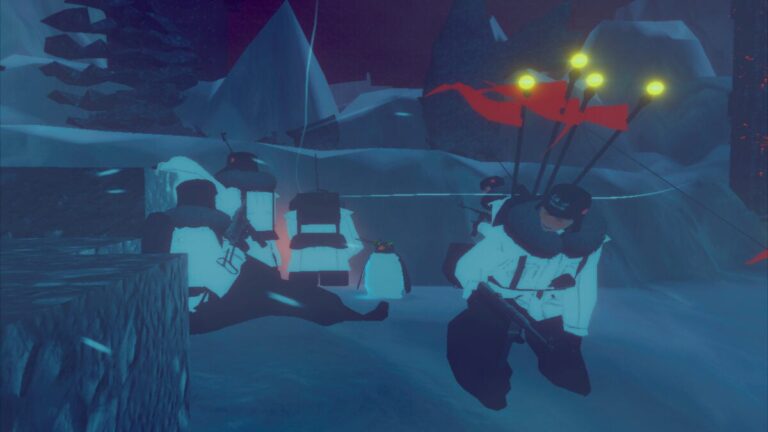
The game casts players as a collective of penguins: emperor penguins, baby penguins, rockhoppers, and chinstraps. The core mechanic involves nuzzling against another penguin to transfer your essence from one character to another. Each species brings different capabilities. Some are faster. Others swim better. A few can jump higher. One mode lets you act as a photographer. The tundra becomes a playground where you belly slide, waddle, and navigate the harsh Antarctic landscape. These mechanical basics create the foundation for what the game actually wants to say.
When Nazis Meet Ancient Gods
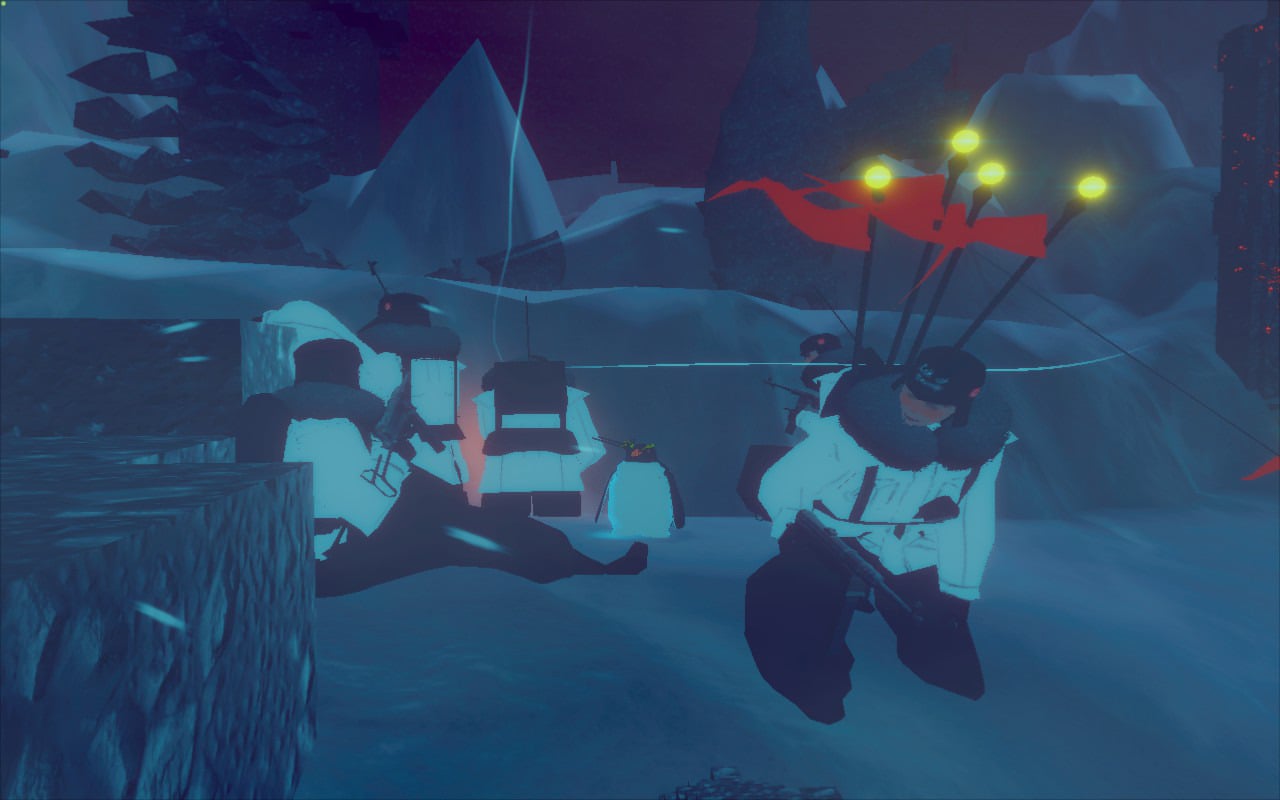
In Faulkner’s hands, Lovecraft’s cosmic tale of doomed exploration becomes a story about how human stupidity and ideology destroy everything they touch. Instead of the well-funded New England academics of Lovecraft’s original work, Nazis form the doomed expedition in Penguin Colony. They discover an ancient god frozen in the ice. Their goal is to prove their racial purity by finding a being that matches their vision of what a deity should resemble. The entity they uncover, naturally, obliges no such comparison. What emerges is shapeless, mind-melting terror, indifferent to the beliefs and hierarchies that humans construct around it.
Yet the penguins persist, waddling deeper into forbidden tombs and pecking at shards of knowledge that would shatter a human mind. They exist in the spaces that humans cannot survive. They feel neither the pull of ideology nor the gravitational weight of human consequence.
Deconstructing the Genre from Within
Using Lovecraft Against Himself
Faulkner’s approach deconstructs what makes Lovecraftian horror function. In Lovecraft’s original stories, the fundamental terror arrives through the weakness of human understanding. Western academics become the engine of apocalypse not because they are uniquely foolish, but because their certainty blinds them to what they are actually encountering. Lovecraft’s work consistently punishes curiosity and intellectual reach, but always through the lens of people wealthy or powerful enough to pose the questions in the first place. Penguin Colony inverts that formula by making the observers indigenous peoples—local caretakers who appear in brief segments spliced between chapters.
Indigenous Caretakers and the Unseen Labor
These segments intentionally resemble clips from other games, sometimes appearing as if you accidentally changed the input, hopping in and out of an active session. They depict people managing the consequences of exploration and exploitation across generations, a labor that requires no narrative arc or special knowledge, just ongoing maintenance of survival.
A Contrast to Other Lovecraft Adaptations
Most Lovecraft send-ups that address the source material’s ugliness do so by pitting the audience against Nazis or other obvious antagonists—Hellboy comes to mind as an example. Faulkner instead wields Lovecraft’s own storytelling machinery against him. He uses the tropes of cosmic horror, the language of dread, the visual vocabulary of tentacles and incomprehensible geometry, and redirects them toward a story about the emptiness of human ideology. The penguins are not heroes. They do not overcome the cosmic threat. They simply live in a world where that threat is merely another fact of their environment, no more or less strange than the temperature or the ice.
Adorable Penguins, Grotesque Humans
The game is narrated by Lenval Brown, an actor whose voice carries the weight of melancholy and weariness familiar to players of Disco Elysium. His delivery moves across a landscape described as vast, dark, and howling. The developers hid secrets throughout the environment, many requiring players to use specific penguin abilities to reach them. The visual presentation pairs this austere setting with a gameplay experience that is fundamentally cute. Penguins emit precious little anime sounds when they jump. Nazi soldiers graphically flay their own faces and pull intestines out like paper towels as consequences of their failed experiments, yet the player is too busy coordinating penguin belly slides and platforming sequences to dwell on the human grotesquerie. This tonal dissonance is intentional.
The Comfort of Witnessing
A Safety Net for Penguins
Faulkner previously stated he would never force players to watch penguins suffer. In practice, this shapes every failure state. If a penguin falls into a pit, the game snaps the player to the next available bird. If a penguin becomes corrupted by a shoggoth or elder god, that creature is no longer playable, but another replaces it instantly. You are positioned throughout Penguin Colony as an observer, much like the photographer role in Umurangi Generation. The objective is to witness the unfolding catastrophe, not to interfere.
Jank as Intentional Design
You pace through impossible architecture and warped geometry not to save the world, but simply to see it. According to Kotaku’s playthrough, the game accommodates intentional mechanical jank to realize its vision. Rockhoppers seem to possess magnetic feet, allowing them to cling to surfaces in ways that defy the physics of the game world. This imprecision serves the design rather than frustrating it. Kotaku reported finding itself hopelessly wedged into a crevice at least three times in an un-cosmic way, a failure mode the game apparently tolerates within its vision.
A Philosophy of Non-Mastery
The platforming is built around the idea that you will use penguins with specific traits to solve environmental puzzles. You do not own these birds; you move through them. The landscape persists. The penguins move through it, each offering a different lens on the architecture and terrain. The penguins understand this role instinctively. They do not share humanity’s assumption that comprehending the fabric of time and space represents a worthy goal. Defying cosmic forces out of hubris is not for the birds.
Frequently Asked Questions
What is Penguin Colony?
Penguin Colony is a game by Naphtali Faulkner that retells H.P. Lovecraft's "At the Mountain of Madness" from the perspective of Antarctic penguins—emperor penguins, baby penguins, rockhoppers, and chinstraps—who witness Nazis discovering an ancient god frozen in ice.
How does the game criticize Lovecraft?
Rather than simply replacing the protagonists of Lovecraftian horror, Faulkner wields Lovecraft's own storytelling machinery (cosmic dread, impossible geometry, cosmic terror) to tell a story about the emptiness of human ideology and the futility of human arrogance. The game centers indigenous peoples as the true observers and survivors, inverting Lovecraft's focus on Western explorers.
What are the main gameplay mechanics?
Players nuzzle penguins to transfer their essence between four species, each with different abilities: speed, swimming, jumping, and photography. Players navigate frozen tombs and platforming challenges, using each penguin's traits to solve environmental puzzles while an observer role positions them as witnesses rather than saviors of the unfolding catastrophe.
