
Key takeaways
- Sandbox games existed long before Minecraft arrived, though they operated under different design philosophies and technical constraints.
- Minecraft’s fundamental gameplay loop revolves around gathering resources, crafting tools, and building structures in procedurally generated worlds—environments created algorithmically rather than hand-designed.
- Minecraft’s use of procedural generation fundamentally changed expectations for game world size and player investment.
- Minecraft began as a weekend project by Swedish programmer Markus “Notch” Persson in May 2009, initially released as a free game in early development.
Minecraft stands as one of the most influential video games ever created, fundamentally transforming how developers and players approach game design and creative expression. Since its initial release in 2009, the game has sold over 300 million copies across all platforms, making it the best-selling video game of all time. The title’s impact extends far beyond commercial success, establishing a new template for sandbox games—titles that prioritize player agency and environmental interaction over linear progression—that continues to influence game development today.
Understanding Sandbox Games Before Minecraft
Sandbox games existed long before Minecraft arrived, though they operated under different design philosophies and technical constraints. Games like SimCity, released by Maxis in 1989, allowed players to construct and manage virtual cities with minimal restrictions, emphasizing systems-based gameplay where player decisions directly affected simulated outcomes. The Elder Scrolls III: Morrowind, released in 2002, offered vast open worlds where players could explore freely and pursue objectives in any order they chose, though the game still maintained traditional RPG progression systems and narrative structures.
However, these predecessors generally combined sandbox elements with other game design traditions, balancing player freedom against directed goals and structured progression. Minecraft distinguished itself by removing most traditional game objectives entirely, replacing them with pure environmental interaction and creative possibility.
The Revolutionary Design of Minecraft’s Core Mechanics
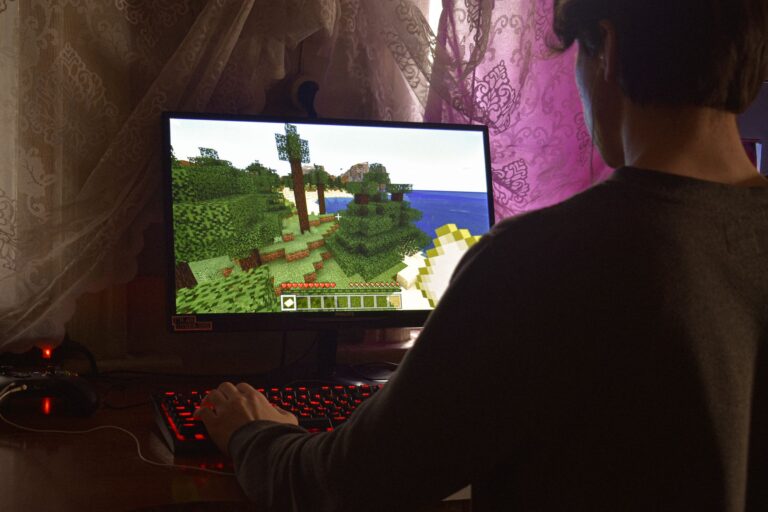
Minecraft’s fundamental gameplay loop revolves around gathering resources, crafting tools, and building structures in procedurally generated worlds—environments created algorithmically rather than hand-designed. The game presents players with a simple interface: a first-person perspective, a hand for interaction, and an inventory system. Players harvest materials like wood, stone, and ore by striking them repeatedly, then combine these materials in a crafting grid to create tools, weapons, and building blocks with increasingly sophisticated properties.
This elegant system proved revolutionary because it removed gatekeeping mechanisms that traditionally restricted player access to creative tools. Unlike previous games that locked advanced building or crafting behind skill checks or progression gates, Minecraft grants access to virtually all building materials within the first hour of gameplay. A player can construct elaborate structures moments after beginning their first world, democratizing creative expression in a way few games had attempted.
Procedural Generation and Infinite Worlds
Minecraft’s use of procedural generation fundamentally changed expectations for game world size and player investment. Rather than designing every mountain, forest, and valley by hand, Minecraft generates worlds algorithmically based on mathematical formulas called Perlin noise, creating realistic terrain that varies dramatically while maintaining visual coherence. This technique allowed developers to create effectively infinite worlds limited only by computing power, rather than storage capacity or developer time.
The psychological impact of infinite worlds cannot be overstated. Players in games like The Elder Scrolls IV: Oblivion, released in 2006, eventually reached world boundaries and understood the artificial limits of their environment. Minecraft players, by contrast, can travel for months of gameplay without encountering a world edge, fundamentally changing how they conceptualize the game space as a persistent, inexhaustible frontier.
Minecraft’s Development and Evolution
Minecraft began as a weekend project by Swedish programmer Markus “Notch” Persson in May 2009, initially released as a free game in early development. The project gained rapid traction through community engagement and organic growth, accumulating millions of players before any major marketing campaign. Microsoft acquired Mojang Studios, the company behind Minecraft, in September 2014 for $2.5 billion, representing the largest video game acquisition at that time and signaling the industry’s recognition of the game’s cultural significance.
Since its acquisition, Minecraft has expanded dramatically across platforms. The game launched on Xbox 360 in 2012, establishing itself as a console experience, while subsequent releases on PlayStation, Nintendo Switch, and mobile platforms transformed it into a truly ubiquitous title. Each platform version introduced cross-play functionality—the ability for players on different systems to play together—a feature that was technically challenging but became standard practice across the industry following Minecraft’s implementation.
The Creative and Educational Impact
Minecraft transcended entertainment to become a genuine educational tool, with schools worldwide integrating the game into curricula for teaching mathematics, history, environmental science, and collaborative problem-solving. The game’s accessibility to players of varying ages and abilities made it particularly valuable in educational settings, where students could engage with complex concepts through hands-on construction and experimentation. Teachers could guide students to recreate historical landmarks, model mathematical principles through building, or collaborate on large-scale projects that developed teamwork skills.
Educational institutions embraced the game so thoroughly that Mojang Studios released Minecraft: Education Edition in 2016, a version specifically designed with classroom features like classroom management tools, lesson templates, and curriculum integration resources. This formal educational recognition established Minecraft not merely as an entertainment product but as a legitimate pedagogical tool.
Modding Communities and Extended Gameplay
Minecraft’s architecture permitted extensive modification by players and developers, creating a modding ecosystem that generated entirely new gameplay experiences and extended the game’s lifespan indefinitely. Mods—modifications created by community members that alter or add game content—ranged from simple texture packs that changed visual appearance to complete overhauls that introduced new dimensions, creatures, magic systems, and survival mechanics. Popular mods like Tekkit introduced industrialization systems, allowing players to progress through technological tiers and automate resource gathering.
The modding community demonstrated that players would invest thousands of hours in creating content for games they loved, a principle that influenced how major publishers approached post-launch support and community engagement. Platforms like CurseForge emerged as central hubs for mod distribution, hosting millions of modifications and creating infrastructure that other games would eventually replicate.
Frequently Asked Questions
What makes Minecraft different from other sandbox games?
Minecraft prioritizes creative freedom and environmental interaction above all other design considerations, removing traditional progression systems and offering virtually unlimited building possibilities from the game’s beginning. Most sandbox games before Minecraft combined creative elements with structured objectives, while Minecraft allows players to define their own goals entirely.
How does Minecraft generate its worlds?
Minecraft uses Perlin noise algorithms to generate terrain procedurally, creating mathematically consistent but varied landscapes without hand-designing individual locations. This approach allows for effectively infinite worlds while maintaining visual and structural coherence across the entire game world.
Why did Microsoft acquire Minecraft for such a high price?
Microsoft recognized Minecraft’s massive player base, cultural impact, and cross-platform potential as justifying the investment, viewing the acquisition as securing a foundational title that would drive engagement across Xbox, Windows, and mobile platforms. The purchase proved strategically sound, as Minecraft continues generating substantial revenue and player engagement years after the acquisition.
Minecraft fundamentally altered how the gaming industry approaches sandbox games, player creativity, and long-term engagement, establishing design principles that countless subsequent titles have adopted and adapted. The game’s continued evolution and cultural relevance demonstrate the lasting value of prioritizing player agency and creative expression over traditional narrative and progression systems.
