
Key takeaways
- Multiple humanoid robots at Beijing's World Humanoid Robot Games reportedly exceeded Usain Bolt's 100-meter sprint record, with one Chinese AI robot achieving 14.5 meters per second.
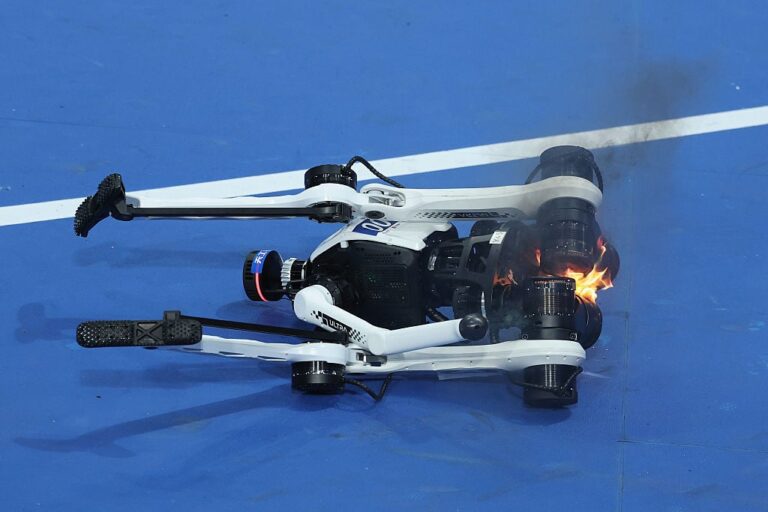
- Despite the speed achievements, robots failed at executing their core functions: one caught fire mid-competition, another defeated itself in boxing, and many broke down from extended standing.
- Engineers appear to have prioritized programming celebratory Fortnite emotes over ensuring mechanical reliability and basic task capability.
- Industry experts warn that humanoid robotics could face widespread weaponization within 2–3 years, following the trajectory of Boston Dynamics quadruped robots.
The World Humanoid Robot Games are currently underway in Beijing, representing what appears to be the largest competition of its kind ever assembled. The event mirrors the scale and spectacle of major tournaments like BattleBots, but instead of remote-controlled combat machines, human engineers pit humanoid robots against one another in a diverse range of challenges.
The competition features boxing, weightlifting, track races, and real-world scenario simulations—firefighting and hospitality tasks designed to demonstrate whether these machines can perform the work they were ostensibly engineered to accomplish. These aren’t theoretical demonstrations in controlled laboratory conditions. Instead, they are public tests of whether humanoid robotics have reached a point where they can handle practical applications beyond simulation.
The Speed Claims
Several reports have emerged claiming that multiple robots competing in the games have broken Usain Bolt’s 100-meter dash record. One Chinese AI robot reportedly achieved a speed of 14.5 meters per second. On paper, these figures suggest that humanoid robotics have achieved remarkable speed capabilities—surpassing the fastest times recorded by the human athletic world.
The Reality Behind the Numbers
The gap between these headline-generating speeds and what actually occurred on the competition floor tells a more complicated story. While some robots may have clocked impressive velocities during track races, the broader narrative from Beijing’s games centers on spectacular failures and design flaws that undermine the celebration of speed records.
What Went Wrong
Mechanical Brittleness
The robots competing in Beijing demonstrated a troubling pattern: they appear to be constructed in ways that cannot withstand the stresses of the tasks they were designed for. Machines have been observed falling apart from the simple act of standing for extended periods. Rather than recovering from minor malfunctions, robots have required stretchers to be carried away from the competition floor—a visual that cuts against the narrative of advanced capability.
Catastrophic Failures
One robot literally caught fire during its event, with its rear section combusting mid-competition. This was not a minor malfunction that engineers could quickly address; it was a complete system failure that rendered the machine inoperable and posed safety risks. Unlike Usain Bolt, who could theoretically run multiple races without igniting, these robots cannot reliably complete even a single event without risk of fire.
Unexpected Behavior
In one of the boxing events, a humanoid robot defeated itself—essentially malfunctioning so severely that it lost to its own mechanical failures rather than to genuine competition with its opponent. More bizarrely, after this self-inflicted loss, the robot’s opponent suddenly executed Fortnite emotes, suggesting that significant engineering resources went into programming celebratory dance moves rather than ensuring the machines could accomplish their primary functions.
Design Priorities and Actual Performance
The incidents emerging from Beijing suggest a troubling misalignment in engineering priorities. The effort invested in allowing these robots to execute taunting and celebration movements—performing Fortnite emotes in a boxing ring—indicates that developers may have prioritized showmanship over fundamental mechanical reliability. If robots cannot consistently stand upright, complete a boxing match without defeating themselves, or run without catching fire, then what is the point of programming them to do viral dance moves?
This pattern extends across multiple events. Robots seem to be falling apart during their assigned tasks, incapable of performing the functions they were ostensibly built to execute. The contrast between the technical feat of building a machine that can theoretically move quickly and the inability to make a machine that can reliably do anything—boxing, weightlifting, running—without mechanical failure is stark.
The Broader Concerns
The current spectacle in Beijing cannot be separated from a longer conversation in robotics development and technology ethics. Advances in humanoid robotics have generated enthusiasm across the industry, much like the earlier excitement surrounding Boston Dynamics’ quadruped robots. Those Boston Dynamics machines became cultural phenomena, admired for their mobility and coordination. But that enthusiasm proved temporary when developers began attaching weaponry to these robots, transforming them from impressive technical demonstrations into potential instruments of warfare.
The timeline is worth noting: observers estimate there are approximately two to three years remaining before similar weaponization becomes common across humanoid robotics. If machines continue to develop at their current pace, and if the pattern of Boston Dynamics serves as a guide, the current moment of amusement at robots doing Fortnite emotes may give way to serious concerns about how this technology is deployed.
The Beijing games are a reality check on humanoid robotics ambitions. Speed records matter only if the machines can actually complete their intended tasks without catastrophic failure. Until that fundamental problem is solved, the world’s fastest humanoid robot is just an expensive machine that catches fire faster than any human competitor ever could.
Frequently Asked Questions
What events are featured in the World Humanoid Robot Games?
The competition includes boxing, weightlifting, track races, and real-world scenario simulations such as firefighting and hospitality tasks.
Did any robots break Usain Bolt's sprint record at the Beijing games?
Yes, multiple robots reportedly exceeded Bolt's 100-meter dash record. One Chinese AI robot achieved a speed of 14.5 meters per second.
What were some of the major mechanical failures observed at the competition?
Robots caught fire, fell apart from standing for extended periods, required stretchers for removal from the competition floor, and in one boxing match, a robot malfunctioned so severely it defeated itself.
