
Key takeaways
- Dune: Awakening's PS5 version translates console controls and gamepad play flawlessly, running with solid performance and minimal online lag.
- The game's resource harvesting and combat mechanics avoid typical survival game tedium, making gathering feel satisfying and gunplay worth seeking out.
- A longtime survival game skeptic logged over a dozen hours and plans to play substantially more—a rare outcome for someone who typically abandons the genre within hours.
There is a category of games that one reviewer has learned to avoid entirely. Survival crafting experiences—what some call tree punchers—held initial appeal during their first few hours of exploration and fort-building, yet invariably devolved into tedious grinding that never provided enough moment-to-moment satisfaction to justify continued play. The pattern repeated so consistently that avoidance became policy.
Then came Dune: Awakening, and that policy shattered. After spending well over a dozen hours with the MMO survival RPG on PS5, the same person now intends to log considerably more.
The Unexpected Console Home
Dune: Awakening launched on PC last year, but the bulk of its current iteration has arrived through a substantial update that brought the game to PS5 and Xbox simultaneously. That update bundled more than console ports—it introduced new gameplay options, fresh story content, quality-of-life enhancements, a complete single-player mode, and the ability to sidestep PvP entirely for those who prefer it. According to reporting on the experience, the game translates to consoles with surprising finesse.
Controller Feels Native
The most immediate revelation is how naturally Dune: Awakening inhabits a controller-based ecosystem. Inventory management, base construction, gunplay, and movement across terrain both on foot and by vehicle all register as intuitive on a PlayStation 5 gamepad. The absence of a mouse never registers as a limitation. Curiously, controller-based play shifted the game’s identity in the reviewer’s perception—suddenly it resembled an action-adventure title far more than a Steam-exclusive crafting simulator, a psychological reframing that apparently helped prevent the typical early-game bounce-off.
Performance and Presentation
Technical stability anchored the experience. The game runs smoothly on hardware, with UI responsiveness that never interrupted flow. This technical competence extended to online functionality: multiplayer sessions maintained rock-solid stability with minimal lag or anomalies. For 2026, a survival game that simply works without constant friction feels noteworthy.
Two Distinct Approaches to the Same World
The PS5 version supports both single-player and multiplayer progression, though with an important limitation. Players can experience the opening hours and story content through a solo campaign that functions as a complete experience rather than a gutted MMO variant. However, single-player progress cannot transfer to multiplayer servers. Starting a multiplayer session requires generating a fresh character, a minor inconvenience offset by a graceful design choice: after the tutorial and initial section conclude, the game permits skipping that same section on subsequent character creation.
Single-Player as Standalone
The single-player mode functions without the sensation of compromise. Quests flow naturally, character progression feels purposeful, and the survival mechanics—harvesting blood and dew water from Arrakis while fending off environmental threats—integrate into a coherent experience rather than feeling like extracted multiplayer fragments.
The Multiplayer Transition
Yet multiplayer unlocked something additional. Playing cooperatively with a partner (in this case, a brother) transformed the experience’s texture. Constructing a modest shelter together in the desert sands, gathering materials, and hunting bandits for resources created a different kind of momentum than solo play provided—shared vulnerability and discovery rather than solitary mastery.
Why the Moment-to-Moment Gameplay Clicks
The difference between Dune: Awakening and the survival games that failed to hold this reviewer’s attention lies in granular design choices that compound across hours of play.
Harvesting Without Tedium
Resource gathering operates through a streamlined loop: scanning rocks and other environmental objects reveals extraction points, a laser tool carves along highlighted patterns, and the material breaks free into inventory automatically. Nothing about the process feels laborious, time-consuming, or designed primarily as padding. It satisfies the resource-gathering fantasy without making that fantasy feel like punishment.
Combat Worth Seeking Out
Gunplay in Dune: Awakening occupies an uncommon position for the survival genre. The combat cannot match elite third-person shooters, yet it manages something harder: it feels genuinely good within its own context. Encounters feel snappy, present enough danger to matter, and responsive enough that ducking behind cover or depleting an enemy’s energy shield never registers as watching predetermined animation sequences resolve. Cover-based firefights avoid the clunkiness that plagues many survival titles without achieving the polish of dedicated action franchises. The reviewer found combat compelling enough to deliberately hunt bandits as optional activity rather than necessary routine.
The Universe Beneath the Sand
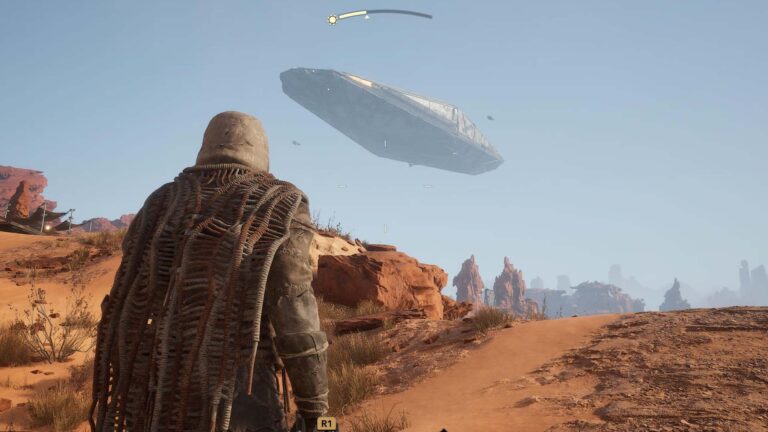
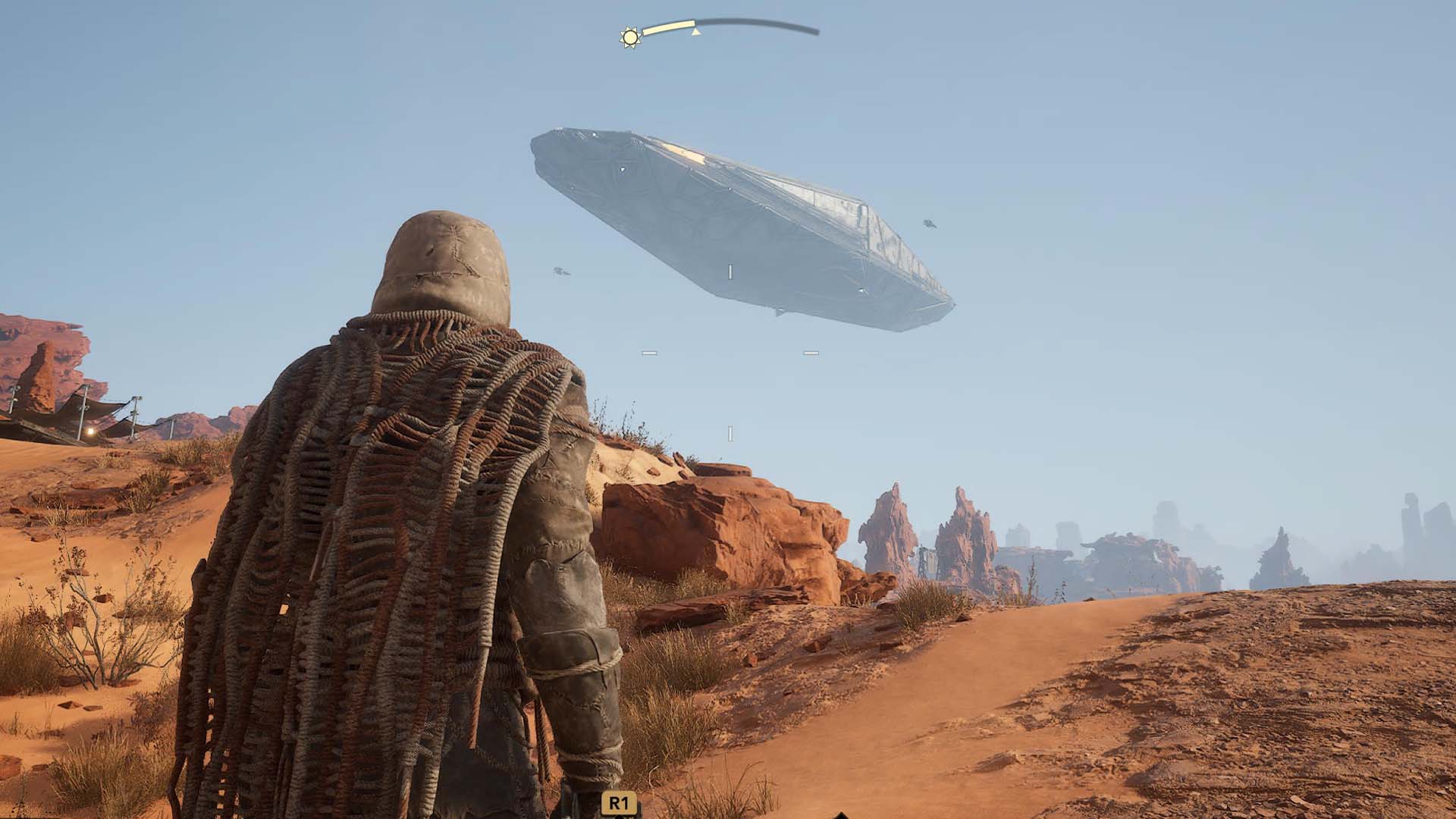
The reviewer harbors no special claim as a Dune encyclopedist. The new films remain unwatched (though slated for viewing later in 2026). The original novel was consumed in middle school. Yet despite this casual relationship with source material, Dune: Awakening’s world-building landed with impact. Arrakis registers as genuinely hostile and ancient. The massive orbital vessels hovering in the sky communicate alien scale and oppressive dominance. Early progression creates a visceral sense of insignificance—the player character is a speck within forces far larger and more consequential than individual understanding permits. For longtime Dune devotees, presumably countless references and Easter eggs reward deep investment. For the casually familiar, the atmosphere proves sufficient.
Co-op as Glue and Catalyst
Multiplayer sessions with a cooperating partner amplified engagement substantially. That solid online infrastructure mattered here: stability without visible lag transformed shared activities from frustration potential into genuine collaborative fun. The technical competence enabled the social experience rather than impeding it.
Finding Joy in the Chaos
A late-night session produced an unscripted memory that captured the game’s capacity for unexpected fun. A massive desert worm patrols the open sand, threatening to devour anything crossing exposed dunes while consuming all carried resources permanently. This creature had been successfully avoided through caution for multiple sessions. Eventually curiosity overtook discretion: the player’s partner removed all equipment and clothing, venturing into open sand to deliberately attract the worm.
Dune: Awakening became an improvisational comedy in that moment. After playful interaction with the creature, luck abandoned the naked explorer. The worm consumed its would-be taunter in a scene the partner wished had been screenshotted but was too busy laughing to capture.
The Unexpected Conversion
The reviewer still does not know whether Dune: Awakening’s endgame content holds quality. Potential negative meta-shifts or community complaints remain unconsidered. Solo play has proven engaging enough that such considerations feel immaterial. The fundamental revelation—that a survival crafting game exists in 2026 that provides sustained enjoyment rather than early burnout—reads as improbable enough to warrant repeated mention. The genre conversion remains complete and apparently durable.
Source: Kotaku
Frequently Asked Questions
Can single-player characters play online with others?
No. Single-player progress cannot transfer to multiplayer servers. Players must create a new character to play cooperatively, though the game allows skipping the tutorial and opening section on subsequent playthroughs.
Does the PS5 version require a mouse and keyboard?
No. The game plays naturally with a PlayStation 5 controller. Inventory management, building, combat, and exploration all feel intuitive on gamepad, and the controller-based setup apparently made the game feel more like an action-adventure title than a survival sim.
What makes Dune: Awakening different from other survival crafting games?
The resource-gathering loop eliminates tedium through automated collection after scanning and laser-cutting highlighted spots, and combat feels snappy and responsive rather than clunky or like watching animations play out, which are qualities the reviewer found missing in comparable titles.
