
Key takeaways
- Mike Klubnika, creator of 2023's breakout hit Buckshot Roulette, has developed Machine Party, a multiplayer party game where up to four players face deadly Squid Game-inspired gauntlets.
- Buckshot Roulette became one of Steam's highest-selling games in 2023, launching as a one-on-one Russian roulette simulator before receiving a multiplayer mode expansion.
- Machine Party combines Mario Party-style social gameplay with dark comedy mechanics where permanent player elimination drives competition, distinguishing it from traditional friendly party games.
Mike Klubnika, the creative force behind 2023’s surprise hit Buckshot Roulette, is now developing Machine Party—a multiplayer party game that applies his dark sensibility to a format traditionally dominated by friendship and lighthearted competition. Up to four players can gather for this experience, though the survival rate remains intentionally dire. Where Mario Party celebrates cooperation through economic gameplay, Machine Party celebrates chaos through elaborate death scenarios.
Klubnika’s path to Machine Party began years earlier, in a catalog of unnerving experiences scattered across Steam. His portfolio includes Fused 240, a Ballardian garage horror piece that established his fascination with psychological discomfort. But it was Buckshot Roulette that would transform him from a niche creator into someone Steam players actually recognized.
The Rise of Buckshot Roulette
The Russian Roulette Premise
Buckshot Roulette launched in 2023 as a deceptively simple one-on-one experience. Two players faced off, each taking turns loading a revolver and pointing it at their own head. The mechanical core demanded strategy—players managed items strategically and calculated odds to determine who would survive the encounter. What could have remained an obscure curiosity shared in gaming forums instead became a phenomenon.
Steam Success and Multiplayer Expansion
Buckshot Roulette became one of Steam’s highest-selling games that year, a commercial achievement that surprised industry observers and likely surprised Klubnika as well. The unexpected success prompted a post-launch addition: multiplayer mode, which expanded the skull-against-skull experience beyond two competitors. This success validated Klubnika’s instinct that players wanted games refusing conventional comfort and safety design.
Machine Party’s Design Foundation
Squid Game-Inspired Gauntlets
Machine Party transplants Klubnika’s dark sensibility onto the party game template. The game structures itself around a series of gauntlets—novel obstacle courses clearly inspired by popular survival competition media. Each gauntlet presents a distinct challenge, designed by someone who has clearly studied how to maximize psychological pressure on social gaming.
Cooperative and Competitive Trial Structure
Some trials actually allow all four players to escape together. One scenario features a narrow, freckled minefield where coordinated navigation lets everyone emerge largely intact—these moments feel almost generous by comparison to what follows. Most trials, however, pit participants directly against each other. An out-of-control escalator forces players to outlast one another simply by remaining on the surface. Another trial has competitors racing to construct an ACME gun—the fastest builder gains offensive capability while others face the resulting attack.
Body Horror and Mechanical Elimination
Body horror elements weave throughout. Drones descend to eliminate slow-moving players. A robot spider roams stages, performing what the game darkly calls unlicensed chiropractic techniques on anyone caught. These aren’t environmental hazards—they’re active forces designed to remove players from competition.
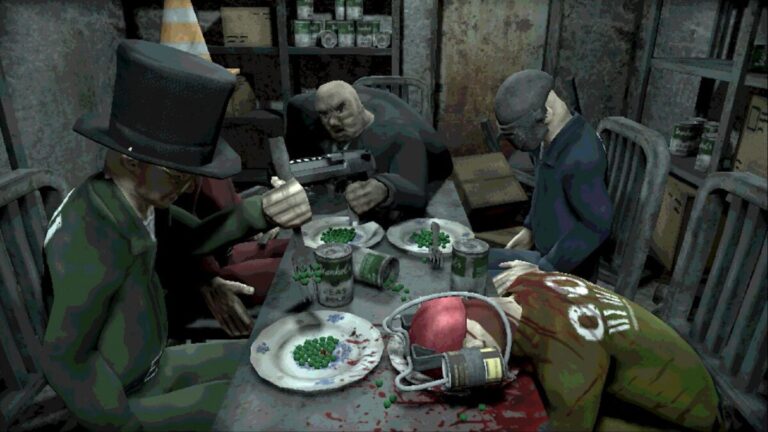
The minigames themselves blend grotesque comedy with genuine danger. Players compete by eating green peas as quickly as possible—an activity sounding innocuous until the game’s consequences make speed meaningful. A cigarette smoking competition runs with similar logic, converting recreational vice into competitive sport. For Klubnika, mundane activities become staging grounds for elimination.

Design Philosophy and Tone
Fans of Buckshot Roulette will immediately recognize the design language. Machine Party exists in the same rusted, hellish aesthetic space. The presentation is loud, worn, deliberately unglamorous—this is industrial decay applied to party game structures.
The game positions itself within a brutal collective world. Some challenges come wrapped in legitimate danger. Others arrive wrapped in absurdity. The distinction barely matters when the outcome remains identical: elimination or survival.
What distinguishes Klubnika’s approach from other dark comedy games is the commitment to actual consequences. In Mario Party, losing a minigame costs currency or adjusts board position. In Machine Party, players simply die. Not metaphorically. Not through respawn mechanics or infinite retries. Wario’s cliff fall now has a definitive answer—yes, Wario dies. That clarity of consequence drives the comedy and distinguishes the experience.
Klubnika’s Broader Artistic Portfolio
Before achieving mainstream recognition, Klubnika had been building a catalog of horror and discomfort. These earlier works, scattered across Steam, never achieved Buckshot Roulette’s commercial heights, but they established consistent thematic interests. Fused 240 particularly stands out—a Ballardian garage horror experience that occupies conceptual space aligned with J.G. Ballard’s fiction, where familiar environments become alien through subtle distortion.
This body of work provides essential context for Machine Party. Klubnika is not pivoting toward dark comedy as a trend. This represents Klubnika applying his established sensibility to a new structure. The party game format simply provides a new venue for exploring discomfort and mechanical consequence.
Market Implications and Gaming Culture
Machine Party’s existence signals something about contemporary gaming culture. A dark party game from a developer known for horror secured enough backing to reach production. Publishers or platforms saw commercial potential in a game specifically designed to kill players in ridiculous ways. That calculus would have seemed unlikely five years ago.
Buckshot Roulette’s success proved that players wanted experiences outside conventional safety rails. Machine Party represents what that market looks like when you scale the concept to accommodate more participants and varied scenarios. The formula remains consistent—high consequence, dark comedy, refusal to soften tone—but delivery broadens.
For party gaming specifically, Machine Party represents a fork in the road. The mainstream remains dominated by friendly, inclusive design. Machine Party exists on an alternate path, one that embraces elimination as a mechanic. Every round produces eliminated players. The comedy derives partly from their elimination. That approach generates specific social dynamics, ones traditional party games deliberately avoid engineering.
Buckshot Roulette proved there was an audience for this approach in one-on-one contexts. Machine Party now tests whether that audience expands when you add additional deaths, more chaos, and more opportunities for failure.
Frequently Asked Questions
Who created Machine Party?
Mike Klubnika, the developer behind 2023's Buckshot Roulette, created Machine Party.
How many players can participate in Machine Party?
Up to four players can participate in Machine Party simultaneously across its various gauntlets and trials.
What made Buckshot Roulette successful on Steam?
Buckshot Roulette became one of Steam's highest-selling games in 2023 with its one-on-one Russian roulette mechanics that emphasized strategy and odds calculation. Its success led to a multiplayer mode expansion and validated player interest in dark comedy games with high consequences.
