
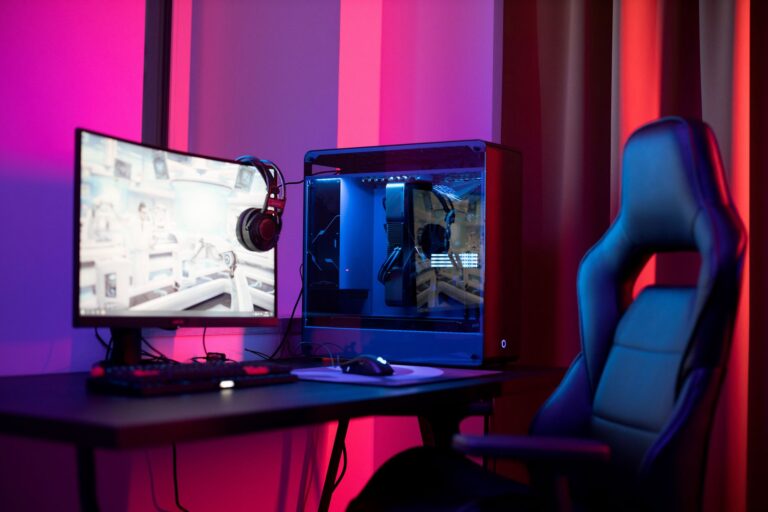
Key takeaways
- A gaming chair’s primary function is to maintain proper spinal alignment and support during extended gaming sessions that often last four to eight hours consecutively.
- Gaming mice represent perhaps the most critical performance-affecting peripheral because they directly determine aiming accuracy in competitive shooters.
- Gaming keyboards function differently from standard typing keyboards in ways that affect both reaction time and consistency.
- Display technology affects performance through refresh rate—the number of times per second a monitor updates the image shown to the player.
The relationship between hardware ergonomics and competitive gaming performance extends far beyond comfort—it directly influences reaction time, accuracy, and sustained focus during extended play sessions. Professional Esports organizations invest thousands of dollars in equipment setups for their players because the physical interface between human and machine fundamentally shapes gameplay outcomes. Understanding how gaming chairs, mice, keyboards, and monitors affect performance requires examining both the physiological mechanisms at work and the empirical evidence from competitive gaming environments.
The Ergonomic Foundation: Posture and Physical Stability
A gaming chair’s primary function is to maintain proper spinal alignment and support during extended gaming sessions that often last four to eight hours consecutively. When a player sits in an unsupported position—such as a standard office chair or couch—the spine curves unnaturally, causing muscle fatigue in the lower back, neck, and shoulders. This fatigue creates micro-movements that translate directly into cursor drift, inconsistent aim, and degraded performance in precision-dependent games like first-person shooters or real-time strategy titles. A properly designed gaming chair with lumbar support, adjustable armrests, and neck pillows distributes body weight evenly and reduces the muscular effort required to maintain position.
Research into occupational ergonomics demonstrates that proper seating reduces fatigue-related performance decline by measurable margins. The International Ergonomics Association has documented that unsupported sitting positions increase error rates in precision tasks by 15-20% after two hours of continuous work, with degradation accelerating thereafter. Professional Esports teams adopted specialized gaming chairs in the early 2010s specifically to address this issue—organizations like SK Gaming and Fnatic began providing custom seating solutions to players competing in marathon tournament formats.
Input Device Precision: Mice, Keyboards, and Muscle Memory
Gaming mice represent perhaps the most critical performance-affecting peripheral because they directly determine aiming accuracy in competitive shooters. A gaming mouse differs from a standard office mouse through several technical specifications: adjustable DPI (dots per inch, measuring cursor sensitivity), polling rate (how frequently the mouse reports its position to the computer), and weight distribution designed to minimize hand strain. When a player uses a mouse with a high polling rate—typically 1000Hz or higher—the computer receives position updates 1000 times per second rather than the 125Hz standard of older peripherals, reducing input lag by 7-8 milliseconds.
Professional Counter-Strike: Global Offensive players demonstrated the practical impact of these specifications during the mid-2010s competitive scene. Players like Nicolai “device” Reedtz and Nikola “NiKo” Kovač attributed significant portions of their aim consistency to using mice with customized weight profiles and DPI settings matched to their play style. The difference between a 125Hz polling rate mouse and a 1000Hz mouse becomes immediately apparent in high-sensitivity flick shots—the lower latency allows for smoother cursor movement and more predictable aiming patterns, directly affecting headshot accuracy rates.
Keyboard Response and Mechanical Advantages
Gaming keyboards function differently from standard typing keyboards in ways that affect both reaction time and consistency. Mechanical keyboards, which use individual switches beneath each key rather than rubber domes, register key presses faster and provide tactile feedback that helps players develop consistent muscle memory. The actuation distance—the depth a key must be pressed before registering—ranges from 1.5mm to 4mm depending on switch type, with shorter actuation distances reducing the time between player intention and in-game action. This seemingly minor difference accumulates significantly across thousands of keypresses during competitive matches.
The adoption of mechanical keyboards in professional gaming accelerated following the 2011 League of Legends Season One World Championship, where players began customizing their setups with specialized equipment. Teams recognized that mechanical keyboards reduced input latency compared to membrane keyboards by approximately 10-15 milliseconds per keystroke, a difference that becomes critical in games requiring rapid ability rotations or complex command sequences. Players competing in games like StarCraft II and Dota 2, where players execute 300-400 actions per minute, found that mechanical keyboards reduced execution errors and improved consistency under pressure.
Monitor Technology and Visual Processing Speed
Display technology affects performance through refresh rate—the number of times per second a monitor updates the image shown to the player. A 60Hz monitor refreshes 60 times per second, while a 144Hz monitor refreshes 144 times per second, resulting in smoother visual feedback and reduced motion blur during fast camera movements. This difference is particularly pronounced in first-person shooters where rapid head movements are common; a higher refresh rate allows players to track moving targets more effectively because the display updates more frequently to reflect their current position. The relationship between refresh rate and competitive performance has been extensively documented through both professional play and controlled testing environments.
Professional esports organizations standardized on 144Hz monitors beginning around 2015, with top-tier tournaments now requiring 240Hz displays for competitive play. Esports research organizations like the University of York’s Human-Computer Interaction laboratory conducted studies demonstrating that players using 240Hz monitors achieved 5-10% higher accuracy rates in aim-training scenarios compared to 60Hz displays. This standardization reflects the consensus that monitor technology directly influences competitive outcomes, making display quality a non-negotiable component of professional gaming setups.
The Evolution of Gaming Equipment Standards
Gaming peripherals have evolved from afterthoughts to specialized equipment categories over the past two decades. In the early 2000s, professional gamers used standard computer peripherals—ordinary mice, keyboards, and office chairs—because specialized gaming equipment did not exist as a commercial category. As competitive gaming professionalized and prize pools expanded, equipment manufacturers began designing products specifically for gaming applications, incorporating the technical specifications that competitive players identified as performance-critical. This evolution mirrors the professionalization trajectory of esports itself, where equipment quality became an expected investment rather than an optional luxury.
The founding of peripheral manufacturers like SteelSeries in 2002 and the subsequent launch of gaming-specific product lines marked a turning point in equipment accessibility. By the late 2000s, professional teams could purchase standardized setups rather than assembling custom solutions from various manufacturers. Organizations like SK Gaming documented measurable improvements in player consistency after transitioning to standardized equipment across their roster, establishing benchmarks that other organizations adopted.
Frequently Asked Questions
Can an expensive gaming chair actually improve my gameplay?
An expensive gaming chair improves gameplay by reducing physical fatigue and maintaining proper posture during extended play, which directly affects consistency and reaction time. The performance benefit derives from ergonomic support rather than brand prestige—a chair with proper lumbar support, adjustable armrests, and neck support will outperform a standard office chair regardless of price point, though quality construction ensures durability across thousands of hours of use.
How much does monitor refresh rate actually matter for competitive play?
Monitor refresh rate creates measurable performance differences in competitive games, with players using 144Hz+ displays achieving 5-10% higher accuracy in aim-dependent tasks compared to 60Hz monitors. The difference becomes more pronounced in fast-paced games requiring rapid target tracking, though the improvement plateaus at certain refresh rates depending on the player’s capability and the game’s specific demands.
Is a mechanical keyboard necessary for competitive gaming?
Mechanical keyboards reduce input latency by 10-15 milliseconds compared to membrane keyboards and provide tactile feedback that aids muscle memory development, making them advantageous for competitive play. However, the advantage primarily manifests in games requiring rapid ability execution or complex command sequences—the benefit is less pronounced in games emphasizing aiming over mechanical execution.
Gaming equipment affects performance through quantifiable physiological and technical mechanisms rather than psychological placebo effects. Professional esports organizations continue to invest in specialized chairs, monitors, mice, and keyboards because the performance improvements directly correlate with competitive outcomes across measurable metrics.
