
Key takeaways
- Kotaku found Fallbearers as one of the few genuine games worth playing at Steam Next Fest, buried among thousands of AI-generated demos.
- Fallbearers merges QWOP's awkward physics controls with Victorian pallbearing, demanding precise coordination to transport a coffin through urban obstacles without dropping it.
- Solo play feels like a puzzle-solving challenge, but cooperative mode turns the game into chaotic, comedic moments where two human players constantly desynchronize their actions.
- The full game promises to expand with snowy landscapes and skiing mechanics beyond the demo's current urban setting.
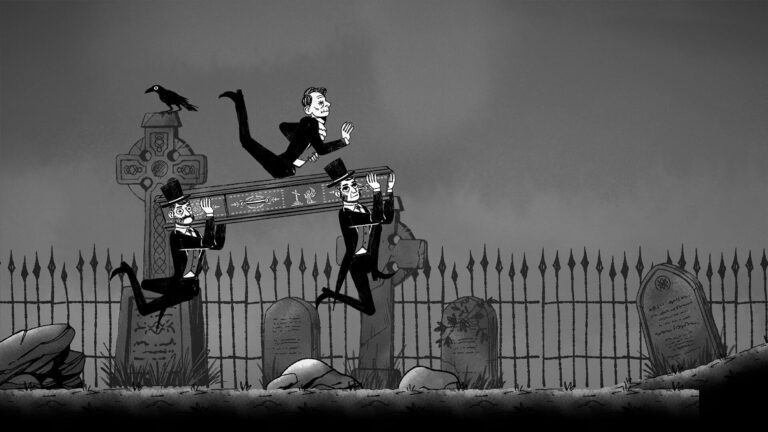
Steam Next Fest has become a numerical exercise in quantity over quality. The latest edition brings thousands of demos to Valve’s platform, but according to Kotaku, an overwhelming majority consists of AI-generated content that muddies discovery for players with limited free time. Rather than accept defeat, Kotaku waded through the festival and identified a single demo worth downloading: Fallbearers, a Victorian-era coffin-carrying simulator that merges the physics-comedy of QWOP with the dark-humor spirit of Tim Robinson’s “Coffin Flop” bit from HBO’s I Think You Should Leave.
What Fallbearers Actually Is
Fallbearers asks players to occupy an unexpected role: Victorian pallbearers transporting the deceased to their final resting place. You can play alone or cooperatively with another person, controlling two pallbearers as they navigate from hearse to grave through urban obstacles. The two characters walk automatically, but you control their speed, jumping behavior, and the height at which they carry their slippery cargo. Success requires coordinating movement through busy streets populated with environmental hazards: open manholes, steep inclines, and occasionally, aggressive bulldogs. Drop the coffin, and the game ends immediately, creating constant tension around every potential collision or misstep.
The Mechanics: Awkwardness as Design
Physics-Based Precision
Fallbearers succeeds because it understands that awkwardness can be a mechanic. Similar to QWOP, which asked players to control individual leg muscles to make a runner move across a track, Fallbearers makes pallbearing feel genuinely complicated despite its apparent simplicity. The challenge emerges from the precision required: the height at which you grip the coffin determines clearance for obstacles, and your speed affects how quickly you can react to terrain changes. When the two pallbearers move at different paces or hold the coffin at mismatched angles, the entire operation destabilizes. Kotaku described having a great time figuring out when and how to raise and lower the pallbearers to successfully clear each challenge, indicating that the learning curve is steep but rewarding.
Navigating the Obstacle Course
The demo presents obstacles such as open manholes, steep inclines, and aggressive bulldogs that each require a specific approach to navigate without dropping the coffin. Players need to determine the correct combination of coffin height, movement speed, and jump timing to clear each hazard. Kotaku found this aspect of the game engaging, describing the process of learning the right approach to each challenge as intrinsically rewarding despite the constant possibility of failure.
Solo Play Versus Cooperative Experience
Playing Alone
According to Kotaku, the demo is “criminally short,” but playable time in single-player mode feels manageable. You’re coordinating two characters who must move in relative concert, managing one set of inputs to keep them balanced. The difficulty can adjust to allow a certain number of failures before a complete run ends, which provides room for learning the game’s rhythms. Solo play transforms Fallbearers into a puzzle where you’re solving for the exact inputs required to clear each section.
Cooperative Chaos
Introducing a second human player fundamentally changes the experience. Kotaku suggested it would “likely be a hoot,” indicating that coordinating with another person introduces miscommunication, timing mishaps, and moments of comedic failure. One player might hold the coffin too high while the other raises it further. A jump might happen when one person expects a walk. These moments of desynchronization produce the kind of organic humor that co-op physics games generate naturally. The game becomes less about solving a puzzle and more about managing chaos with a partner.
Planned Expansion: Snowy Terrain and Skis
The full game is promised to expand beyond the demo’s urban setting. Fallbearers will include snowy landscapes that force players to navigate terrain while wearing skis. This signals the developers understand the core appeal and plan to introduce environmental variety rather than simply repeating the same obstacle types throughout a longer experience. Adding skis to the pallbearer equation introduces an additional control layer, since movement on snow behaves differently than movement on city streets. No release date has been announced. Kotaku’s joking reference to the hypothetical timing between other upcoming titles underlines how the game’s announcement remains deliberately vague.
Why This Discovery Matters in Context
Fallbearers succeeds through focused creative vision: take a niche concept, execute it cleanly, and let humor emerge from players wrestling with the game’s constraints. In a Steam Next Fest saturated with AI-generated content, discovering a game with clear human design choices and intentional creativity feels like genuine discovery. Kotaku’s recommendation carried weight because it came from actually playing the demo, which sets it apart from algorithmic suggestions that cannot distinguish between polished work and generated filler. When festivals designed to showcase upcoming indie titles become difficult to navigate due to volume and quality dilution, word-of-mouth recommendations from players who engaged with demos become more valuable than algorithmic curation. Kotaku’s identification of Fallbearers serves a practical function: it signals where genuine human creativity exists within the noise.
Frequently Asked Questions
What game did Kotaku recommend from Steam Next Fest?
Kotaku recommended Fallbearers, a Victorian-era coffin-carrying simulator that combines QWOP's physics controls with the "Coffin Flop" bit from Tim Robinson's HBO show I Think You Should Leave.
Can you play Fallbearers solo or only with another person?
You can play Fallbearers solo or cooperatively with another person, though Kotaku found the experiences notably different; solo play is more puzzle-focused, while cooperative play introduces moments where players constantly desynchronize.
What obstacles and features will the full game include?
The demo includes urban obstacles such as open manholes, steep inclines, and aggressive bulldogs. The full game is promised to add snowy landscapes where players must navigate while wearing skis, expanding the environmental variety beyond the demo's current setting.
