
Key takeaways
- Dog Online crossed 10,000 players after quietly growing through word-of-mouth since its April Fools' Day beta launch.
- The game combines Neopets-style pet care with fishing, farming, trading, and a surprisingly deep turn-based RPG dungeon called the Lonely Tower.
- Its progression design prioritizes discovery and patience over grinding, with time-gated activities that reward checking back daily rather than marathon sessions.
- Dog Online taps into 2000s internet nostalgia while representing independent creation as an alternative to corporate gaming platforms.
Sometimes the smallest games remind us what we loved about the internet before algorithms decided what we should see. Dog Online, a browser-based virtual pet simulator and role-playing game now in open beta, taps directly into that nostalgia while offering surprising depth beneath its MS Paint aesthetic. The game mirrors Neopets in structure but charts its own course with turn-based dungeon crawling, resource management, and an economy built around discovery and patience rather than aggressive progression mechanics.
From Quiet Launch to Viral Success
Dog Online arrived with minimal fanfare on April Fools’ Day, released by a small team that came together less than a year prior under the direction of lead developer Mimi. For months, the game remained largely hidden, accessible mainly through word-of-mouth despite its awkwardly un-Googleable name. The development team maintained only a modest Bluesky account, occasionally sharing pieces of fan art created by its early players. The actual growth mechanism was organic: people discovered Dog Online through friends and online communities, not marketing campaigns or social media algorithms.
That quiet trajectory shifted dramatically within the past two weeks. According to Kotaku, the game surpassed 10,000 active users, a milestone that caught the development team off-guard. The sudden influx forced them to scramble upgrading server infrastructure to handle the load. For a beta project from an independent studio, this represents an unexpected validation of their design philosophy and the appetite among players for something different from mainstream live-service games.
More Than Pet Care
Fishing and Farming Anchors
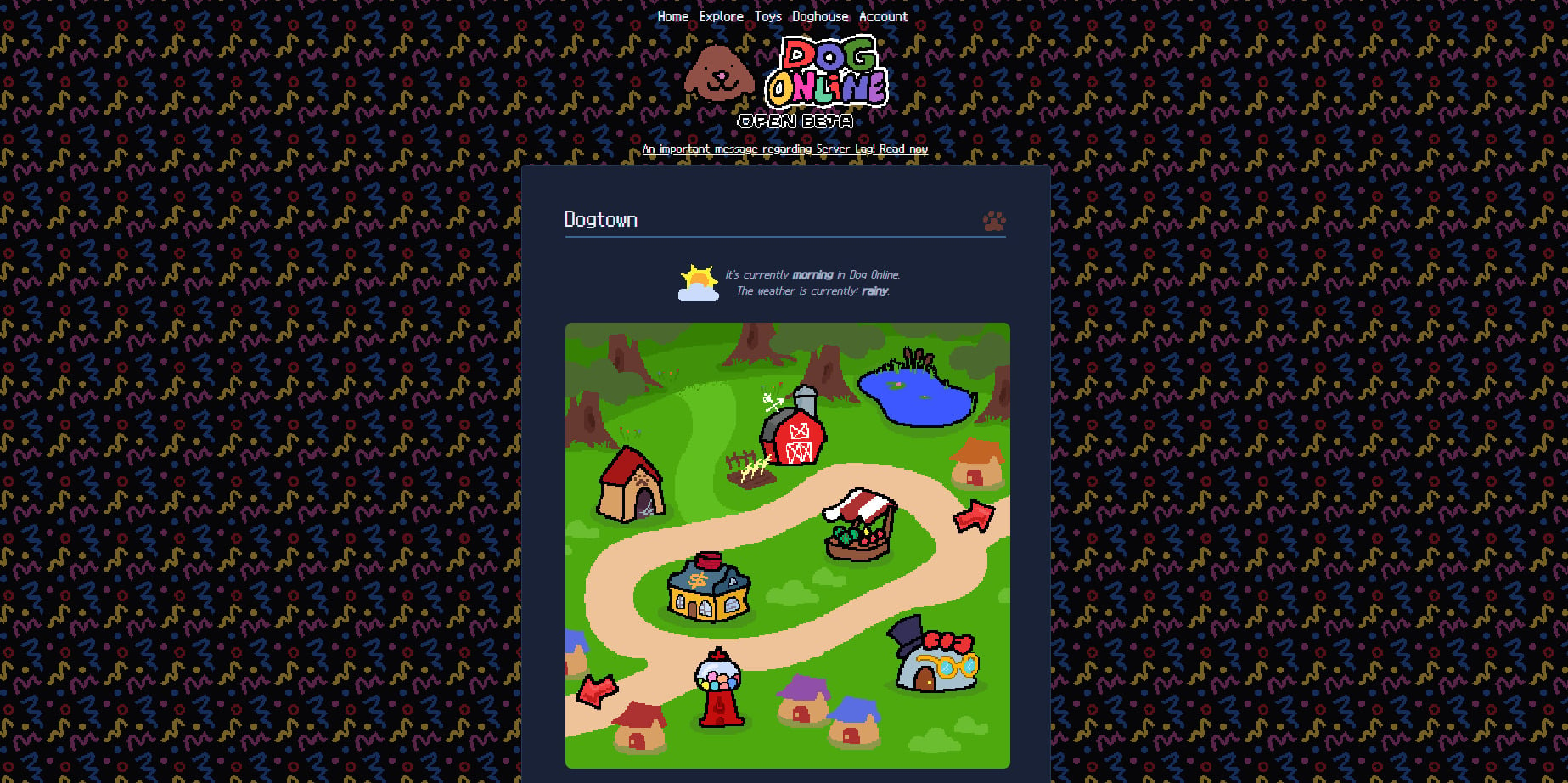
The core loop involves caring for one or more dogs while engaging in multiple resource-gathering activities. Fishing provides one stream of income and progression, though players can only cast a line a limited number of times per day. Farming operates on a longer timescale: crops planted can take actual days to mature before harvest. This time-gating runs counter to modern game design, which typically removes real-world wait times. Dog Online embraces the friction deliberately, rewarding players who check back over time rather than those who marathon sessions.
The Lonely Tower: Hidden Dungeon Complexity
Buried within the game’s various locations sits the Lonely Tower, a grid-based turn-based RPG dungeon that reveals surprising tactical depth. According to Kotaku, exploring the Tower involves navigating a grid while battling enemies that grow progressively tougher across floors. Players might encounter treasure chests, random status effects, healing fountains, or even alternate floors with entirely new enemy sets. Each run can take hours, and Kotaku’s experience with the Tower suggested the game contains layers that even dedicated play barely scratches.
Trading and the Economy
Beyond solo activities, Dog Online includes trading mechanics and an economy where players can sell wares when market conditions align. The game also offers cosmetic customization: players dress their dogs in clothes and equip items found during exploration. The ability to show off favorite possessions on a personal Dogpage creates a display mechanism akin to early internet homepages, though the game lacks a direct chat feature. Gift-giving to friends and collaborating on discovery serve as the primary social hooks.
Staggering Content Volume in Beta
Despite beta status, Dog Online contains far more content than its simple presentation suggests. The game currently catalogs 73 fish species, 238 foods, 57 enemy types, and 76 crops and other harvestable items. Beyond those tracked numbers lie a host of weapons, creatures, enemy drops, and miscellaneous items waiting to be discovered. Players have already started collaborative documentation, with fan-created Discord communities and wikis cataloging findings, though the developers encourage approaching the game with experimentation rather than guide-checking.
Progression Built on Discovery, Not Grinding
Each dog maintains five core stats—bravery, coordination, and three others—that can only be leveled by discovering new content. The first time a player defeats a previously unknown enemy type, bravery increases. Catching a new fish species for the first time grants coordination progress. This design creates a hard ceiling on daily progression; once you’ve discovered all available content for the day, meaningful advancement stops until new content exists or the daily reset arrives.
The philosophy inverts standard live-service thinking, which maximizes engagement by encouraging constant play. Dog Online instead suggests that players should log off, step away, and return fresh the next day. Kotaku noted this quality makes the game feel unusually offline despite running in a browser, rewarding breaks over marathons. In 2026, when most games compete for screen time by eliminating downtime, this approach feels almost radical.
Channeling 2000s Internet Culture
Aesthetically, Dog Online drips with early-2000s internet references and aesthetics. Players can shop for scene clothing at Hot Dog Topic, a parody of the real-world Hot Topic chain. Spamton glasses, a reference to the recurring character from Toby Fox’s Deltarune, can be equipped on dogs. Currency includes something called Freaky Tokens. These touchstones resonate with millennial and Gen Z audiences who experienced the web before corporate consolidation and algorithmic curation reshaped online spaces. The game winks at shared cultural memory while maintaining earnestness about why that period felt different.
Independent Creation as Resistance
In a developer update, Mimi articulated the team’s motivations directly. “Between social media and AI and the general corporate nature of the internet, it may feel like the good times are over,” Mimi said. “But I and the team know that there are still rich pockets of independent creators and people creating websites simply as a labor of love; they just typically don’t get the spotlight in the ecosystem of the modern web. When things feel strange and scary, sometimes the best thing to do is respond with creativity, absurdity, and joy from your heart!”
That statement captures what Dog Online represents beyond its mechanics: a deliberate rejection of extraction and engagement-maximization in favor of something made with affection rather than spreadsheet optimization. The game’s success, measured in users and server strain, validates that audience exists. The question now becomes whether the small team can scale their vision without compromising the qualities that attracted those players in the first place.
Source: Kotaku
Frequently Asked Questions
What is Dog Online?
Dog Online is a browser-based virtual pet simulator and role-playing game in open beta. It combines Neopets-style pet care with activities like fishing, farming, cooking, trading, and a turn-based dungeon called the Lonely Tower. Currently it has 73 fish species, 238 foods, 57 enemies, and 76 crops to discover.
How did Dog Online become popular if it has no marketing?
Dog Online launched on April Fools' Day with minimal publicity and only a small Bluesky account. The game grew primarily through word-of-mouth and player recommendations. In the past two weeks, it crossed 10,000 active users, forcing the small development team to upgrade servers.
Why does Dog Online limit daily activities like fishing?
Dog Online uses time-gated progression where fishing can only be done a few times per day and crops take real-life days to grow. The game rewards players for taking breaks and returning the next day rather than grinding for hours, making it feel intentionally offline.
