
Key takeaways
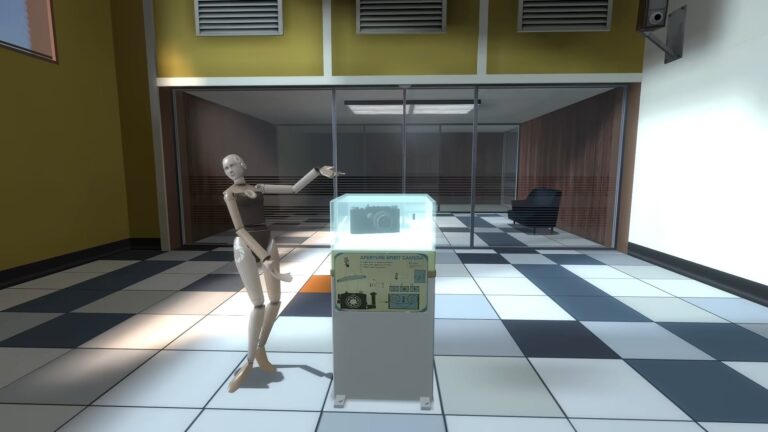
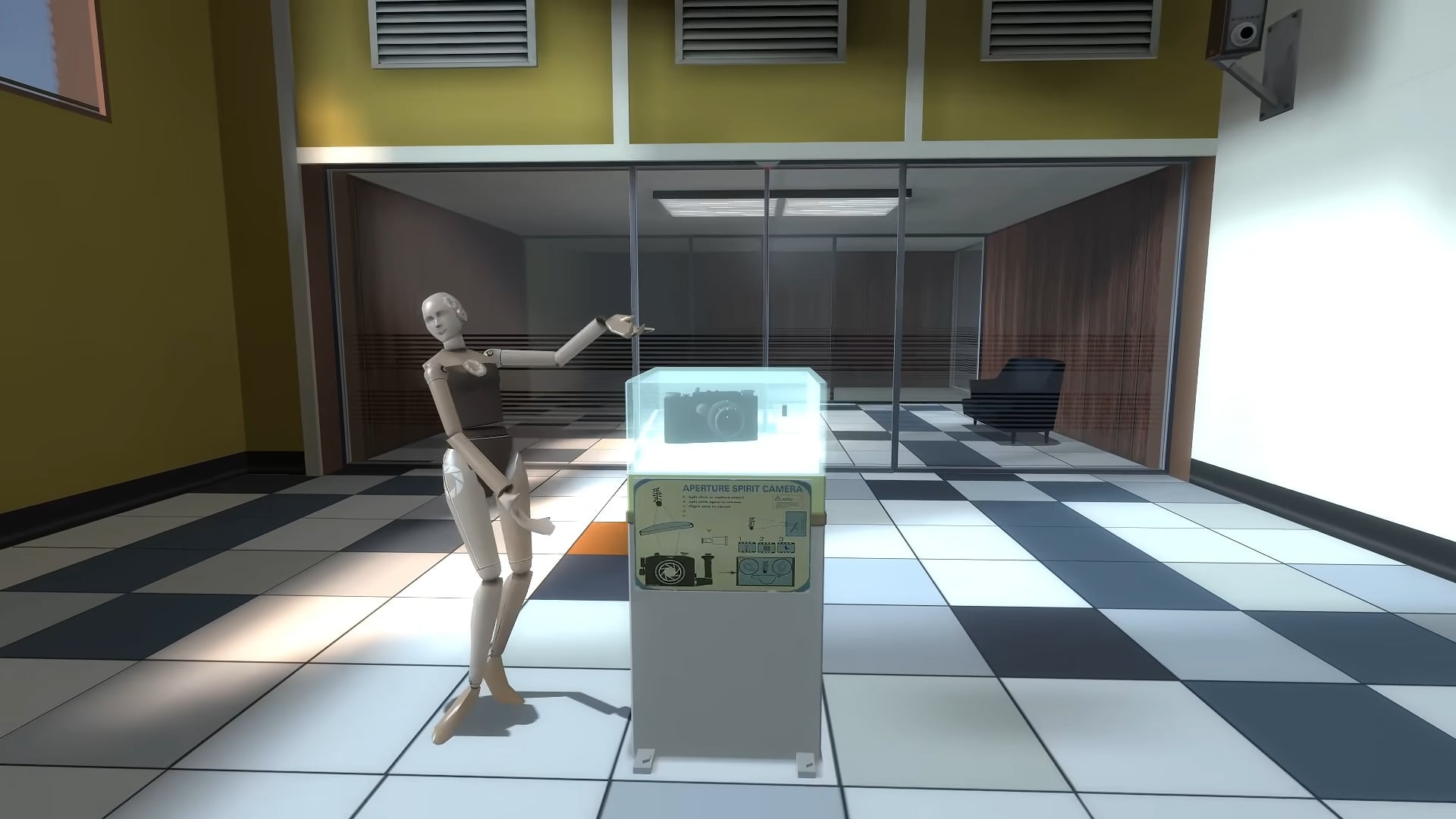
- F-Stop was Valve's cancelled 2007 Portal prequel built around an experimental Aperture Science camera mechanic that manipulated perspective to solve puzzles.
- A three-part leak—Steam depot data, source code, and Discord-shared mapsrc files—combined to create a 99 percent complete playable version.
- Despite Gabe Newell's championing, playtester feedback led Valve to scrap the project, though its dialogue, characters, and mechanics survived in Portal 2.
F-Stop was one of five experimental games Valve created in 2007 during a period it called the Directed Design Experiments. Each team designed and partially created a different concept. F-Stop stood out as Valve’s attempt at a Portal prequel, built around using an experimental Aperture Science camera to manipulate perspective and solve environmental puzzles. Gabe Newell personally championed the project, but when it moved to playtesters, the reception soured. The experiment was ultimately shelved.
For nearly two decades, F-Stop existed only in archived interviews and fragmentary documentation. That changed over the past week, when a combination of leaks transformed the cancelled prototype into a fully playable experience. The journey to recovery involved three separate breaches of Valve’s archives, each contributing a critical piece to bring F-Stop back to life.
How F-Stop Came to Be
The context matters: in 2007, Valve didn’t just greenlight one experimental project. During the Directed Design Experiments, the studio split into five teams, each tasked with designing and building a video game experiment from the ground up. This approach yielded a range of concepts, some of which would influence the studio’s future output. F-Stop, as the fifth experiment, centered on a creative core: an experimental camera device from Aperture Science that could alter how players perceived and interacted with the game world.
The mechanic tied directly into Portal’s design philosophy—environmental manipulation through creative use of tools—but approached it from a wholly different angle. Instead of opening portals to redirect yourself through space, you wielded a camera capable of warping perspective to solve puzzles. Gabe Newell found the concept compelling enough to champion, suggesting the experiment had genuine promise within the studio.
Why Playtesting Changed Everything
The Response to F-Stop’s Mechanics
Despite Newell’s enthusiasm, the playtesters who experienced F-Stop did not share his vision. Their feedback was decisive: the concept, while novel, didn’t resonate with players in practice. The disconnect between what worked in theory and what felt engaging to test audiences led Valve to make the difficult call to shelve the project entirely.
Salvaging the Pieces
Rather than discard the work entirely, Valve extracted value from the experiment. The dialogue, characters, and mechanical systems that had been developed for F-Stop were repurposed and integrated into Portal 2. This approach allowed Valve to recoup its investment in the experimental work while moving forward with a direction that playtesting had already validated.
The Three-Part Leak
The resurrection of F-Stop as a playable artifact was never a single breach, but rather a confluence of three separate leaks that collectively provided everything needed to reconstruct the game.
Steam Depot Data and the Steam2 Leak
In late August, approximately 13 terabytes of Steam depot data surfaced online under the designation Steam2. The leak contained what appeared to be nearly every Steam depot from 2003 through 2013—a historical archive of Valve’s source repositories. Among this massive dump, F-Stop’s assets were present and accounted for. However, the assets alone were insufficient to create a playable version. What the Steam2 leak provided was raw game data, textures, models, and audio, but not the glue that would bind them into executable form.
The Missing Pieces
Two critical components remained absent from Steam2: F-Stop’s source code and its mapsrc data—Valve’s internal designation for map source code files. Without these elements, F-Stop remained a collection of pieces rather than a functional game. The source code would define how the game logic operated, while the mapsrc data would contain the blueprints for the game’s levels and environments in editable form.
The Final Component
Over the 48 hours prior to the article’s publication, the Valve Cut Content project—a community effort dedicated to archiving and reconstructing cancelled Valve projects—received the missing mapsrc data via their Discord server. According to the project’s moderators, the person who initially leaked the mapsrc files requested $1,000 for access. For reasons unstated, the leaker subsequently decided to distribute the files for free instead.
The Valve Cut Content team independently verified the authenticity of the mapsrc files and confirmed they aligned with the F-Stop assets that had emerged in the Steam2 leak. The combination of all three sources—Steam2’s assets, the leaked source code, and the mapsrc data—provided everything required to assemble F-Stop into a playable state.
The Current State of F-Stop
Those who have spent time with the reconstructed F-Stop report that the game is approximately 99 percent complete. A few missing assets and scattered dialogue lines remain absent, likely due to distributed storage across multiple Valve systems or the fragmentary nature of how different components were leaked.
The completeness of what emerged is striking when measured against the starting point. A week ago, F-Stop was a cancelled project existing primarily in behind-the-scenes documentation and developer recollections. Had Valve intended an official release, additional polish and refinement would almost certainly have preceded launch. The fact that 99 percent of the game now exists in playable form represents far more reconstruction than anyone could have reasonably predicted given the circumstances.
What This Means for Gaming History
The playable F-Stop represents a recovered artifact of a critical moment in Valve’s design philosophy. It provides direct evidence of how the studio conducted experimental design work and what directions it explored before settling on the Portal games that actually shipped. Researchers, developers, and fans can now experience firsthand why playtester feedback proved decisive, rather than relying on secondhand accounts or extrapolation from Portal 2’s final form.
The three-source leak also illustrates how archival data, once dispersed across multiple systems, becomes vulnerable to recovery through different breach vectors. The Valve Cut Content community’s role in verifying authenticity and synthesizing the fragments into a coherent whole demonstrates the collaborative potential of preservation efforts—even when working with materials that were never intended for public release.
Source: Kotaku
Frequently Asked Questions
What was F-Stop originally intended to be?
F-Stop was a Portal prequel developed during Valve's 2007 Directed Design Experiments. The game revolved around using an experimental Aperture Science camera to manipulate perspective and solve environmental puzzles, a mechanic that Gabe Newell personally championed.
Why did Valve cancel F-Stop?
Playtesters who experienced F-Stop responded poorly to the camera mechanic despite Newell's support. Valve ultimately decided to shelve the project entirely rather than continue development.
How did F-Stop become playable if it was cancelled for nearly 20 years?
Three separate leaks converged to provide everything needed: the Steam2 leak in August provided game assets, while the Valve Cut Content Discord community later received F-Stop's source code and mapsrc map files. Combined, these sources created a 99 percent complete playable version.
