
Key takeaways
- Microsoft’s E3 2013 conference had been marked by controversy.
- Sony backed its hardware strategy with an impressive software lineup designed to appeal to core gamers and mainstream audiences alike.
- Industry analysts quickly recognized Sony’s strategic victory at E3 2013.
- Sony’s E3 2013 conference established momentum that would carry through the entire generation.
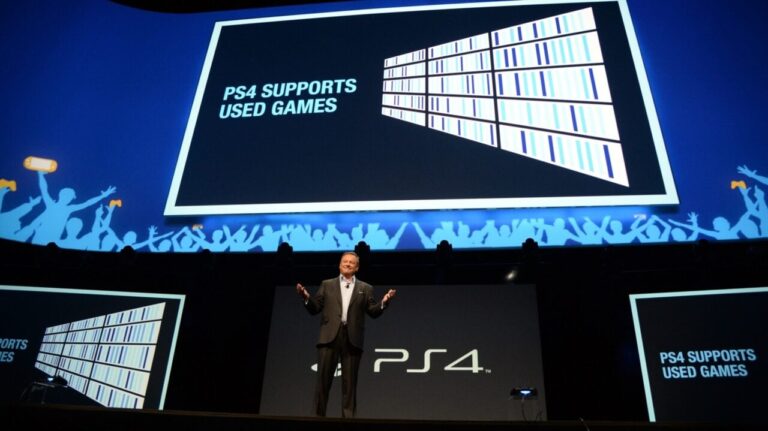
Sony announced the PlayStation 4 would retail at $399—$100 cheaper than Microsoft’s Xbox One—while confirming that used games would work without restrictions on the new console at E3 2013 on June 10. Jack Tretton, SCEA President & CEO, delivered the announcement to thunderous applause, positioning PlayStation 4 as the consumer-friendly alternative in a generation defined by corporate overreach. This moment became the defining highlight of the conference, symbolizing Sony’s decisive pivot against Microsoft’s restrictive digital rights management and online-mandatory policies.
The Price and Policy One-Two Punch
Tretton was greeted with thunderous applause from the audience as he announced that the PS4 would be $100 cheaper than the Xbox One, would not include a mandatory camera monitoring owners, would not require mandatory online connectivity, and that nothing would change regarding used games policies. This direct counter to Microsoft’s approach instantly shifted the narrative of the entire console generation. The $399 price point undercut Microsoft’s $499 offering by a significant margin, making the PS4 immediately more accessible to mainstream consumers.
The used-game policy announcement proved equally consequential. At a time when Microsoft was pushing toward an all-digital future with restrictive DRM that would have prevented players from trading, selling, or sharing physical games, Sony doubled down on consumer ownership rights. This stance resonated with retailers, collectors, and gamers who valued the ability to purchase used titles and recoup some investment through resale—a practice that had defined gaming retail for decades.
Strategic Positioning Against Microsoft’s Misstep
Microsoft’s E3 2013 conference had been marked by controversy. The company’s original Xbox One vision featured mandatory online connectivity, restrictive DRM that limited game sharing, and a bundled Kinect camera that many consumers viewed as an invasion of privacy. These policies generated significant consumer backlash before and during the event, creating an opening for Sony to capitalize on growing frustration with the industry’s direction.
Sony’s messaging was crystal clear: the company was listening to consumers and would not follow Microsoft down the path of restrictive digital controls. This positioning extended beyond pricing and policies. Tretton opened the conference with an apology for the PlayStation Network outage that had occurred earlier in 2013, setting a tone of accountability and consumer focus before shifting to the triumphant PS4 reveal. The combination of contrition, consumer-friendly policies, and competitive pricing created a powerful narrative advantage.
Game Lineup and Ecosystem Expansion
Sony backed its hardware strategy with an impressive software lineup designed to appeal to core gamers and mainstream audiences alike. The company revealed major PS4 titles including inFAMOUS: Second Son, Killzone: Shadow Fall, The Order: 1886, Mad Max, Final Fantasy XV (formerly Versus XIII), and Kingdom Hearts 3. These flagship titles showcased Sony’s commitment to exclusive, high-profile games that would define the generation.
Beyond traditional games, Sony announced that Music Unlimited and Video Unlimited would be available on day one for PS4. Music Unlimited offered access to 20 million songs, while Video Unlimited provided 150,000 or more movies and television shows. These services positioned the PS4 as a multimedia hub within Sony’s broader ecosystem. Additionally, Sony invited indie game makers to showcase their work, signaling early support for an open platform approach that would become a hallmark of the PS4 era. The company also revealed new PS3 games including Gran Turismo 6, Beyond: Two Souls, and The Last of Us, extending the previous generation’s lifecycle alongside the new console launch.
The Immediate Industry Reaction
Industry analysts quickly recognized Sony’s strategic victory at E3 2013. The combination of aggressive pricing, consumer-friendly policies, and strong software lineup effectively neutralized Microsoft’s momentum heading into the console launch. What became known as Sony’s “one-two combo”—the $399 price point paired with unrestricted used-game support—proved devastatingly effective at shifting consumer sentiment.
Microsoft felt the pressure immediately. Within weeks of E3 2013, Microsoft reversed its most controversial Xbox One policies, eliminating mandatory online connectivity requirements and removing DRM restrictions on used games. The company also dropped the mandatory Kinect bundling and lowered the Xbox One price to $399 to match the PS4. These reversals represented a rare moment of a major corporation backing down on core platform policies due to consumer and retailer pressure, underscoring just how significant Sony’s E3 2013 positioning had been.
A Generation-Defining Competitive Advantage
Sony’s E3 2013 conference established momentum that would carry through the entire generation. The PS4 launched later in 2013 around the same time as the Xbox One, but with substantial competitive advantages rooted in the messaging and policies announced at the Los Angeles Convention Center. The $100 price difference remained a consistent talking point throughout the holiday season and into 2014, influencing purchasing decisions across millions of households.
The used-game policy announcement proved particularly prescient. As the generation progressed and digital distribution grew, the ability to purchase, trade, and resell physical games remained important to a significant portion of the gaming audience. Sony’s willingness to support this consumer behavior—while competitors moved toward all-digital futures—positioned the company as the defender of consumer choice during a pivotal moment in gaming history.
The Lasting Echo of Consumer-First Positioning
Tretton’s performance at E3 2013 became iconic precisely because it articulated a simple consumer proposition at a moment when the industry seemed intent on restricting player freedoms. The thunderous applause that greeted the used-game policy announcement was not merely a reaction to favorable pricing or policies—it represented validation of a consumer-first philosophy that resonated across the gaming community.
The PS4 would go on to become the best-selling console of its generation, moving over 117 million units worldwide. While numerous factors contributed to this success, the foundation was laid at E3 2013, where Sony made clear choices about whose interests would come first. That moment continues to define how the company approaches hardware launches and platform strategy, serving as a reminder that consumer trust, once lost, is difficult to regain—and once earned through genuine commitment, becomes a powerful competitive advantage.
